
Would you like to save this?
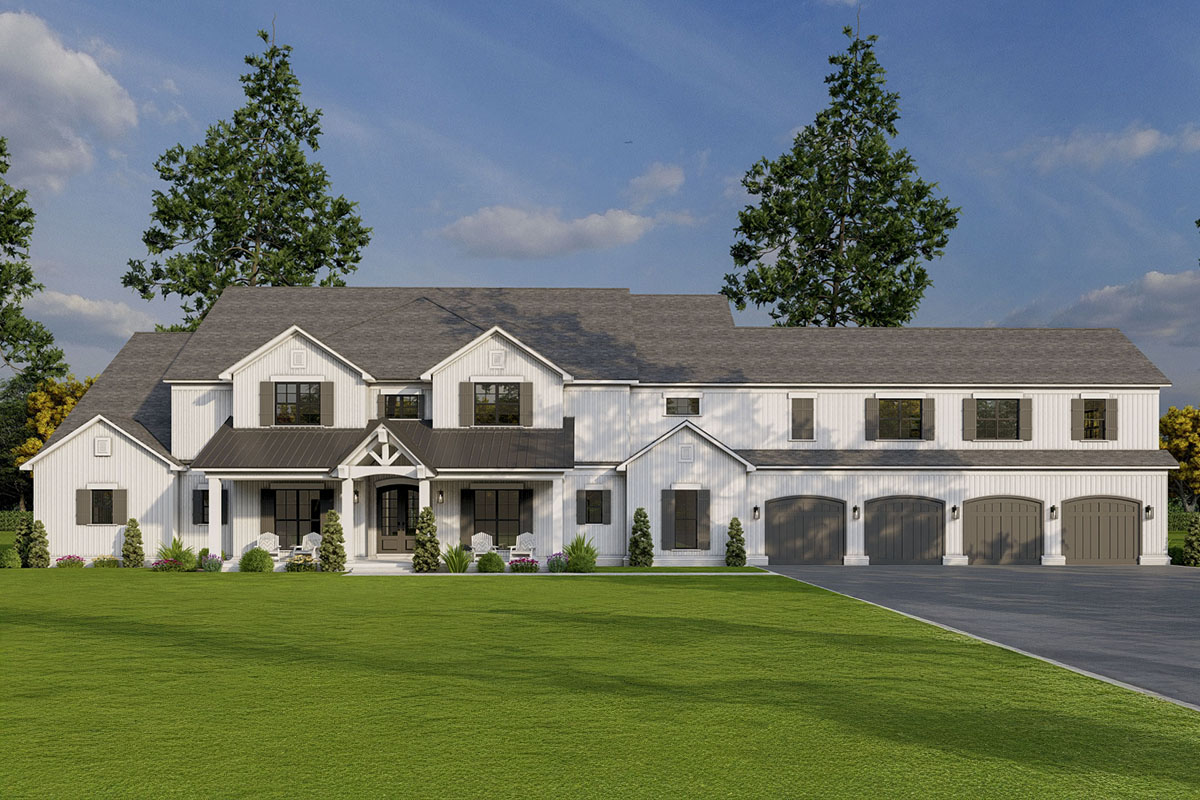
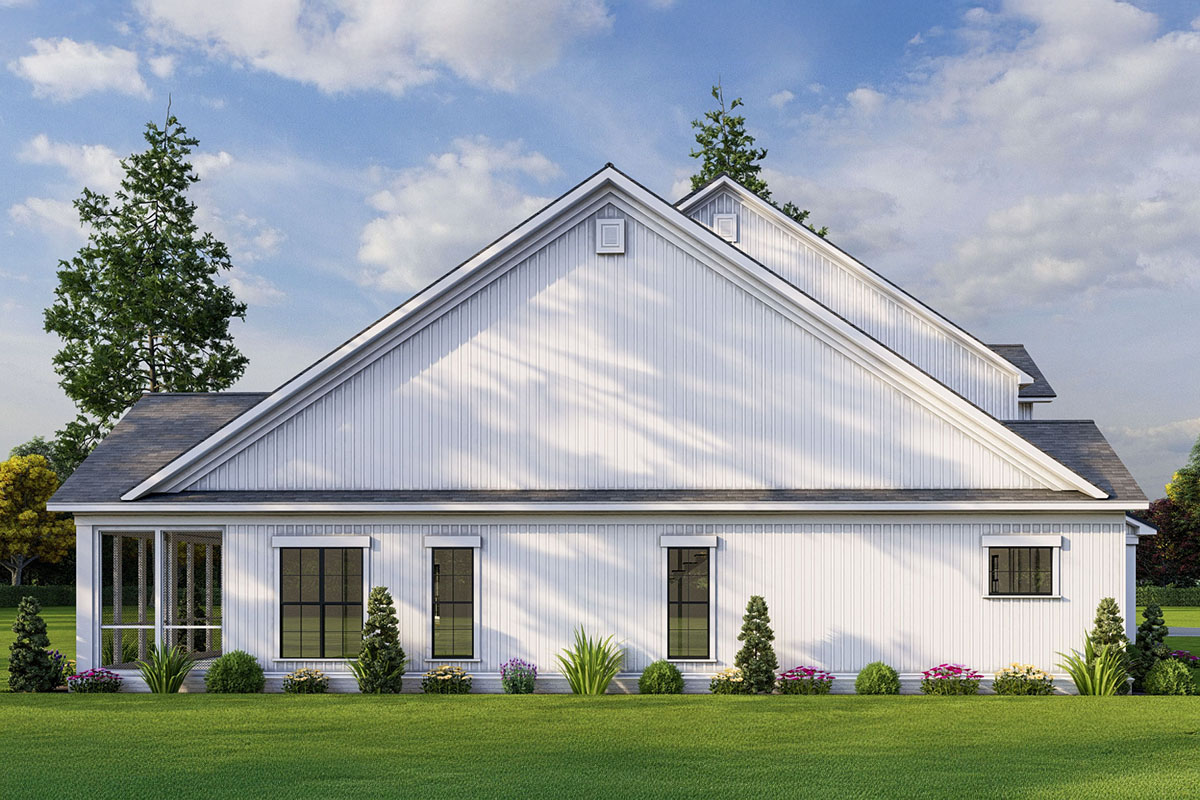
Welcome to this sprawling 7,618-square-foot modern farmhouse, a perfect blend of classic craftsmanship and farmhouse style.
The best feature of this luxury farmhouse isn’t the 2-story great room or the four-car garage. It’s a FEMA-grade safe room tucked inside the master suite – steps from your bed, not buried in the basement where you’d never reach it at 2 AM.
It’s the kind of detail you walk right past on a floor plan until someone points it out. Here’s what the rest of this plan gets right.
Specifications:
- 7,618 Heated S.F.
- 5 Beds
- 5 Baths
- 2 Stories
- 4 Cars
The Floor Plans:

The Covered Front Porch That Changes How You Walk Into Your Own House
You’ll walk up to a broad covered porch running the full width of the entry. Most farmhouse porches look great in photos and collect leaves in real life. This one is deep enough for furniture, which means it actually works as a room three seasons out of four.
The open ceiling above the foyer hits you at double height before you’ve crossed the threshold. Low porch ceiling to tall foyer is a compression-to-expansion trick that architects have used for centuries. Your brain registers the shift before your eyes finish adjusting.
A coat closet sits just inside the door. In a house this size, the nearest closet can be 30 feet from the entry. This one is within arm’s reach. It’s a small thing, but it changes the rhythm of arriving home every day.
What the Ground-Floor Guest Room Quietly Adds at Resale
Just off the foyer sits a full bedroom with its own bathroom and walk-in shower. No tub. That’s deliberate.
YOU’LL ALSO LOVEElegant Luxury Farmhouse with Wraparound Porches and 2-Story Great Room (Floor Plan)
The walk-in shower with no step-over edge is an ADA-adjacent move that costs nothing extra during construction. In homes over 5,000 square feet, a main-level guest room isn’t a luxury. It’s what keeps a parent or in-law from navigating stairs every morning.
Dual master suite homes list for roughly 9% more than comparable single-master homes. This room is the first of two full suites in this plan, and it’s the one that makes the whole house work for aging-in-place without a single retrofit.
Here’s where the layout gets clever.
Where Every Room Connects Without Cutting Through the Kitchen
The grand hall is the spine of this home. It connects every main-level space without forcing foot traffic through the kitchen or great room.
In a typical open floor plan, the kitchen becomes a highway. Everyone cuts through the cook’s triangle to get anywhere. This plan uses the grand hall as a bypass instead. You can walk from the front door to the master suite without passing through a single living space.
That’s not an accident. It’s a traffic-flow solution that experienced builders notice immediately.
The home office sits near the front of the house, separated from kitchen and great room noise by the grand hall itself. Large windows pull in natural light from the street-facing elevation, giving you even, non-glare light for video calls. Since 2020, remote workers have driven a 30% increase in demand for dedicated home offices in new construction. This room delivers that without stealing square footage from the living areas.
The 2-Story Great Room That Fixed Its Own Echo Problem
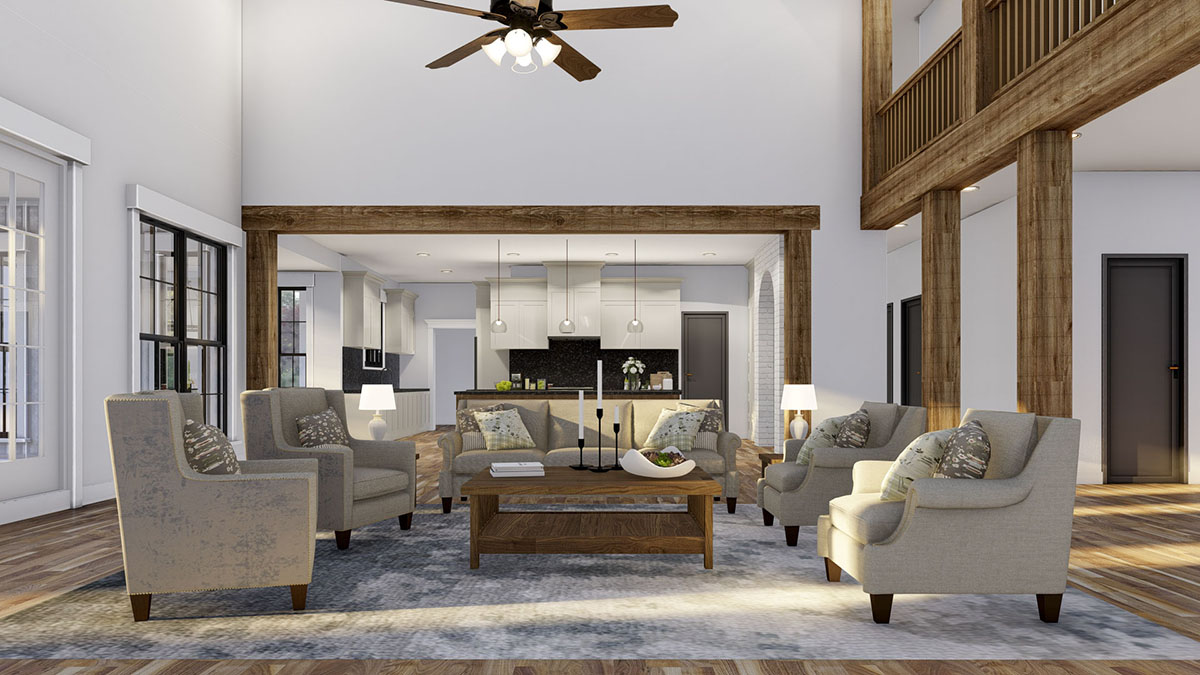
This is the room that sells the house. A vaulted ceiling rises two full stories, with an open balcony overlooking from the second floor. Tall windows flood the space with light. A fireplace anchors the far wall.
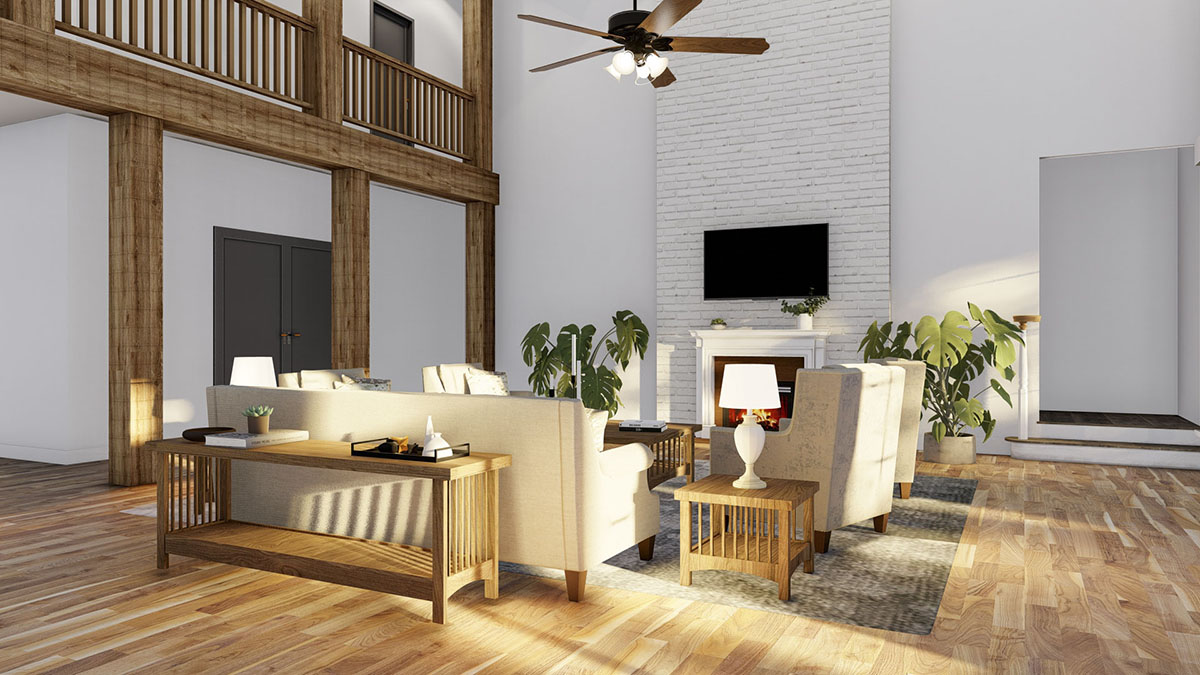
Most plans this size get the double-height room wrong. Without acoustic treatment, sound bounces off the upper walls and drywall at those heights. Your conversation carries upstairs like you’re standing in a gymnasium.

The reverberation time in an untreated room this tall can exceed 2 seconds, which is when speech gets muddy and TV audio turns painful.

How the Balcony Breaks the Echo
The open balcony above isn’t just a view. It breaks up the upper wall surface and scatters sound instead of reflecting it straight back down. That’s structural acoustic treatment disguised as a design feature.
Soft furnishings and area rugs help, but they’re not enough alone. Plan for acoustic panels or textile treatments on the upper walls during framing. Retrofitting after drywall is up costs 30% to 50% more, and most builders who’ve done double-height great rooms before will tell you to budget for it during construction, not after.
Take a guess – how much does a full masonry fireplace with a two-story stone surround actually cost? Most people estimate around $3,000. The real number is $8,000 to $15,000 for a wood-burning setup. Gas insert versions drop the price, but you lose the crackle and the smell of real wood on a winter night.
This next room surprised even me.
The Coffee Bar That Keeps Morning Traffic Out of the Kitchen
Off the great room sits a built-in coffee bar in a corner placement. In 2026, built-in beverage stations are one of the fastest-growing luxury home features. Designers are tucking them into primary suites, family rooms, and home offices.
YOU’LL ALSO LOVE3-Bedroom Farmhouse Plan with Two-Story Great Room – 2481 Sq Ft (Floor Plan)
The corner placement keeps the coffee station entirely outside the kitchen workflow. You don’t walk past the cook to get your morning cup. Built-in systems from Miele or Sub-Zero fit the corner format.
In a house with five bedrooms and potentially six or seven adults on a holiday morning, that traffic separation is the difference between a calm start and a bottleneck.
The Kitchen Island That Directs All the Room’s Traffic
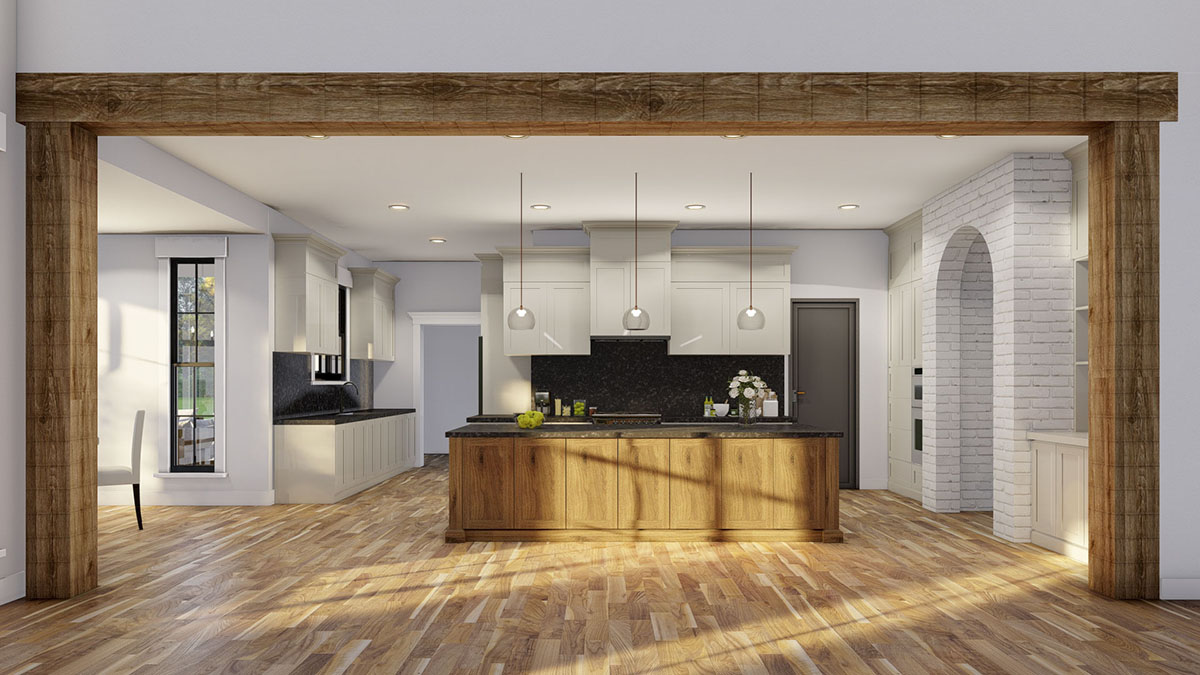
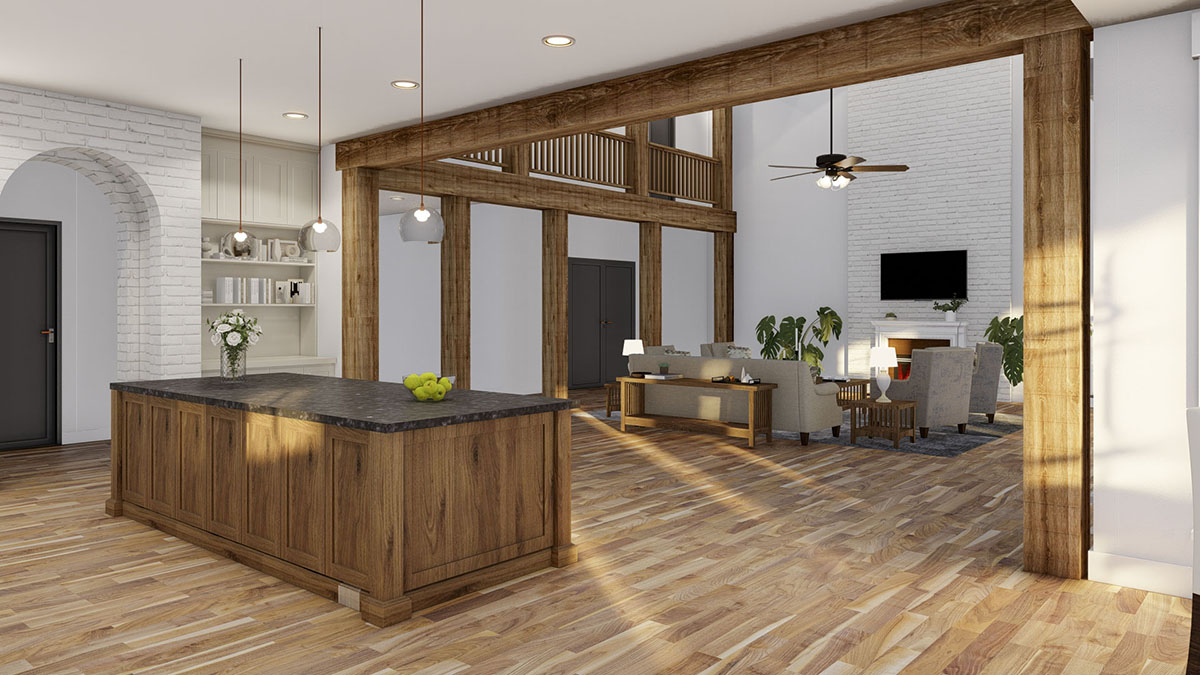
The island stretches across the center of the kitchen with enough surface area for prep on one side and bar seating on the other. White cabinetry lines the perimeter, and a backsplash ties the visual together.
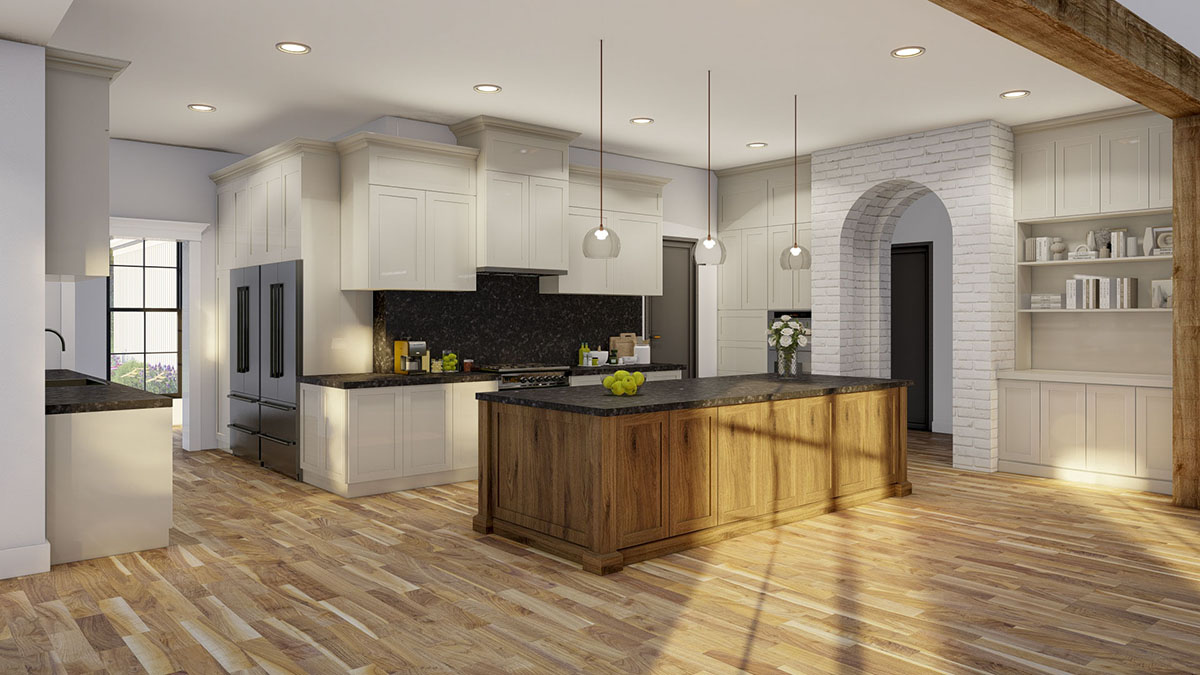
The walk-in pantry sits steps from the island’s prep zone. No hauling cans across the kitchen. The traffic flow is designed so guests circulate around the island’s seating side while the cook works the opposite face uninterrupted.
The Cabinet Decision You Need to Make Before Framing Starts
At this kitchen’s scale, semi-custom cabinets from Home Depot or Lowes run $22,000 to $35,000. Full custom pushes past $40,000.
That’s a $20,000 decision you need to make before framing starts, because changing your mind after the cabinet openings are framed costs more than the cabinets themselves.
I saved this room for a reason.
Where Morning Light Does All the Work
Windows wrap the breakfast room on three sides. Morning sunlight fills it without a single recessed can firing.
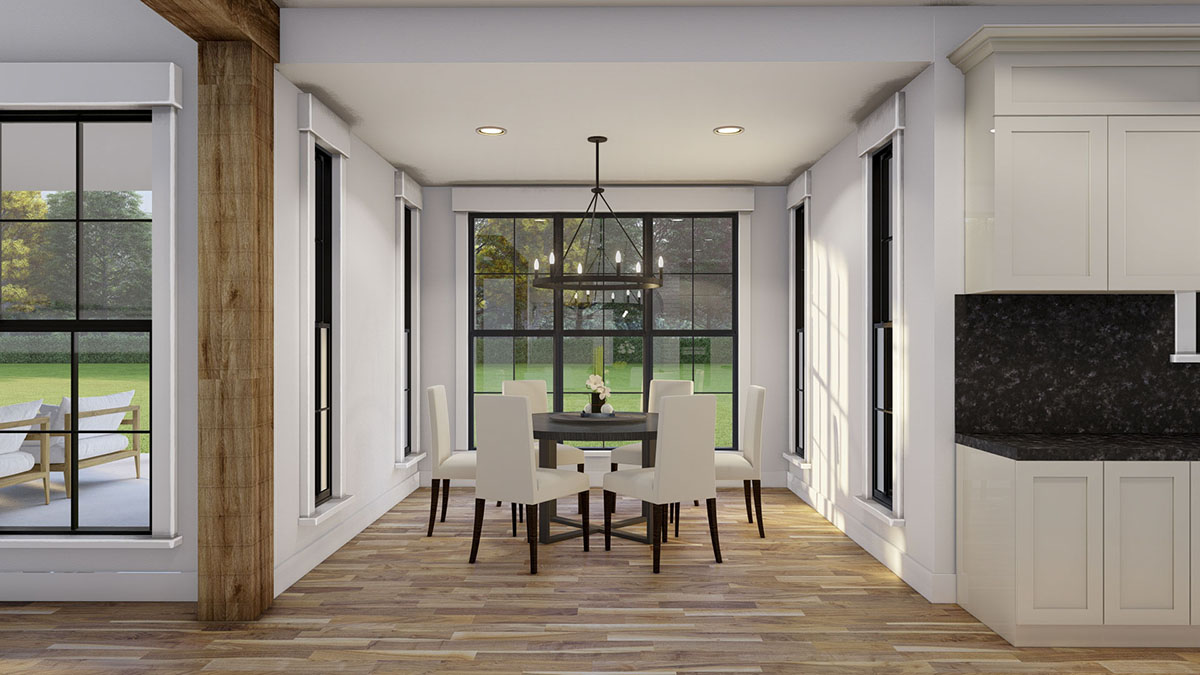
This is the room you’ll actually eat in most days while the formal dining room waits for holidays. Three walls of glass turn it into a greenhouse in winter, which can cut your heating load for this zone during morning hours. In summer, that same glass needs low-E coating to prevent it from becoming an oven.
Pella’s Lifestyle Series and Andersen’s 400 Series both handle the low-E requirement at this scale. The room is where your family will spend the most time together on any given weekday morning, and if you want to see another plan where the window placement drives the entire room’s feel, the L-shaped modern farmhouse with the vaulted great room does it with fewer square feet and more drama.
Now here’s what the floor plan doesn’t show you.
The Back Porch You’ll Use More Than Almost Any Room Inside
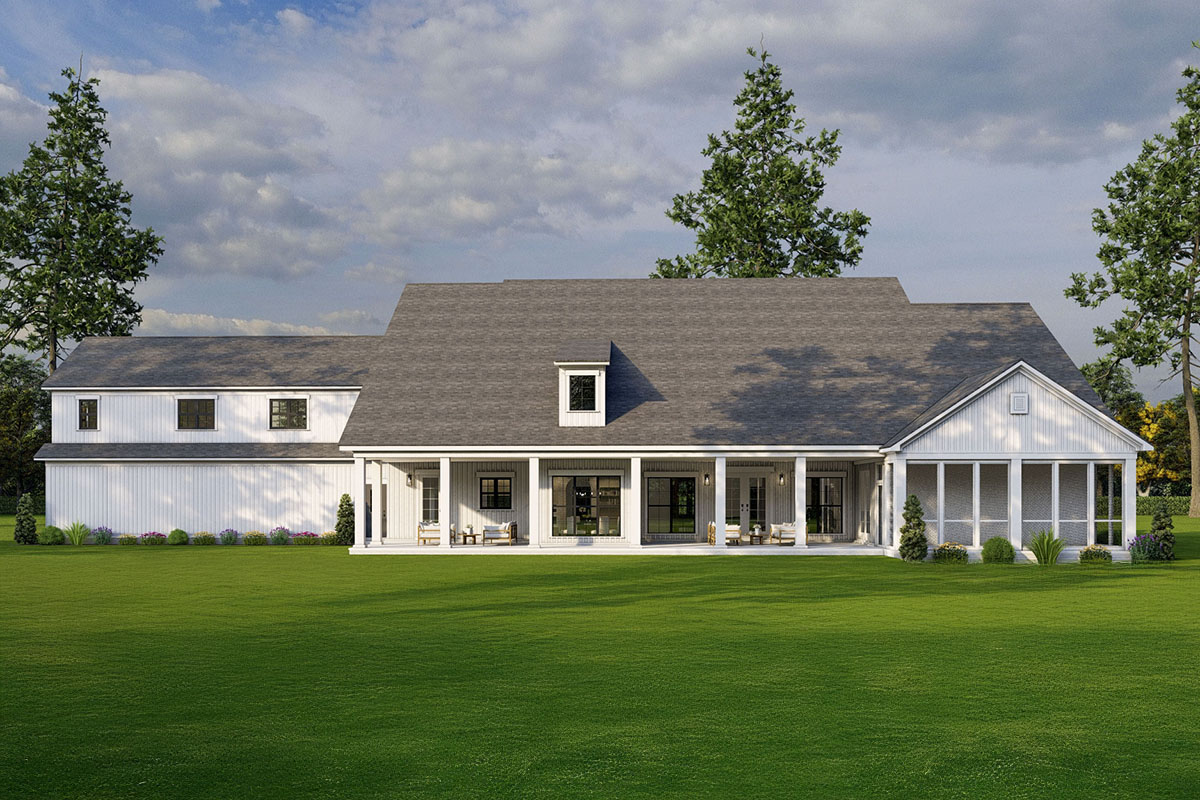
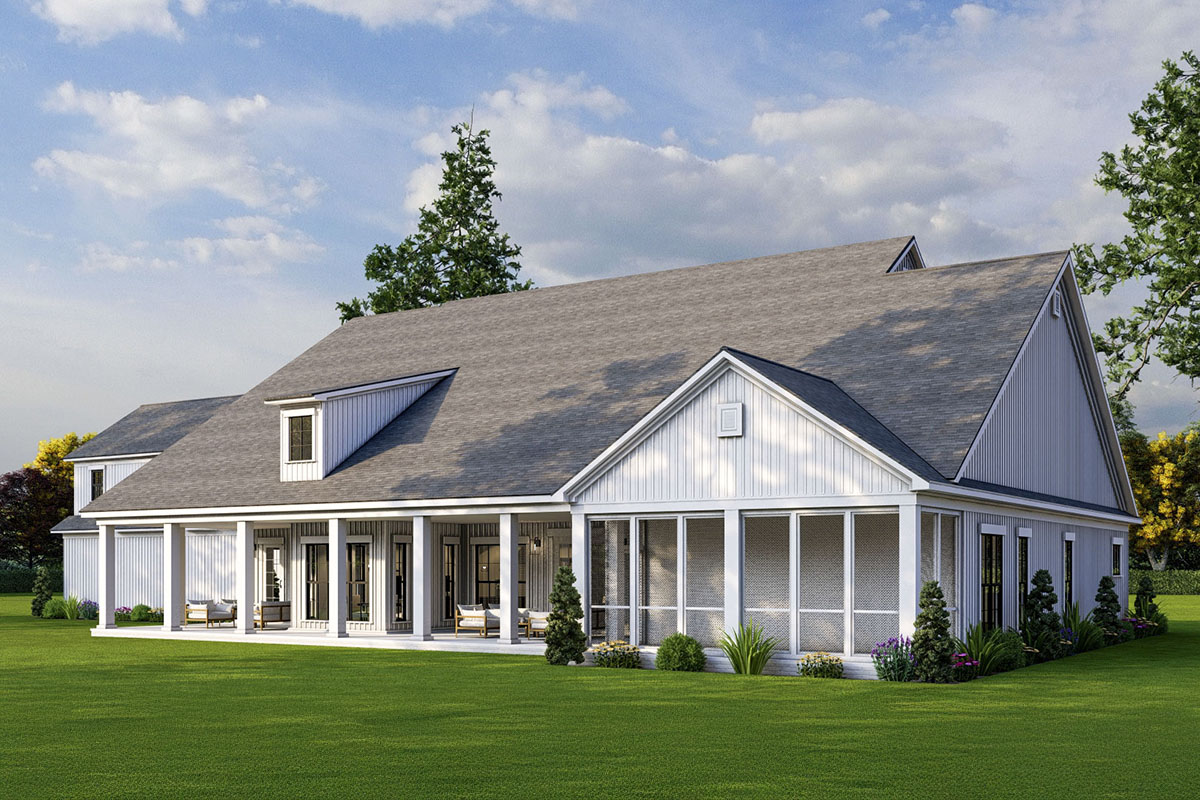
A covered porch stretches the entire back of the house. A screened section branches off near the master area, giving you bug-free outdoor living without the maintenance of full enclosure on the rest.
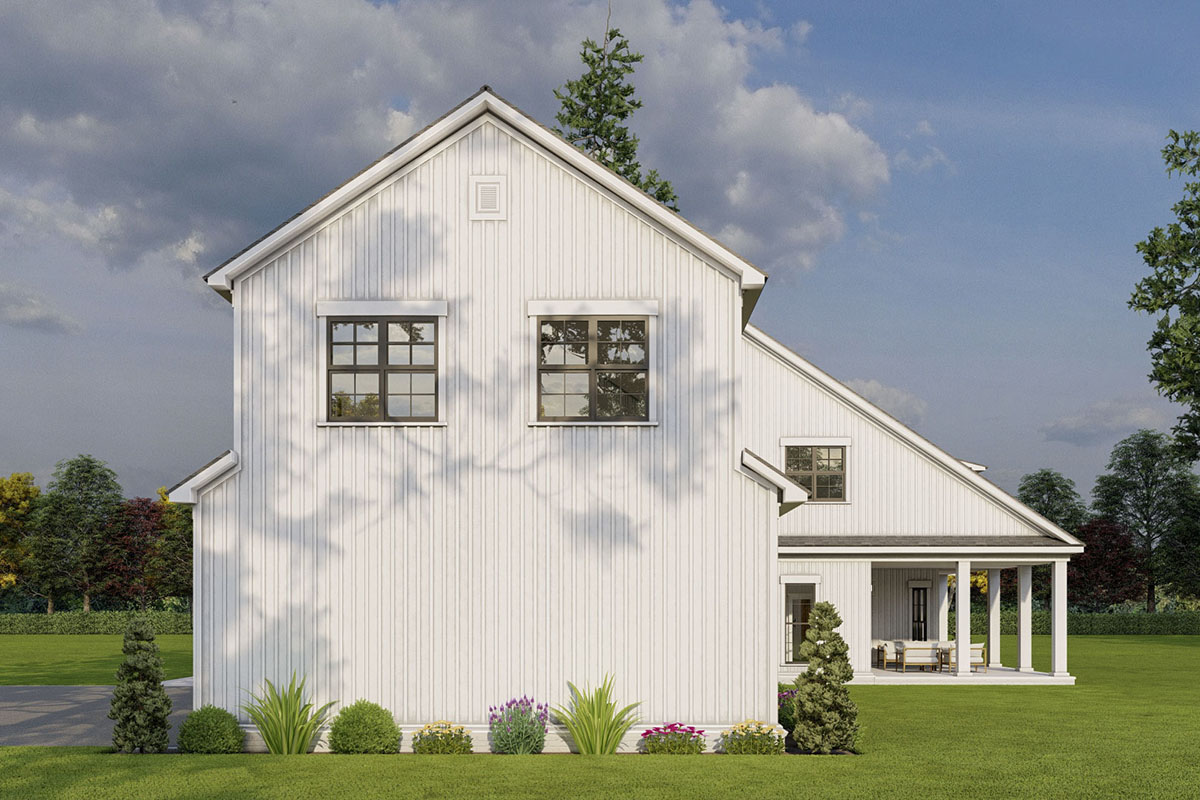
The screened section off the master suite is the real move. It creates a private outdoor room that only the master suite accesses. Your guests use the open porch. You get the screened one.
That’s a separation most plans at this price point don’t bother with, and it’s the kind of detail that shows up in how you actually live in the house, not how it looks in photos.
This plan includes the screened porch in the base design, which means you’re not paying the 15% to 20% change-order markup that hits every modification added after blueprints are finalized. Covered porches return about 84% of their cost at resale. Few home improvements hit that number.
For another plan that handles the covered outdoor space at this scale, the industrial modern farmhouse at 4,472 sq ft does the covered patio better than most plans twice its size.
The Main Level Floor Plan

The mudroom, hobby room, and storage room sit grouped together near the garage entrance. They’re the unglamorous backbone of a house this size.
YOU’LL ALSO LOVE3,200 Square Foot Modern Farmhouse Plan with Two-Story Great Room (Floor Plan)
Most 7,000-plus square foot plans dump you from the garage into a hallway and call it a day. This plan gives you a full mudroom with room for five kids’ backpacks, coats, and shoes before anyone tracks dirt into the main living space.
The hobby room next door handles everything that currently happens on your kitchen island – wrapping presents, potting plants, sorting mail, staging groceries.
Why 68% of Buyers Want the Laundry Right Here
The laundry room sits on the main level near both the kitchen and the garage. The NAHB survey found 68% of buyers prefer main-level laundry, and this plan delivers it without eating into the living space. A half bath nearby serves the mudroom and kitchen zones without forcing guests to walk into a private wing.
Builders will quietly tell you this is the smartest part of the plan.
The Four-Car Garage and Why the Fourth Bay Pays for Itself
This garage holds four vehicles across roughly 1,000 to 1,200 square feet of covered, climate-controlled space with direct access to the mudroom.
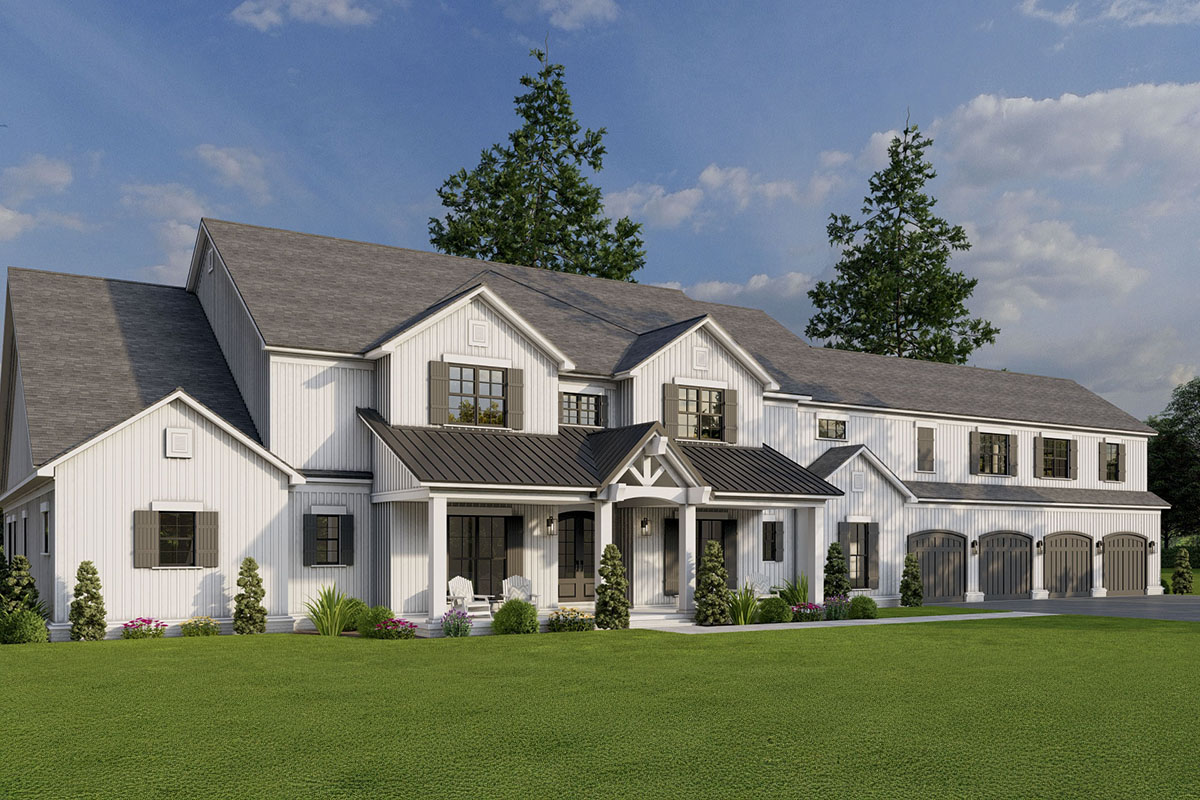
The fourth bay is set apart from the main three, positioned to function as more than car storage. The plan designed it as a potential workshop, lawn equipment room, or even a hobby space with its own motor court access.
The real value isn’t the resale number. It’s the storage. At 7,618 square feet of living space, you’ll accumulate proportionally more furniture, seasonal items, and equipment than someone in a 2,500-square-foot home. The fourth bay becomes your de facto storage unit, which means you’re not paying for off-site storage every month. Over a decade, that adds up to more than most people expect.
After reviewing thousands of layouts, this detail still stands out.
The Master Suite With a FEMA-Grade Safe Room Steps From Your Bed
The master suite is generous. A pair of walk-in closets. A master bath with a soaking tub, separate shower, and dual vanities. That’s expected at this price point.
What’s not expected is the safe room.
FEMA P-361 compliant safe rooms withstand 250 mph winds from an EF5 tornado. Building one during new construction, when the framing crew is already on site, runs $3,000 to $6,500. Waiting until after the house is built doubles that number.
This plan tucks it inside the master suite, which means the room you’re sleeping in is steps from the room that could save your life.
Most safe rooms get placed in garages or basements. At 2 AM when the sirens go off, you’re not running downstairs in the dark. You’re walking 10 feet.
The Master Bath Anchored by a Freestanding Soaking Tub
The soaking tub is a freestanding model – the kind from Kohler’s Veil Collection or Victoria + Albert that becomes the visual anchor of the entire bathroom. The dual vanities give each person their own sink, mirror, and counter space. That’s the single most requested master bath feature in luxury homes.
Afternoon light hitting warm tile while you’re soaking is the kind of sensory experience that doesn’t show up on a floor plan but changes how the room actually feels day after day.
YOU’LL ALSO LOVETransitional Farmhouse Plan with Two-Story Great Room and Outdoor Fireplace – 2768 Sq Ft (Floor Plan)
The master living area and screened porch connected to this suite turn it into a private apartment within the house. You can spend an entire evening in the master wing without entering a shared space.
Would you like to save this?
That’s a privacy feature most 5-bedroom plans ignore, and the plan that handles the dual-bathroom master suite in a completely different way is the 5,985 sq ft luxury home with two bathrooms in the main-floor master. It solves a problem most couples don’t realize they have until year five.
Master Living & Screened Porch
Connected to the suite is the Master Living space, with its own access to the rear Screened Porch.
You might use this as a private lounge, a morning yoga room, or simply a place to unwind away from the bustle of the main living spaces.
I think this kind of flexible retreat makes a big difference in daily comfort.
Now, let’s explore upstairs to see how it expands your living options.
The Upstairs Overlook That Doubles as an Acoustic Buffer
The second floor opens to the great room below. An open balcony overlook lets you see the full double-height space from above.
This isn’t just a view. The overlook creates an acoustic break between the upstairs bedrooms and the great room’s volume. Sound rises, hits the ceiling, and dissipates into the open balcony space instead of channeling down a hallway into bedroom doors.
The great room can run at full volume while upstairs stays quiet. There are no hallways connecting the upstairs bedrooms directly to the great room volume below. That’s not an oversight.
Guest room 2 features a vaulted ceiling and its own bathroom with a walk-in shower. Bedroom 4 mirrors that with a vaulted ceiling and walk-in closet. Vaulted ceilings in secondary bedrooms add only a few dollars per square foot in framing costs compared to flat 9-foot ceilings, but vaulted bedrooms photograph better, feel larger, and list higher on real estate descriptions.
A large storage room occupies the back corner upstairs. In a house this size, dedicated storage that isn’t a closet is the feature you’ll appreciate most at year three, when every closet is already full.
The Second Master Suite That Makes This a True Dual-Primary Home
This is where the plan separates from everything else at its price point. The upstairs master suite 2 has a bigger closet than the downstairs master. A deluxe bath with a freestanding tub. And its own living area.
Dual master suite homes list for an average of 9% more than comparable single-master homes at the top of the market. On a home in the $2 million range, that’s roughly $180,000 in additional listing value.
The dual-primary layout appeals to multi-generational buyers, couples who want separate sleeping spaces, and investors who can rent the upper level as a semi-independent apartment.
The Second Level Floor Plan
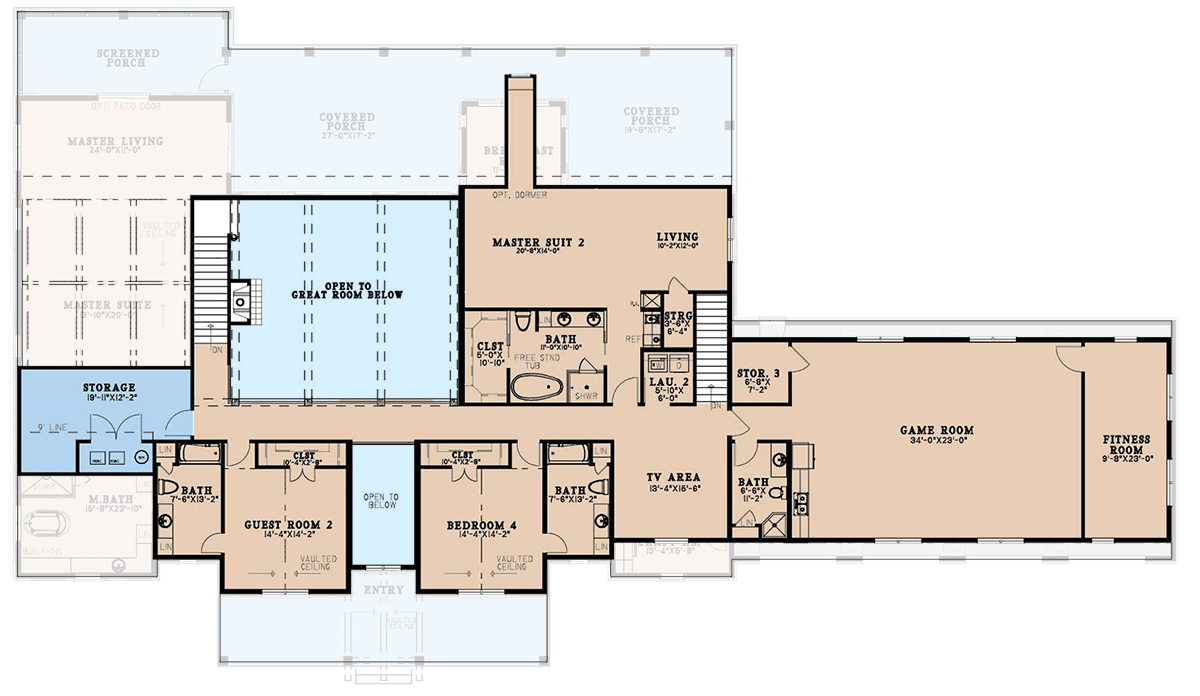
A second laundry room upstairs means the upper-level occupants never carry a basket downstairs. For aging parents or adult children living on the second floor, that’s not a convenience. It’s a necessity that makes the dual-primary concept actually sustainable long-term.
HVAC zoning for a house this size needs at minimum 3 to 4 zones, and more likely 5 or 6. The IRS Energy Efficient Home Improvement Credit covers up to $2,000 for qualifying heat pumps. Carrier’s Infinity series and Trane’s XR series both qualify.
That upstairs living area solves a problem most people don’t anticipate.
The Game Room and Fitness Room That Keep the Upstairs Alive
Here’s the mistake most luxury homeowners make. They build a gorgeous main level, fill the upstairs with bedrooms, and then nobody goes upstairs except to sleep.
The upper floor becomes dead space 16 hours a day.
This plan fights that with three dedicated living spaces on the second floor. A centrally located TV area serves as the upstairs common room. A game room and fitness room occupy the far end of the upper level.
The TV area pulls people up. The game room keeps them there. The fitness room means you’re not paying monthly gym memberships for a family of four. Commercial-grade equipment from Life Fitness or Rogue retains 60% to 70% of its value after five years, and the break-even versus gym memberships for a household of four adults is about 18 to 24 months.
Every upstairs bedroom has its own bath access. No sharing. In a 5-bedroom home at this price point, shared bathrooms are a dealbreaker at resale.
For another plan that builds the fitness space directly into the master suite, the two-story plan with the gym in the master bath handles the plumbing in a way that makes the gym actually work long-term.
What Insurance and Financing Actually Look Like at This Scale
Most people don’t think about insurance until the builder asks for the certificate. A home this size, at a replacement cost of $350 to $550 per square foot, carries a replacement value of $2.67 million to $4.19 million.
Annual homeowner’s insurance runs $8,000 to $15,000 through carriers like State Farm, Allstate, or specialty insurers like Chubb and PURE.
Construction loan rates in April 2026 sit around 7% on a 30-year fixed, compared to 6.07% to 6.30% for standard mortgages through lenders like Rocket Mortgage or Bank of America. The spread means you want to lock a rate conversion as early as your lender allows.
Whole-home automation from Savant, Control4, or a Lutron and Ecobee integration gives you single-app control of lighting, HVAC zones, security, and audio across the entire house.
I almost glossed over this, but it’s actually the key to the whole design.
BONUS The One Modification Every Builder Recommends for This Plan
After walking this plan section by section, the single modification builders suggest most often is adding a dedicated elevator shaft between the first and second floors.
The shaft and structural framing during construction runs $3,000 to $5,000. Installing the actual elevator later costs $20,000 to $35,000 for a residential hydraulic unit.
Why do builders recommend it? This plan is designed for multi-generational living. The ground-floor guest suite handles aging-in-place needs now. But as the homeowners themselves age, having the elevator infrastructure already in the walls means a future retrofit takes days instead of months.
It’s the cheapest long-term modification you can make to a plan at this scale, and it’s the one most buyers wish they’d done after the framing crew leaves.
What would you change about this plan? Would you build it as-is or modify the master wing?
If you want to see what happens when a modern farmhouse pushes the split-bedroom layout and bonus room into the same plan without compromising either, the modern farmhouse that gets modified less than any other on this site handles both in a way that changes how the whole house lives.
Interested in a modified version of this plan? Click the link to below to get it from the architects and request modifications.