

Would you like to save this?
3,204 square feet. Three bedrooms. Two and a half baths.
And a split 4-car garage, two separate entries, not one wide span, that lake-country builders will quietly tell you is the smartest part of the whole plan.
I’ve walked through thousands of floor plans on this site and this brick-skinned modern farmhouse does something with its mudroom-to-butler’s-pantry-to-kitchen traffic spine that changes how the house actually lives, not just how it looks on paper.
Let me take you through it room by room.
But whatever you do, don’t miss what happens with the two upstairs bedrooms. It’s not a Jack-and-Jill, and that single decision spares this plan from the number-one complaint about farmhouses this size.
Specifications:
- 3,204 Heated S.F.
- 3 Beds
- 2.5 Baths
- 2 Stories
- 4 Cars
The Floor Plans:
The 25-Foot Porch Built for a Three-Rocker Evening
You pull up to the house and the porch is doing work before you even step out of the truck.
YOU’LL ALSO LOVEModern Farmhouse Plan with Cathedral Ceiling above Living Space (Floor Plan)
It stretches 25 feet across the front, brick at your back, framed posts carrying the roof. The width is generous enough for a porch swing (4 to 6 feet long, with another 4 feet of clearance for the swing arc) plus three rocking chairs and a small side table without anything crowding the front door.
Here’s the thing nobody budgets for.

A mid-range covered porch in 2026 runs $25,000 to $70,000 depending on materials and column detail, and the cost is driven almost entirely by depth, not width. A 25-foot wide porch at only 6 feet deep cannot fit a swing at all. Plans like this one read as generous because they commit to both dimensions.
That’s where the lakeside context starts to matter. Hold onto that, it pays off when we get to the garages.
The Great Room Where 25 Feet of Width Does the Talking
Step inside and the Great Room opens up across the same 25-foot span as the porch. A fireplace anchors one end. The visual line runs clear through to the kitchen and dining area behind it, which is how a footprint under 3,300 feet manages to feel like something twice its size.
Most 25-foot-wide great rooms in plans this size go one of two ways. Flat ceilings at 10 feet, or vaulted at 18 to 22 feet with a two-story opening. Either works here.
At a flat 10, the fireplace can be a simple surround. At a vault, it becomes a stone or brick stack running two stories, which is what you’ll see in most modern farmhouse renderings.
On the fireplace cost:
- An electric unit runs $200 to $2,500 installed, no venting required
- A gas insert runs $2,300 to $10,000
- A real wood zero-clearance build is $18,000 and up
In Southern lake-country new builds, electric is quietly dominating because HOAs don’t care and you skip the chimney system entirely. Savings: $1,500 to $4,000 on a Class A chimney alone.
But the room I’m walking you to next is where this plan earns its build cost.

The Kitchen Island That Shares Its Job With a Butler’s Pantry
This is a chef’s room.
The island is the visible workhorse, sized to function as both prep surface and casual eating bar. What most competitor articles skip is the second room doing half the lifting: a dedicated Butler’s Pantry sitting between the main kitchen and the dining area, separate from the walk-in pantry.
Take a guess how much a butler’s pantry adds in a 2026 new build.
YOU’LL ALSO LOVEStylish 4-Bed Modern Farmhouse Plan with Vaulted Master Suite – 3076 Sq Ft (Floor Plan)
Most people guess $15,000 or so. The real number is $45,000 to $75,000 as a new-build add, and it shows up in only 7 percent of 2026 remodels, which means a plan that includes one standard is punching well above its price band. The resale lift alone runs 1.5 to 3 percent of home value.
You get:
- A counter for staging
- Cabinetry for the everyday dishes you actually use
- Usually a second sink, sometimes a beverage fridge
The result is a kitchen that photographs clean even when Thanksgiving is in full swing, because every small appliance, half-used bag of flour, and spent wine glass has somewhere to disappear that isn’t your island.
The adjoining Dining area sits flexible between the kitchen and great room. Casual breakfast on Tuesday. Holiday dinner on Thursday. Same room, same table.
And now let me show you the detail that most plan catalogs bury.
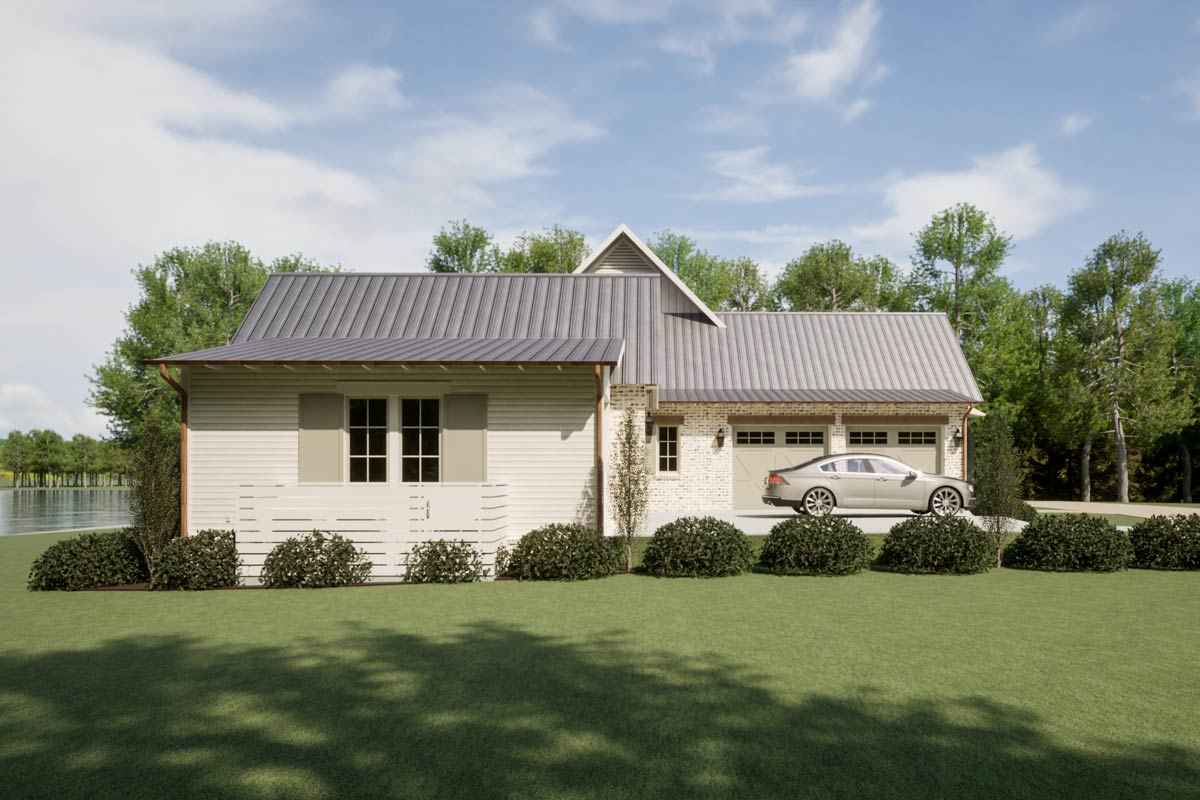
The Back Porch That Extends Your Season by Months
You walk straight through the kitchen and you’re outside on the Back Porch. Space for seating. Space for a grill.
The hand-off between kitchen and porch is short enough that you can plate in the kitchen and serve on the porch without anything cooling.
Here’s the lakeside reason this layout matters.
A rear porch at this depth (figure 8 to 12 feet on a plan of this size) extends your usable outdoor season by three to four months in Southern climates compared to a pure patio. You get rain coverage. You get shade. You get a place to eat without the kitchen swelling in size.
The honest downside: rear porches in lakeside flood zones have to budget for floor elevation and sometimes a separate flood insurance rider. Standard NFIP coverage doesn’t extend to detached or semi-attached porch decks in mapped zones. Budget a small rider or confirm your lot is out of Zone A.

The Mudroom That Earns Its Square Footage
The Mudroom is the first thing you hit coming in from the garages.
It’s not decorative. Lockers, hooks, bench, maybe cubbies. This is the room that keeps the rest of the house clean.
On a lake plan, the mudroom pulls triple duty: everyday entry for the family, staging area for wet swimsuits and life jackets in the summer, and drop zone for muddy boots in the off-season. A real mudroom on a plan this size runs 60 to 100 square feet with closed storage and dedicated drainage-friendly flooring (tile, LVP, or sealed concrete).
YOU’LL ALSO LOVEL-Shaped Modern Farmhouse with Vaulted Great Room and Master Suite (Floor Plan)
One thing to notice here.
The mudroom flows directly into the butler’s pantry hallway, which flows into the kitchen, which flows to the back porch. That’s a four-room traffic spine with no wasted hallway. Builders quietly call this “the groceries path.”
You carry six bags in from the garage, drop coats in the mudroom, drop dry goods in the pantry, drop everything else on the island, and walk straight to the porch. Zero backtracking.

Why the Split 4-Car Garage Is the Quiet Flex of This Plan
Here’s where the plan shows its personality.
Four-car garages usually read as one wide span with three or four doors across the same face. This one splits. Two entries. Different elevations. It costs more, and on paper it appraises slightly lower than a flush 4-car because it complicates future ADU conversion.
Here’s why builders keep drawing it anyway.
Bays 1 and 2 stay the everyday vehicles. Bays 3 and 4 become the actual reason you picked a lakeside plan:
- A workshop
- A home gym
- A bass boat on a trailer (note that a boat bay wants a minimum of 32 feet of interior depth, which this plan has room to accommodate)
- Jet skis
- Paddleboards on overhead racks
At 2026 national pricing, a 4-car garage runs $45,000 to $80,000 to build, with ROI at resale running 60 to 80 percent of cost and adding $10,000 to $29,500 in appraised value. On a lakeside plan, the ROI tilts higher because the second bay pair is doing lifestyle duty no hobbyist wants to give up.
Builders will quietly tell you this is the smartest part of the plan. The plan that follows proves it.
The Main Level Floor Plan
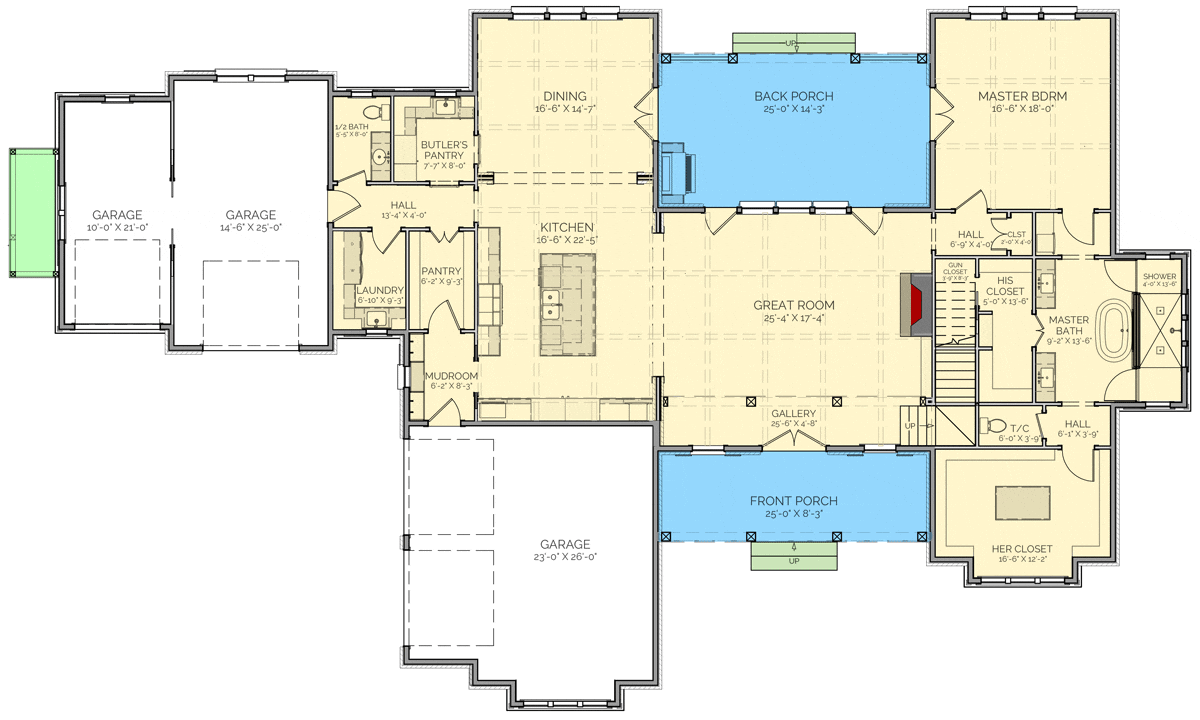
This is the detail that tells me whoever drew this plan has actually lived in a family home.
The Laundry Room is not tucked behind the master. It’s not at the end of an upstairs hallway. It sits in the traffic spine between the pantry and the garage halls.
What that means in daily life: you come in from the garage, you strip off wet or muddy clothes in the laundry, and they hit the washer before they ever enter the rest of the house.
The laundry isn’t an afterthought room. It’s part of the buffer system between outside and inside.
YOU’LL ALSO LOVEModern Farmhouse Plan with In-Law Suite (Floor Plan)
Enlarged is the word the source uses, and it earns it. Figure 80 to 120 square feet on a plan this size, with counter space for folding, a utility sink option, and a second refrigerator pad if you run an extra fridge for game day. A room that size runs $8,000 to $15,000 over a minimal laundry closet at construction time but saves real friction every single day.
The Master Suite That Gets Two Open Connections
You step into the Master Bedroom Suite and the first thing you notice is the light.
The room has proximity to both the Great Room and the Back Porch, which means you’re getting two exposures of glass, rear and partial side, instead of the single exterior wall most master bedrooms make do with.
Would you like to save this?
The Master Bath delivers dual vanities.
That’s the practical non-negotiable on a plan at this price band. Dual vanities at roughly 4 feet each, a separated toilet compartment in most executions, and a combination of a walk-in shower and soaking tub.
Expect the suite to consume 300 to 400 square feet total including the bath corridor. On a 3,204 sq ft footprint, that’s roughly 10 to 12 percent of the house dedicated to the primary. Right in the modern farmhouse sweet spot.
Why the His and Her Closets Are Deliberately Lopsided
Not every plan does this, and the ones that don’t usually regret it by year three of ownership.
This plan gives you two closets. His is efficient. Hers is expansive. The source calls it out as a potential dressing area or a shoe sanctuary, and that’s not marketing flourish, it’s the actual design intent.
Shared closets at this home size hit a predictable failure mode: by year three, one side is 40 percent empty and the other is overflowing onto the bedroom chair.
The design trade-off is real though.
Builders will tell you, quietly, that a single large shared walk-in with a center island is the better resale choice because it future-proofs for buyers with different habits. Dual closets read as built for the original couple, not the next buyer. If you’re building to stay, go dual. If you’re building to flip within five years, consider flexing one of them into shared storage at the framing stage.
2026 closet finishes run warm: walnut, honey oak, warm taupe. The cool gray and bright white that dominated 2019 through 2023 are already reading as dated in high-end markets.
The Half Bath That Keeps Guests Out of Your Private Zone
Half bath placement separates a pro plan from an amateur plan.
On this one it sits near the main living and kitchen areas, which means your Tuesday poker night guests are handled without anyone wandering into the master wing or the upstairs bedrooms.
It’s a small room. It does one job. It does that job well.
If you’re modifying this plan, the upgrade I’d quietly ask the architect about is whether the half bath can fit a stacked shower insert for future flex, if the kids ever bring friends back from the lake and somebody needs to rinse off without tracking through the master suite.
The Upstairs That Actually Gives Each Kid Their Own Bathroom
Here’s the detail I teased in the intro.
The two secondary bedrooms upstairs don’t share a single bathroom, and they don’t split a Jack-and-Jill layout. They share access to two separate bathrooms.
If you’ve ever lived through the morning shower fight between two siblings, you know why this matters. A Jack-and-Jill saves roughly 40 to 60 square feet of plumbed space, but it guarantees you a daily conflict over the shared sink and the locked pass-through door. Separate bathrooms cost more to plumb and tile (figure $4,000 to $8,000 upcharge at construction), but they eliminate the fight entirely.
Both bedrooms feature large closets. They’re genuine rooms, not minimum-square-footage boxes. Bedroom dimensions in this range typically run 12 by 12 to 12 by 14 feet with full walk-ins.
The Second Level Floor Plan
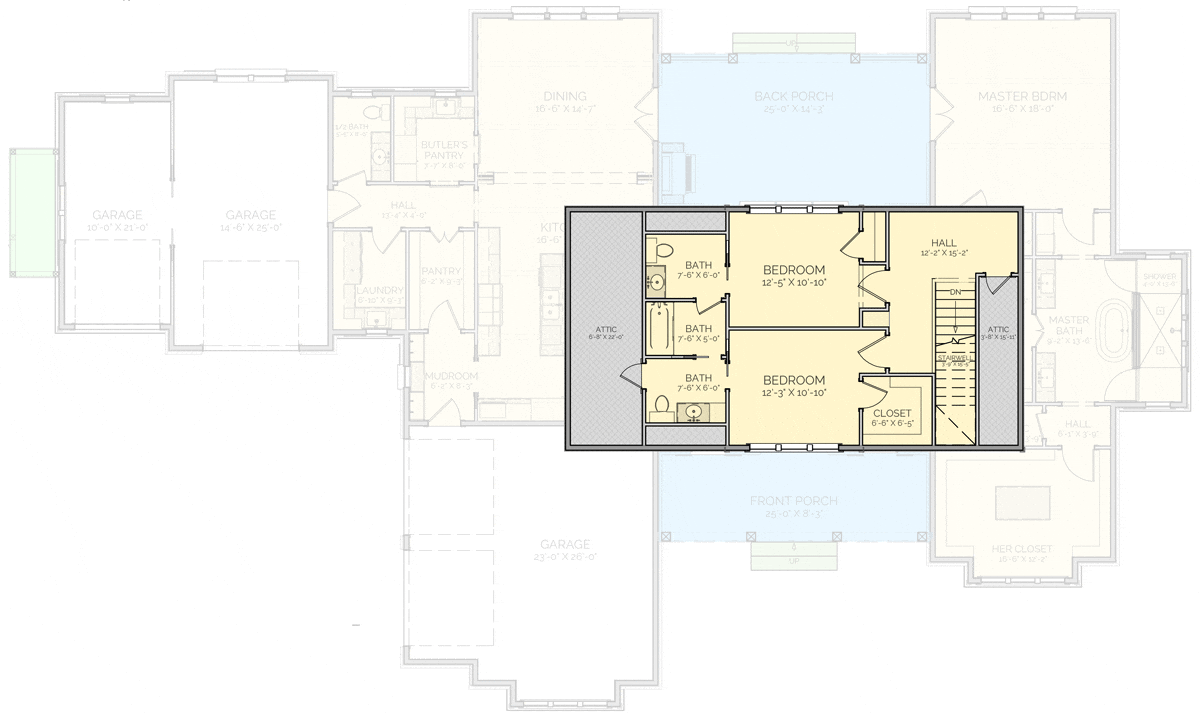
The Attic That’s Secretly a Bonus Room In Disguise
The upstairs Hall threads between the two bedrooms and delivers access to the Attic. Most plans at this size end the story right there.
This one keeps going.
Attic space on a two-story plan this size is typically framed with enough height and joist depth to be converted to conditioned bonus square footage later. Figure 200 to 400 square feet of potential, converted at roughly $35 to $65 per square foot in 2026 if the attic was engineered for future finish at framing. If it wasn’t, you’re looking at structural reinforcement and the cost jumps toward $100 per square foot.
Ask your builder one question at contract signing: is the attic framed for a future bonus conversion?
If yes, you’ve just secured 200 to 400 unbuilt square feet of future teen hangout, home gym overflow, or lake-gear storage. If no, negotiate it in. The delta at framing is roughly $5,000 to $10,000 versus tens of thousands to retrofit later.
The One Modification Every Builder Recommends For This Plan
If I had this plan in front of a builder and one change to ask for, it would not be the kitchen. It would not be the master. It would be the laundry room.
Here’s why.
The laundry sits in the traffic spine between the pantry and the garages, which is the highest-traffic corridor in the whole house. Builders will tell you that on lakeside plans specifically, this corridor needs three things:
- A floor drain
- A utility sink
- A hose bib
Not all three are standard on 3,200 sq ft builds at this price band. Adding them at framing runs about $800 to $1,500. Adding them after drywall runs $4,000 to $6,000 and requires cutting the slab.
The payoff lives in every dripping swimsuit, every sandy pair of sneakers, and every muddy dog that walks through this door for the next thirty years.
What would YOU change about this plan? The lakeside version probably wants a second upstairs HVAC zone and an outdoor shower off the back porch. The farmhouse version probably wants a walk-in pantry expansion.
Tell me in the comments which side you’re on.
Interest in a modified version of this plan? Click the link to below to get it and request modifications.