
Would you like to save this?
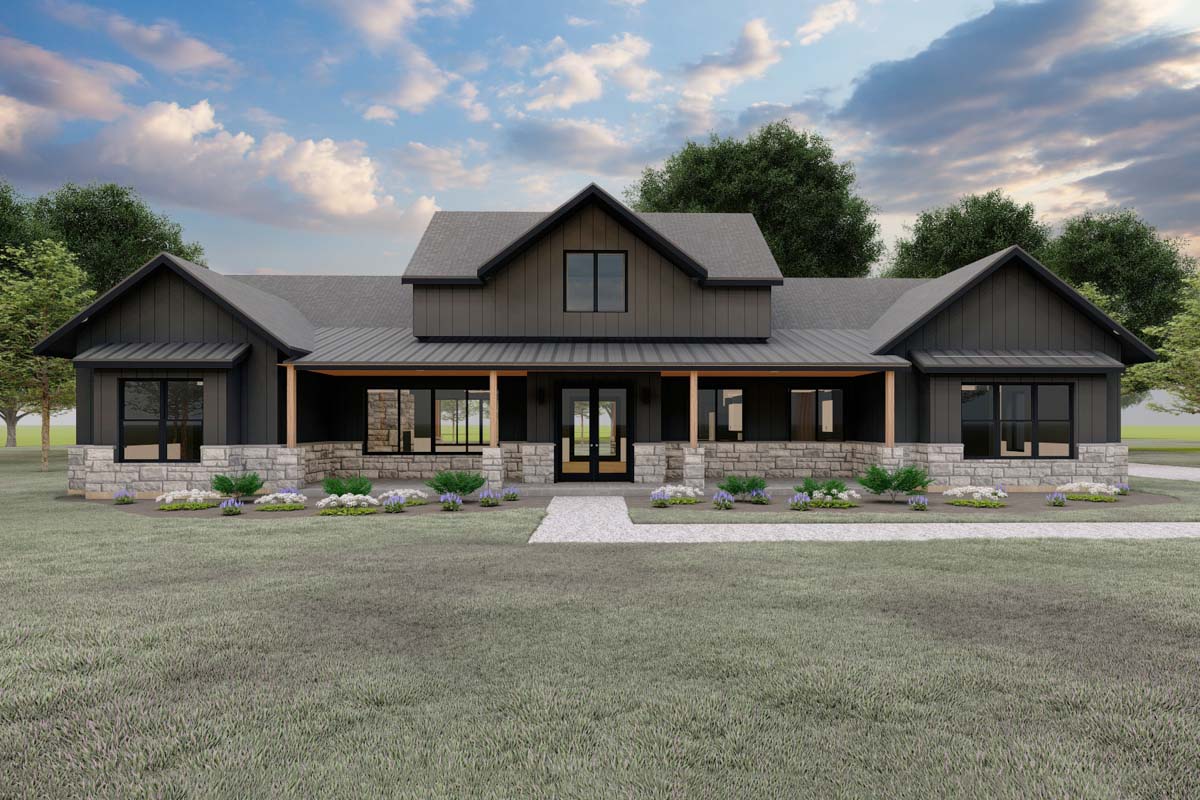
After reviewing hundreds of one-story modern farmhouse plans in this size range, this one does something most don’t – it hides a 745-square-foot side-entry garage so well that from the street, the house looks like it’s all home. No giant garage doors competing with that 46-foot front porch. Just clean farmhouse lines from edge to edge.
I’m walking you through every room, but whatever you do, don’t skip the safe room section. It’s a feature that most plans this size charge extra for – and this one tucks it in without wasting a single square foot.
This 3,305 sq ft modern farmhouse hides its 2-car garage on the side – but the real surprise is what’s inside the mudroom wing.
Specifications:
- 3,305 Heated S.F.
- 4 Beds
- 4 Baths
- 1 Stories
- 2 Cars
The Floor Plans:
The 46-Foot Porch That Makes the Whole Street Disappear
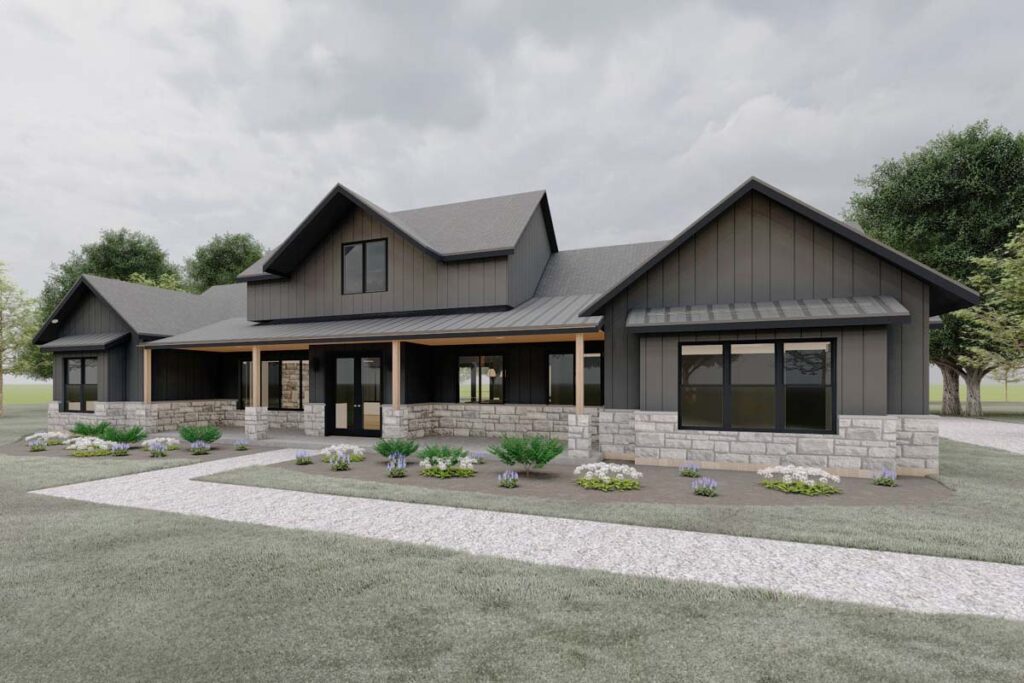
You pull into the driveway and the first thing that hits you is scale. This porch stretches 46 feet across the front of the house – nearly the full width of the facade.
That’s not decorative. That’s a genuine outdoor living room.
Most porches on plans under 3,500 square feet run 20 to 30 feet. This one blows past that by a wide margin, giving you enough space for a full furniture grouping on one end and a porch swing on the other without anything feeling cramped.
Here’s the design detail most people miss. Because the garage sits on the side instead of the front, the porch gets the entire facade to itself. A front-loading garage would eat 16 to 20 feet of that frontage.
YOU’LL ALSO LOVEOne-Story Modern Farmhouse Plan Under 3000 Sq Ft with 4 Bedrooms (Floor Plan)
Side-entry plans like this one typically cost 10 to 20 percent more in driveway paving, but the curb appeal payoff is enormous. Real estate agents consistently say side-entry garages make a home appear larger and more upscale from the street.
At roughly 350 square feet of covered porch space, you’re looking at a feature that would cost $15,000 to $25,000 to add as a change order on a plan that didn’t include it.
But the porch is just the handshake. The real layout starts the moment you step inside.
The Entry That Funnels You Straight Into the Best View in the House
The foyer measures 5 feet 7 inches by 9 feet 8 inches. That sounds small on paper – roughly 55 square feet.
It’s not meant to impress you. It’s meant to aim you.
This entry acts as a compression point. You step through the front door into a purposely tight space, and then the house opens up into the living and dining areas ahead. Architects call this a “reveal” – the contrast between the small entry and the expansive great room makes the open-concept space feel even larger than its actual dimensions.
The trick works because the ceiling height shifts as you move forward. That 55-square-foot entry punches well above its weight when it’s framing a sight line that runs over 25 feet deep into the living room beyond.
Most plans this size waste the entry with a wide-open foyer that bleeds into the living space. This one uses restraint – and it pays off.
Here’s where the layout gets clever.
The Living and Dining Room That Quietly Seats 20
You walk past the foyer and the combined living and dining space unfolds at 25 feet 9 inches deep. Both rooms share that same generous dimension, giving you over 500 square feet of connected entertaining space.
Take a guess – how many people could you comfortably seat for a holiday dinner across the living and dining areas? Most people say 10 to 12.
With this layout, you’re looking at 16 to 20 if you use the dining room for the table and the living room for secondary seating. The open-concept design keeps everyone in the same conversation even when they’re spread across both zones.
YOU’LL ALSO LOVEModern Farmhouse Plan with Cathedral Ceiling above Living Space (Floor Plan)
The open sight line from the living area through to the kitchen means the cook never gets isolated – a problem that kills the energy at dinner parties in homes with closed-off kitchens.
One-story plans with this much open-concept space feel dramatically larger than two-story homes with the same square footage. There’s no visual break from a staircase or a second-floor overhang chopping the space in half. The ceiling plane runs uninterrupted, and natural light from the rear patio doors floods the entire central zone.
At current national building averages of $150 to $200 per square foot, this 3,305-square-foot plan puts you in the $495,000 to $661,000 range before land.
A two-story home with the same footage would save roughly $15,000 to $25,000 on foundation and roofing – but would need a staircase, dual HVAC zones, and more complex structural engineering that eats those savings right back.
This next room is where the plan earns its keep.
The Kitchen That Commands Nearly 26 Feet of Wall-to-Wall Function
You round the corner from the dining area and the kitchen stretches nearly 26 feet wide. That’s not a typo. Twenty-six feet.
For context, the average kitchen in a 3,000-plus square foot home runs about 15 to 18 feet. This one pushes past that with room to spare, giving you a prep zone, a bar area, and a pantry all within arm’s reach of one another.
The bar area sits adjacent to the main kitchen workspace. Builders will quietly tell you this is the smartest part – it works triple duty:
- a serving station during parties
- a homework counter during the week
- a coffee bar every morning
One feature, three daily uses, zero wasted footage.
The walk-in pantry is steps from the main prep area. No hauling groceries across the kitchen. No cluttered countertops because you ran out of cabinet storage.
The pantry-to-prep distance in this layout is shorter than what you’d find in most kitchens half this size, because the designer positioned them on the same wall line rather than across the room from each other.
At roughly 400 square feet of kitchen and bar space, customization options here are wide open. Cabinetry alone for a kitchen this size typically runs $12,000 to $30,000 depending on whether you choose stock, semi-custom, or fully custom builds.
YOU’LL ALSO LOVEStylish 4-Bed Modern Farmhouse Plan with Vaulted Master Suite – 3076 Sq Ft (Floor Plan)
Most people walk right past this next feature.
The Nearly 40-Foot Patio That Doubles Your Entertaining Space Overnight
You step through the glass doors from the living room and the patio unfolds at nearly 40 feet across.
That’s almost as wide as the front porch. Combined, you’re looking at roughly 86 feet of covered outdoor living across the front and back of this house.
Here’s what the floor plan doesn’t show you – this patio is positioned directly off the main living zone, not tucked behind a hallway or accessible only through a bedroom. That placement matters.
Rear patios connected to the living room get used three to four times more often than patios accessible only through a side door or secondary room.
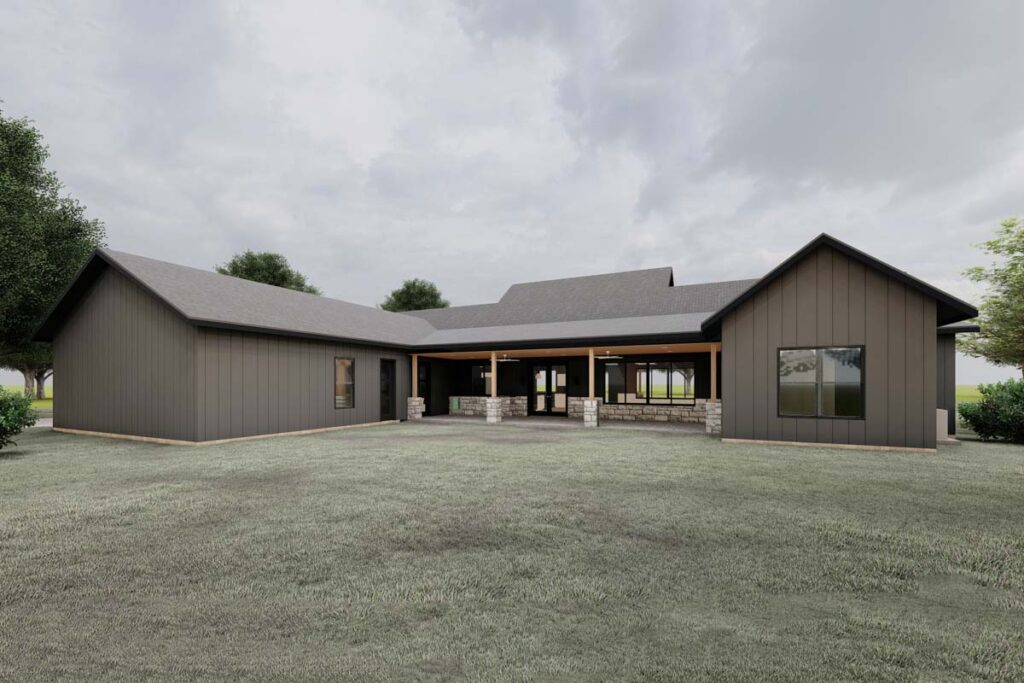
Adding a pergola or outdoor kitchen to a patio this size typically runs $8,000 to $25,000 depending on materials. But the bones are already here – the nearly 40-foot span gives you enough room for a full dining setup on one end and a lounge area on the other without either zone feeling squeezed.
I saved this next section for a reason.
Why the Primary Suite Sits 40-Plus Feet From the Nearest Bedroom
This is where the split-bedroom layout changes everything.
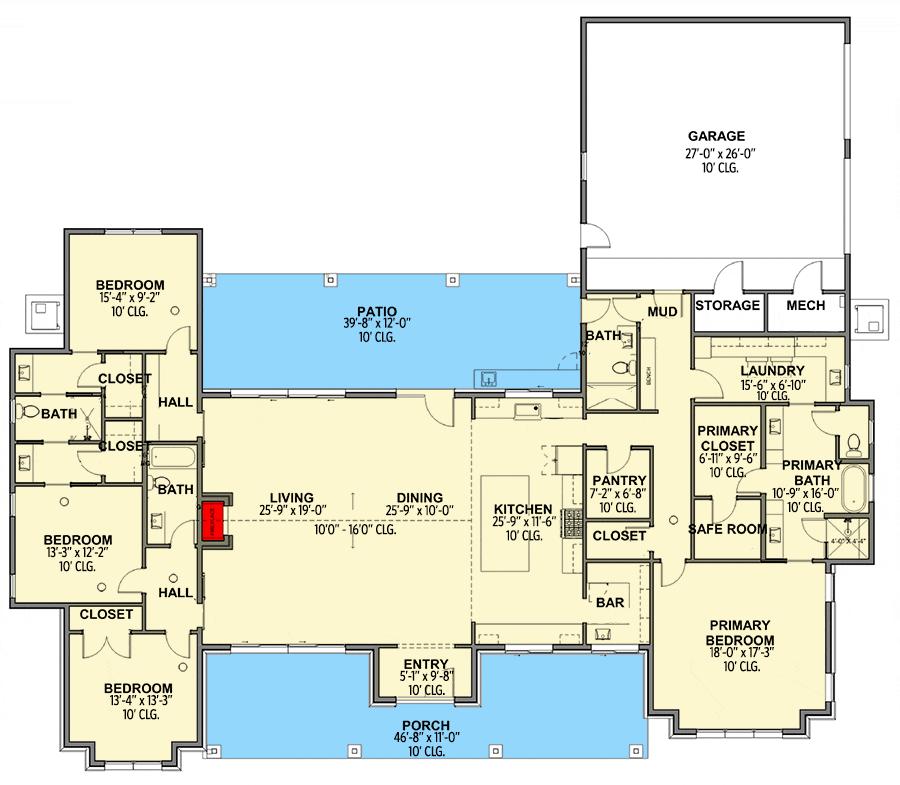
The primary bedroom suite sits on the opposite side of the house from the three secondary bedrooms. Between them? The entire living room, dining room, and kitchen. That’s over 40 feet of buffer space.
You could run a blender at midnight in the kitchen and the person in the primary suite wouldn’t hear it. That’s not an exaggeration – it’s physics. Sound dissipates over distance, and this plan puts more distance between the sleeping zones than most two-story homes put between floors.
The primary bedroom itself measures an impressive 18 feet by 17 feet – that’s 306 square feet of bedroom space alone.
For reference, the average primary bedroom in new construction runs about 200 to 250 square feet. This one gives you a legitimate sitting area, space for a king bed with nightstands on both sides, and still leaves room to walk around without bumping into furniture.
YOU’LL ALSO LOVEL-Shaped Modern Farmhouse with Vaulted Great Room and Master Suite (Floor Plan)
The ensuite primary bath and walk-in closet complete the retreat. The closet connects to the master wing creating a private hallway effect – you move from bedroom to closet to bathroom without ever crossing a shared space.
Split-bedroom layouts like this one consistently command strong resale value. Buyers with teenagers, aging parents, or home-office needs all gravitate toward plans that offer this kind of separation.
One wing becomes the private master retreat. The other becomes whatever the family needs it to be.
But there’s one design choice here that divides people.
Would you like to save this?
The Three-Bedroom Wing That Secretly Works as a Flex Zone
On the opposite side of the house, three bedrooms share their own wing with well-placed bathrooms and adequate closet space in each room.
One bedroom measures 15 feet by 9 feet – noticeably larger than the other two. That extra square footage makes it a strong candidate for:
- a secondary master suite
- a dedicated home office
- a media room
Here’s the flexibility that most plans this size don’t give you. Because this wing has its own bathroom access and sits completely separated from the primary suite, you could convert one bedroom to an office and another to a guest room without disrupting either sleeping zone. Try doing that in a traditional layout where all four bedrooms share a single hallway.
For families with teenagers, this wing is the answer to a question every parent asks – how do you give them independence without giving them the run of the entire house? The secondary wing is self-contained enough to feel like their own space, but still connected to the main living area through a single transition point.
After reviewing thousands of layouts, this detail still stands out.
The Mudroom-to-Garage Connection That Eliminates the #1 Complaint in Open Floor Plans
You come in from the garage and land directly in the mudroom. Shoes off. Bags down. Coats hung.
Then – and only then – do you enter the main living space.
This is the detail that separates well-designed plans from pretty ones. In an open floor plan, every mess is visible from every room. The mudroom acts as a decompression chamber between the garage and the house, catching the daily chaos before it reaches the kitchen island.
The laundry sits right here too, connected to both the garage entry and the main house. Dirty clothes from sports practice or yard work go straight from the mudroom into the washer without ever crossing the living room carpet.
A storage room sits adjacent to the mudroom, adding another layer of organization. The garage itself stretches 745 square feet – enough for two cars plus a workshop along the back wall. A standard 400 to 500-square-foot two-car garage can’t accommodate that.
The side-entry design means you pull in from a lateral driveway rather than straight off the street. Builders on Houzz forums consistently note that side-entry garages provide better visibility when backing out, especially in neighborhoods with children playing near the road.
This next room surprised even me.
The Main Level Floor Plan
The Safe Room and Pantry That Most Plans This Size Leave Out Entirely
Tucked into the floor plan is a dedicated safe room alongside a spacious walk-in pantry. Most house plans under 4,000 square feet don’t include a safe room at all – it’s typically a $3,000 to $10,000 add-on that gets cut during the budgeting phase.
This plan builds it in from the start.
A FEMA-compliant safe room can withstand EF5 tornado winds up to 250 mph. Whether you’re in tornado country or simply want a secure space for valuables and documents, having one designed into the original floor plan means reinforced walls and proper anchoring are part of the structural engineering – not an afterthought bolted into a closet.
Here’s the number that matters. Homes with built-in safe rooms see a 3.5 percent increase in resale value – roughly $17,000 to $23,000 on a home in this price range. FEMA even offers Hazard Mitigation Assistance grants that can reimburse up to 75 percent of the cost in qualifying states.
The adjacent pantry adds dedicated storage that keeps the kitchen counters clear and the grocery overflow organized.
Together, these two rooms represent some of the most thoughtful square footage in the entire plan – functional, protective, and invisible from the main living areas.
BONUS: The One-Story Advantage Most Buyers Don’t Calculate Until It’s Too Late
Here’s something builders won’t always volunteer. A one-story home at 3,305 square feet costs more per square foot to build than a two-story with the same footage – the foundation and roof are both larger. You’ll pay roughly $15,000 to $25,000 more upfront compared to stacking the same rooms on two floors.
But the long-term math flips that equation.
One-story homes need a single HVAC zone instead of two. That saves $3,000 to $5,000 on installation and hundreds per year on energy bills.
Every exterior maintenance task costs less with no second story to scaffold – gutters, power washing, painting, roof inspections. And insurance companies in storm-prone areas often give lower premiums to single-story homes because they present less wind resistance.
Then there’s the accessibility factor. No stairs means this plan works for:
- young families
- aging parents
- guests with mobility issues
- long-term aging in place
No modifications needed. That flexibility is why one-story plans with split bedrooms consistently command strong resale numbers – they appeal to the widest possible buyer pool.
At 3,305 square feet with four bedrooms, four bathrooms, a safe room, and 86 combined feet of outdoor living space, this plan delivers more usable square footage per dollar than most homes in its class.
What would you change about this plan – or would you build it exactly as drawn?
Interest in a modified version of this plan? Click the link below to get it and request modifications.