
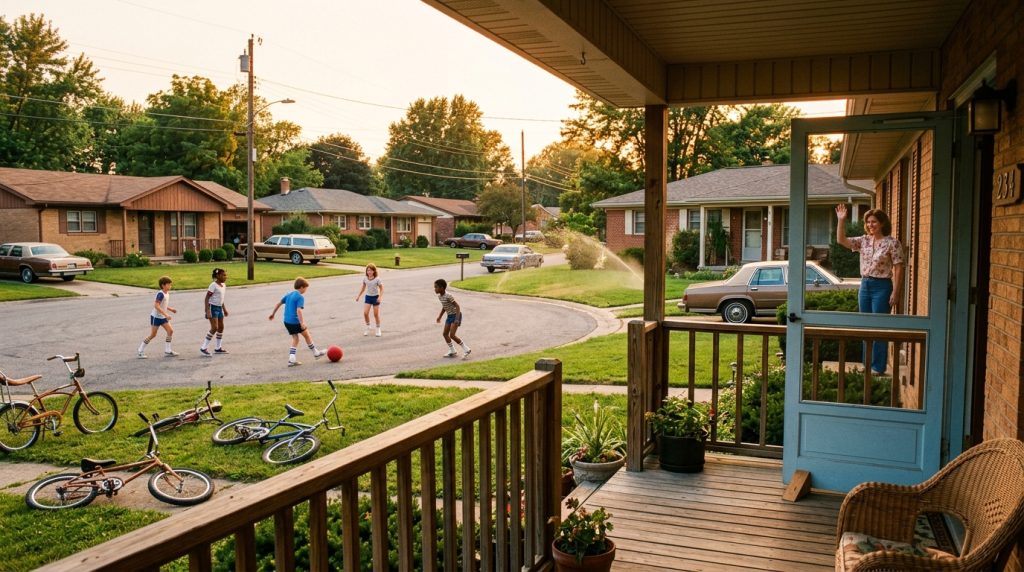
Nobody handed us a rulebook. There wasn’t a flyer in the mailbox. There wasn’t a parent meeting at the school gym.
The rules of the block just existed, the way the air existed, and you absorbed them the same way you absorbed how to ride a bike.
By doing it, getting yelled at, and trying again.
Would you like to save this?
You knew at age six that you could not walk across Mrs. Petranek’s lawn under any circumstance, and you never once had a conversation about it with anyone.
The information came in through the soil. Our generation had a social contract that was invisible, unspoken, and fully enforced.
Number nine on this list is the rule that kept entire neighborhoods running on borrowed eggs and trust, and your kids today have literally never witnessed it happen.
You Came Home When the Streetlights Came On (Not When You Felt Like It)
The streetlight buzzed on around the same time every night, give or take fifteen minutes for the season.
That was the curfew. There was no negotiation. There was no “I’ll be a few more minutes.”
If you were caught on someone else’s porch when the streetlight came on, every mom on the block knew you were already in trouble at home. Your friend’s mom would say “you better get going” without looking up from the casserole.
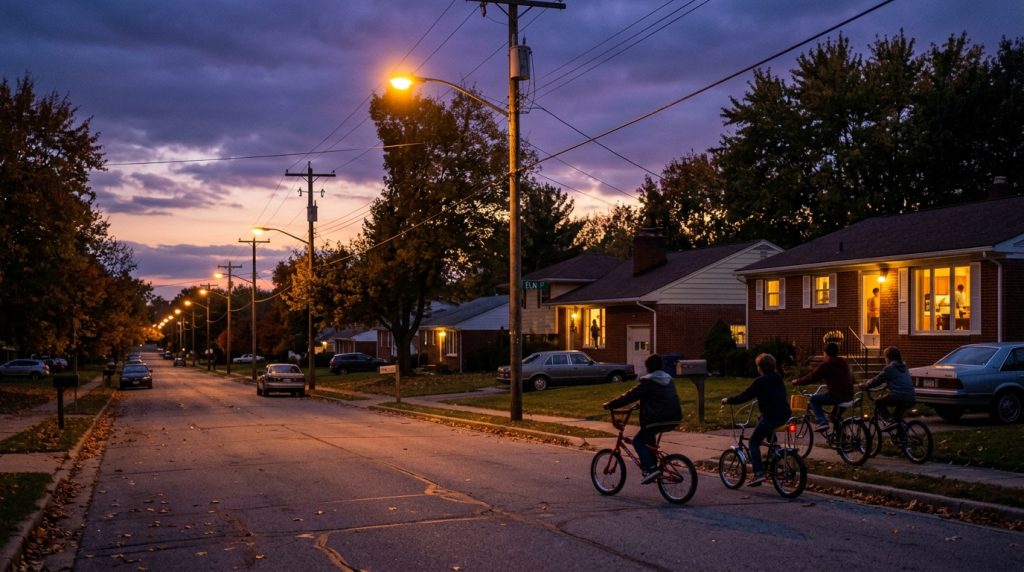
The streetlight wasn’t a parental request. It was a community-enforced contract.
YOU’LL ALSO LOVE25 Things About Your Home That Visitors Notice in the First 10 Seconds (But Never Tell You)
Even the kids enforced it on each other. By the time you were ten, you were saying “streetlight” to a younger kid the way a foreman says “lunch is over.”
Today, parents track location with apps and text “be home by 8.” Back then, the entire block agreed on one yellow light, and when it flickered to life, the day was done.
Pew Research’s 2015 parenting survey put the median age at which today’s parents allow unsupervised neighborhood play at 10, up from 7 in the 1981 cohort the AAP cited in Pediatrics.
Three years of childhood autonomy quietly disappeared. Nobody questioned it. The light was the law. The light was always right.
Don’t Call During Dinner (Or You Get Hung Up On)
Dinner started somewhere between 5:30 and 6:30 depending on the household, and during that hour, the phone was silent.
If you needed to call your friend, you called at 4:45 or you called after 7. Calling at 6:15 was a violation.
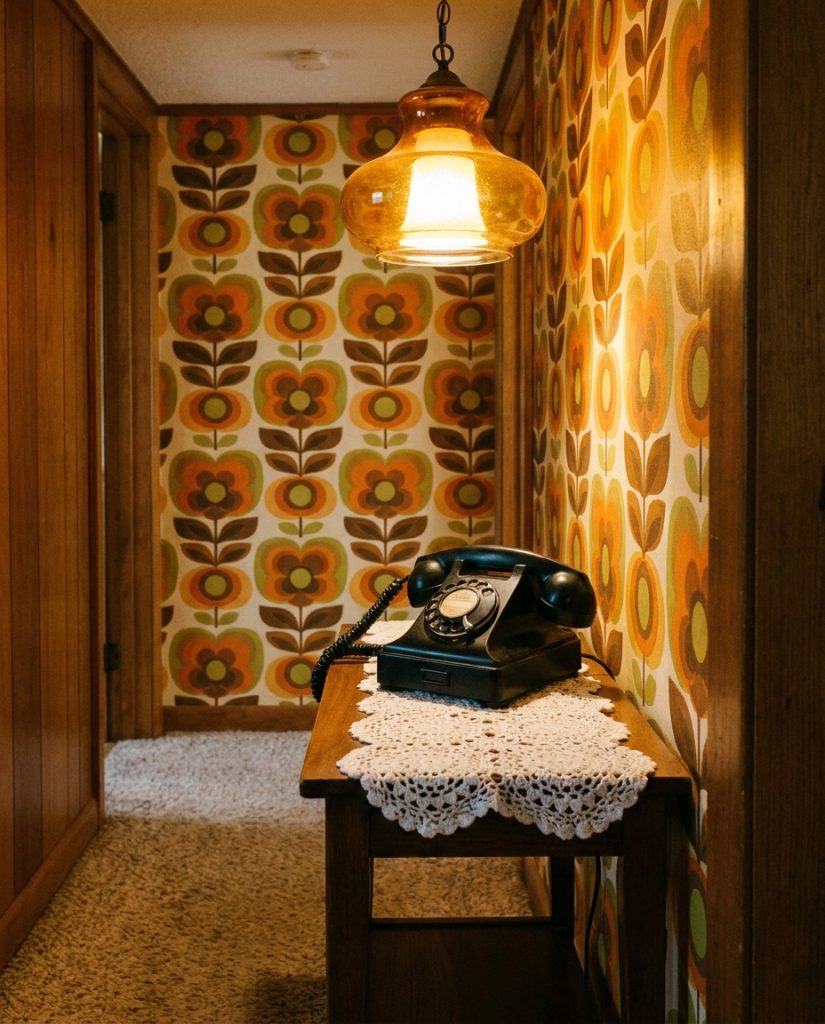
The mom who answered the phone would say “we’re eating,” and that was it. Click.
Some moms would let you leave a one-line message. Most wouldn’t. The rule was so universal that even at age seven you knew not to do it.
You did the math without realizing it. You’d glance at the clock, see 5:48, and put the phone down.
Today, kids text constantly. Notifications during dinner are normal. Phones sit on the table. The family meal was a closed system, sealed against the outside world for one hour, and trying to puncture that seal was the rude move.
Your friend would call you back when his mom said it was OK to use the phone. Until then, you waited.
Knock Once and Walk In (Or Just Walk In)
You did not stand on a porch waiting to be greeted like a vacuum salesman.
You opened the screen door, hollered “Mrs. Henderson?” into the kitchen, and walked toward the sound of the TV.

If you were a kid your friend’s family knew, you didn’t even holler. You opened the door, walked through the kitchen, said hi to whoever was at the table, and headed to your friend’s room.
The door was rarely locked during the day. The house was rarely empty during the day.
YOU’LL ALSO LOVE30 Things in the 1970s Living Room That Would Confuse Anyone Under 30
You never needed a key, never needed a code, never needed to text first.
The walk-in rule made the block feel like one big extended house. Today, walking into a house unannounced is a confrontation in some neighborhoods and a felony in others. Doorbells have video cameras now. Front porches have signs about no soliciting.
The screen door has been replaced by a security door with a deadbolt. You can’t even drop off cookies without it becoming an event.
Anyone’s Mom Could Yell at You (and You Took It)
Mrs. Garcia could yell at you for running through her yard. Mr. Costanza could yell at you for skateboarding in his driveway.
The mom three doors down whose name you didn’t know could yell at you for being too loud during her baby’s nap, and you would say “yes ma’am” and lower your voice.
There was no concept of “you’re not my parent.” Every adult on the block had standing authority over every kid on the block, full stop.
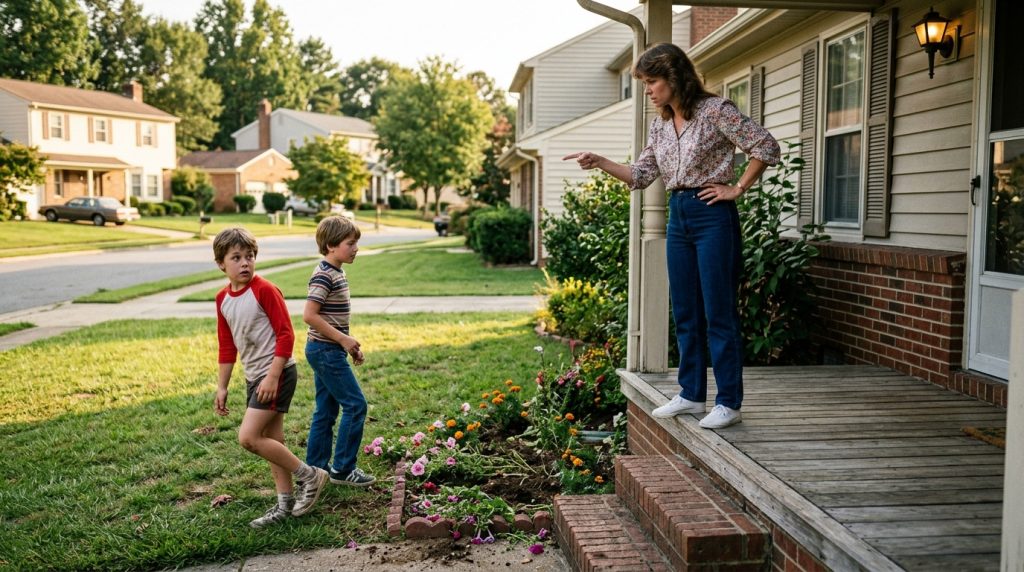
If your mom found out somebody else’s mom had yelled at you, she would either yell at you again or send you over with a plate of brownies as an apology, depending on what you’d done.
Authority was distributed. Discipline was a shared resource.
Harvard sociologist Robert Putnam, in Bowling Alone, named this kind of dense neighborhood enforcement “social capital” and tracked a 58 percent decline in club, civic, and neighborhood participation between 1975 and 2000.
The shared discipline did not survive the decline. Today, intervening in another family’s parenting is a fast way to get a passive-aggressive Facebook post made about you, possibly with a photo of your house. Then it was a normal Tuesday at four in the afternoon.
Older Kids Ran the Block (Until You Became One)
There was always a kid who was twelve when you were eight.
The twelve-year-old set the agenda. The twelve-year-old picked the game. The twelve-year-old said “we’re going down to the creek today” and you went, even if you didn’t want to, because not going meant being eight at home alone all summer.
The twelve-year-old also protected you. If a fourteen-year-old from the next block tried to steal your bike, the twelve-year-old got involved.

The Hierarchy Nobody Taught You
There was a hierarchy that resembled an unspoken military rank, and you knew exactly where you stood in it.
By the time you were twelve, the cycle repeated and you ran the block for a few summers.

Today, age-mixing barely happens. Kids are scheduled into activity groups by birth year.
YOU’LL ALSO LOVE25 ‘Common Sense’ Home Rules Everyone Followed in the 80s That Would Get You Laughed At Today
The CDC’s 2022 youth-activity report found that fewer than 21 percent of American kids ages 6 to 13 engage in any unstructured outdoor play with peers across age groups, down from a 1981 University of Michigan time-use baseline above 70 percent. Block-wide pickup games are extinct as a social form.
The wisdom that used to flow from twelve-year-olds to eight-year-olds about how to fold a piece of paper into the spokes of a bike for that perfect motorcycle sound now lives in YouTube tutorials, which is sad, but which is the new system.
Borrowed What You Needed and Returned Something Better
If your mom needed an egg, she sent you next door with a measuring cup.
The neighbor put one egg in the cup. You walked it back. Three days later, when the neighbor needed flour, she sent her kid to your house and got a cup of flour.
The flour was always slightly more than a cup, because that was the rule. You always returned a little more than you borrowed.
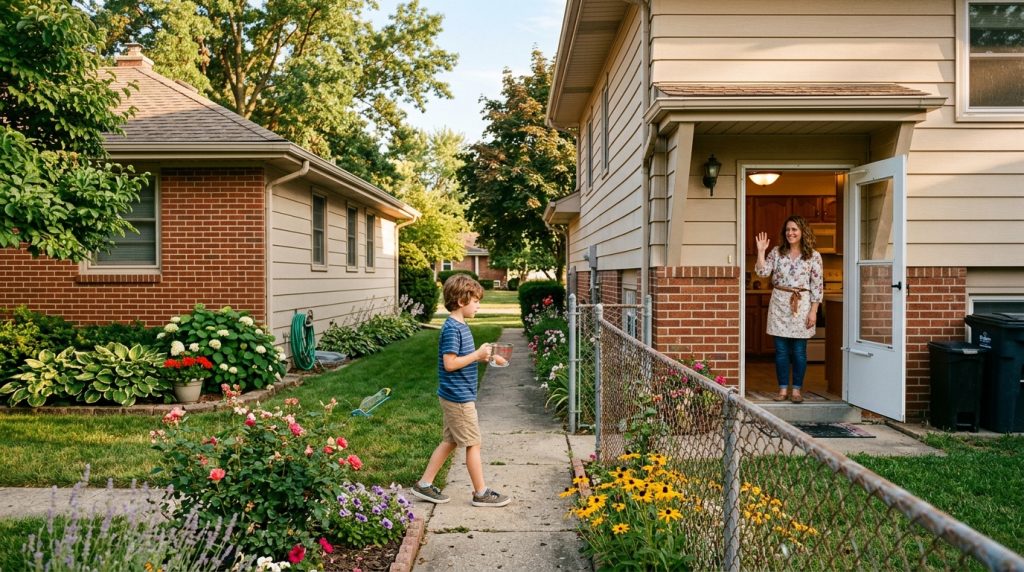
If your dad borrowed a circular saw, he returned it cleaned, with the blade sharpened. If your mom borrowed a casserole dish, she returned it with cookies in it.
The accounting was invisible but constant. The slightly-more rule was the insider mechanism: in a town with no formal credit between households, the small over-return was the interest payment that kept the credit line open.
Borrow even, return even, and the relationship slowly cooled. Borrow a cup, return a cup-and-a-tablespoon, and the next ask was already pre-approved.
Today, asking a neighbor for an egg is awkward enough to require a setup paragraph. People order DoorDash for one missing ingredient. The borrowing economy died because nobody knows their neighbors well enough to feel comfortable asking, and the casual hand-off at the side door is now a logistical event involving a text and a porch drop.
Mom would borrow an egg twice a month. We never thought about it.
You Did Not Go Home Until You Were Done
If you were in the middle of a kickball game in the cul-de-sac and your mom yelled “dinner!” from the porch, you yelled back “five minutes!”
Five minutes meant you would finish the inning. The inning took fifteen minutes. Mom understood this.
She’d start the kettle for tea, finish setting the table, call you a second time at the actual dinner deadline, and then eat without you if necessary.
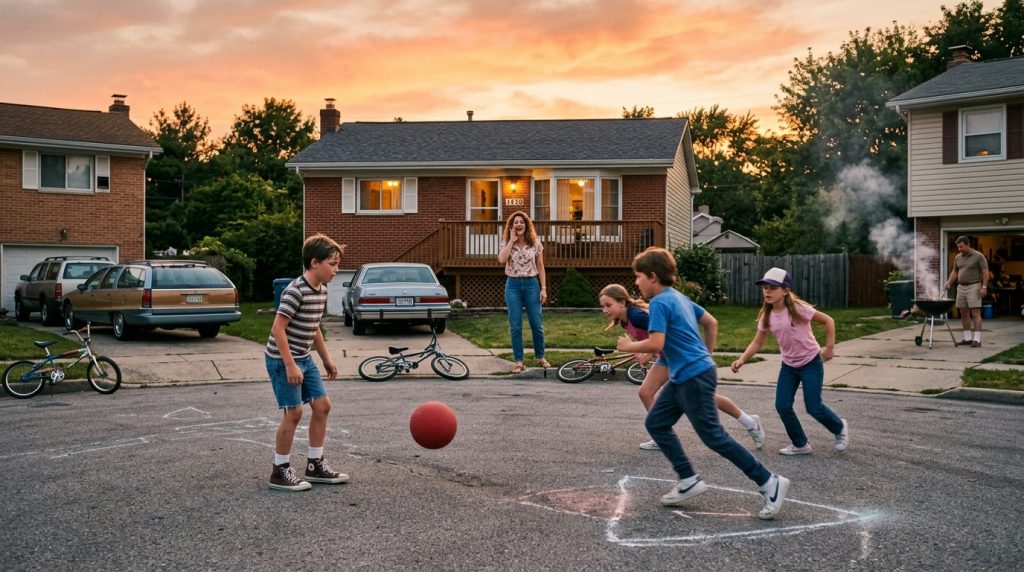
The rule was that the game came first if the game was at a critical moment.
The kids understood this, the moms understood this, and the dads understood this even when the dads were the ones grilling the burgers. There was a fundamental respect for the unfinished thing.
Today, kids get pulled out of pickup games for piano practice scheduled at 5:15 sharp. Calendars run children’s lives. The rhythm of “we will be home when the game is over” has been replaced by “we will be home at exactly 5:38 because that’s what the family Google Calendar says.”
It used to be that you finished the play. Now you adhere to a schedule. Both work. One was nicer.
You Used Your Friend’s Bathroom Without Announcing It
You walked through the kitchen, said hi to your friend’s mom, walked down the hall, used the bathroom, came back.
You did not ask. You did not announce. You did not explain.
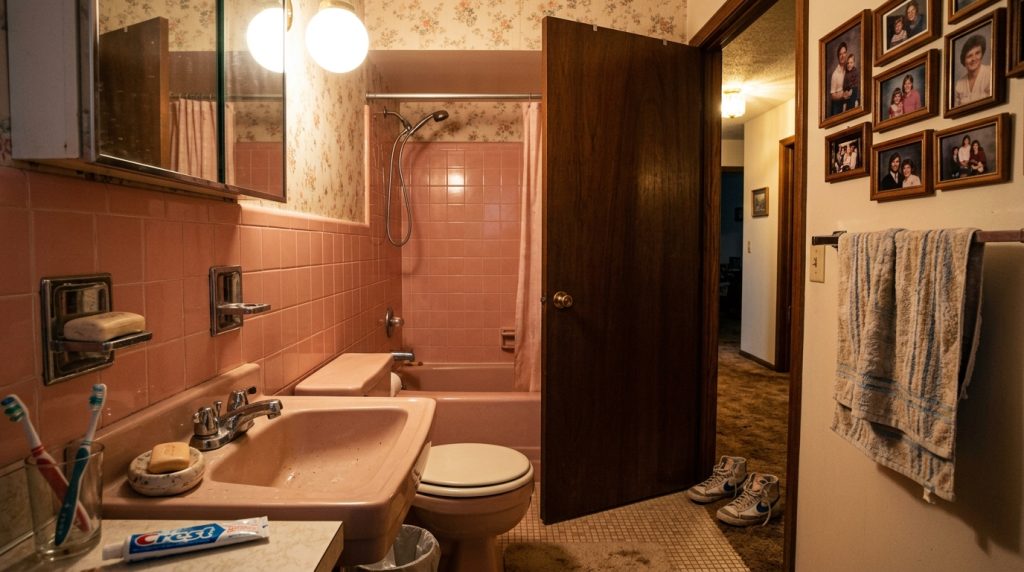
The bathroom was a public utility within the house, and your access to it was a function of being on the block, not a permission you needed to request.
Would you like to save this?
The hand soap was a bar. There was no separate kid soap. The towel was the same towel everyone used, and if you used it last and it was still damp, you draped it back over the rod the way you’d hope your friend would.
Today, sleepovers come with bathroom briefings. Children visiting houses are escorted to a designated guest bathroom by an adult. The casual normalcy of bathroom use has turned into a small ceremony.
The bathroom thing sounds trivial. It isn’t. It was about a level of comfort that doesn’t exist anymore in most American homes.
Sugar, Salt, Spaghetti, and the Pinch of Cinnamon
This is the rule from the intro.
The rule was simple: you walked next door for the missing ingredient. You did not drive twenty minutes to a grocery store. You did not order from an app. You did not text fifteen people in a group chat.
You walked, with whatever empty container you had, and you came back with the ingredient.
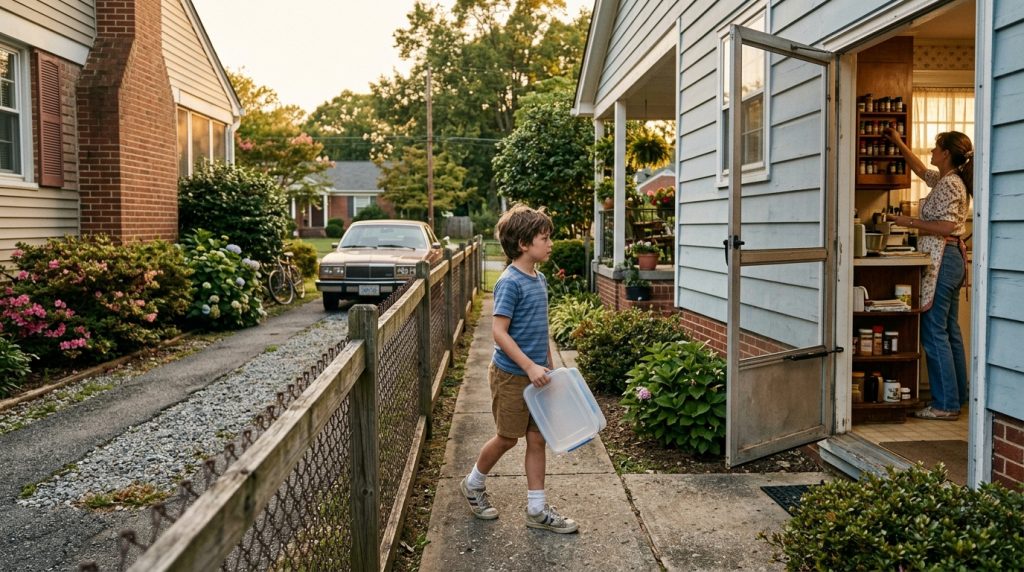
The borrowing covered everything. A pinch of cayenne for chili. Two cups of brown sugar for cookies. A quarter teaspoon of cardamom because mom was making something fancy.
The neighbor’s spice rack was an extension of your mom’s spice rack. By extension, your spice rack was a community resource.
The rule died slowly through the late ’90s as people moved more, knew their neighbors less, and stopped making things from scratch.
The grocery store at 9:30 PM became the new neighbor. The 24-hour Walmart became the new spice rack. The block-level interdependence vanished, and so did the kid who walked an empty Tupperware container next door for half a stick of butter.
First Adult Who Saw You Bleeding Became Your Mom for Twenty Minutes
If you wiped out on your bike in front of the Petersons’ house and you were bleeding, Mrs. Peterson was your mom for the next twenty minutes.
She’d bring you inside, sit you on her kitchen counter, clean the gravel out of your knee with a cotton ball and that brown stuff in the brown bottle, slap a Band-Aid on it, and give you a glass of milk.
Then she’d call your mom and tell her, but only after you were patched up, because the patching was the priority. The phone call was the formality.
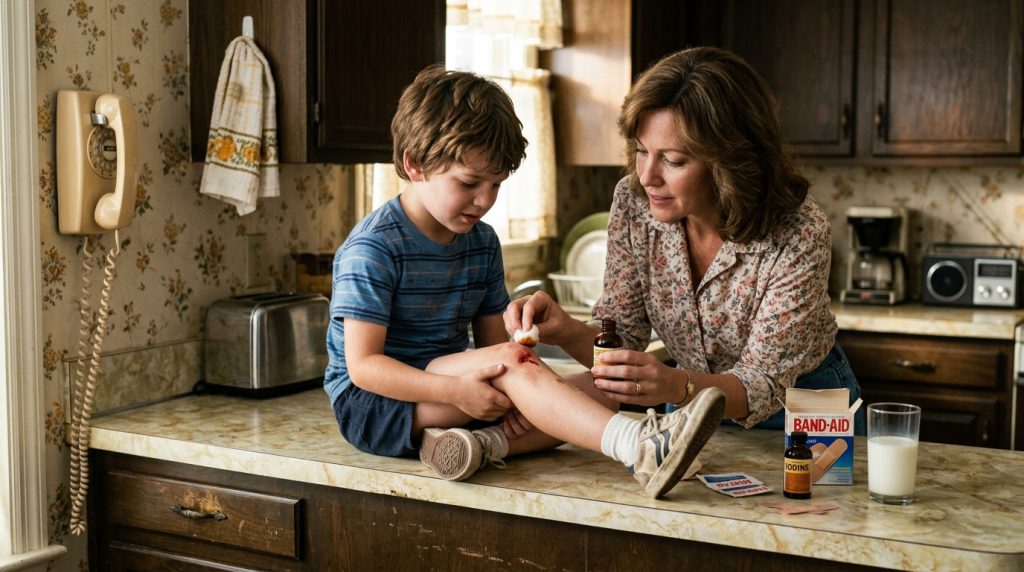
Today, an unsupervised neighbor doctoring an unrelated child’s wounds is a complicated event involving liability and consent and possibly a recorded text exchange.
Then, it was the most natural thing in the world. The block ran a distributed first-aid network with shared protocols and a shared understanding that hurt kids needed help right then, not after a phone call to the official parent.
You Said “Hi” to Every Adult You Walked Past
You did not put your head down. You did not stare at a phone (you did not have a phone). You did not pretend not to see them.
When you walked past Mr. Sherman watering his tomatoes, you said “Hi, Mr. Sherman” and he said “How’s your dad?” and you said “Good, he’s painting the deck this weekend” and you kept walking.
The exchange took four seconds. You did this thirty times a day. It was muscle memory.

Saying hi cost you nothing and it kept the social fabric of the block sewn together with a thousand tiny threads.
Today, kids walk past adults on the sidewalk staring at phones, and the adults walk past kids staring at phones, and the threads aren’t there.
The kids don’t know the adults’ names. The adults don’t know the kids’ names.
There’s no shared spice rack, no shared first-aid network, no shared bathroom access, no shared streetlight curfew, no shared anything, because the basic exchange of “Hi, Mr. Sherman” died and took the rest of it with it.
The hi was the foundation. The hi was the whole block.
BONUS The Hidden Rule That Made All the Other Rules Work
Every adult on the block knew which kids belonged to which house.
That was the whole secret.
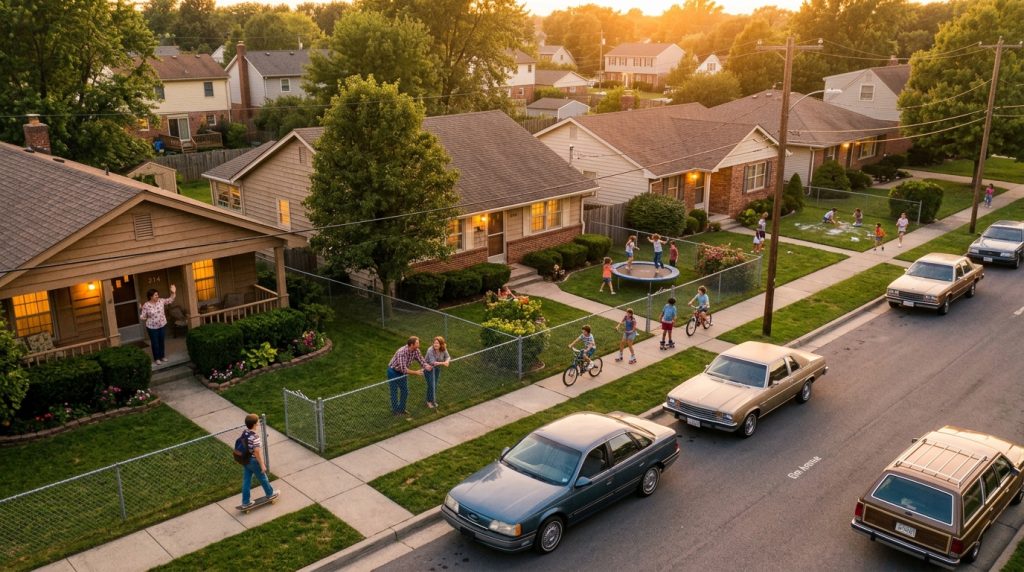
Mrs. Petranek knew you were the Cameron kid from three doors down because she’d seen you in your front yard, in your dad’s car, walking to school, and at the church bake sale, all before you turned six.
The recognition was the engine.
When she yelled at you for cutting through her yard, she wasn’t yelling at a stranger.
She was yelling at you, by name, in a tone she’d use with her own kids, because she knew where you lived and she knew your mom’s first name.
That recognition layer is gone. The Census Bureau’s most recent geographic mobility data puts annual same-county residential turnover above 14 percent, which means the average suburban block sees roughly one in seven households turn over every year.
Front lawns have privacy fences. Garages absorb the residents on arrival. Neighbors don’t see each other unless they engineer the meeting.
The rules of the ’80s block weren’t enforced by mystery and tradition. They were enforced by recognition. Without recognition, none of it works, which is why none of it has come back.
What was the unwritten rule on your block, and which adult enforced it the hardest?