
Luxury Home Plan Under 10,000 Sq Ft with Bowling Alley (Floor Plan)
9,792 square feet. A private bowling alley. And a garage wing connected by a covered portico so it doesn’t swallow the entire facade.
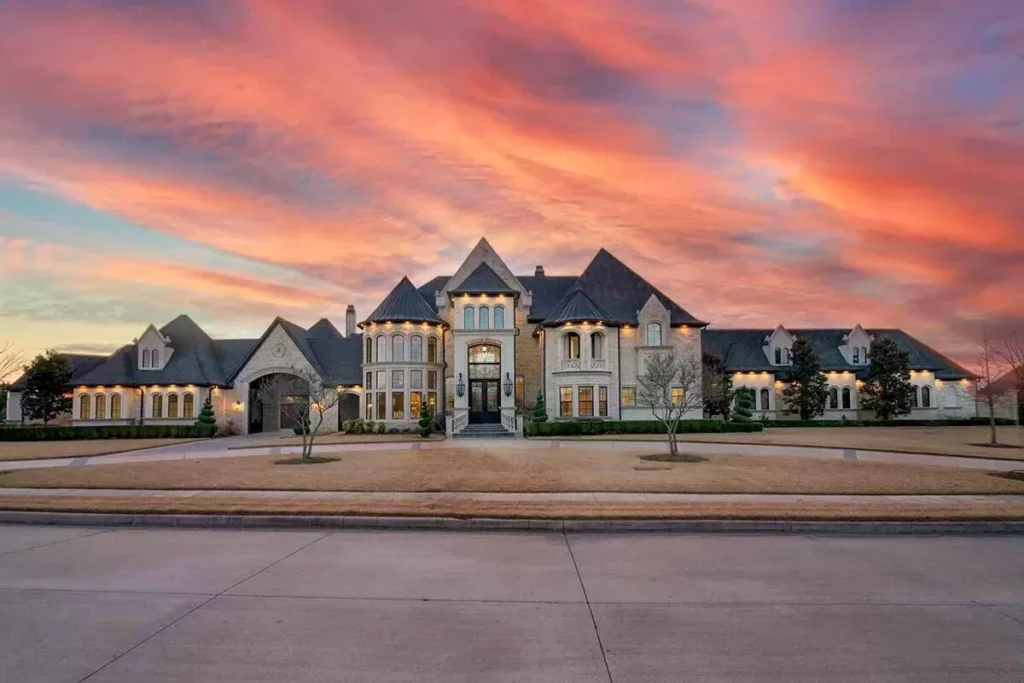
After reviewing hundreds of luxury plans on this site, this one does something rare – it packs nearly 10,000 square feet of living space across two floors without a single room that feels like filler.
Every square foot earns its place.
I’m going to walk you through the entire layout, but pay attention when we get to the entertainment wing. The way the bowling alley, lounge, and game room cluster together – while staying completely isolated from the sleeping quarters – is the kind of zoning detail that separates a great plan from an expensive one.
Specifications:
- 9,792 Heated s.f.
- 4 Beds
- 5.5 Baths
- 2 Stories
The Floor Plan:
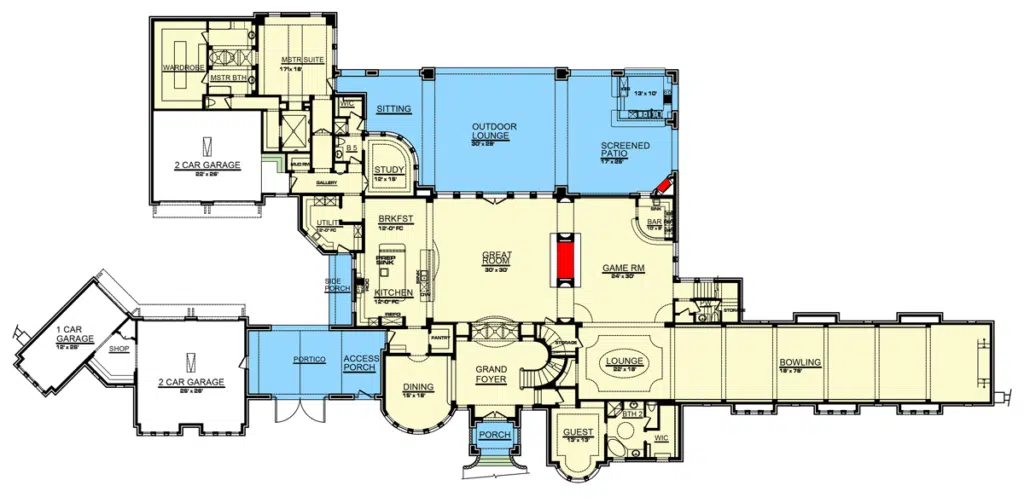
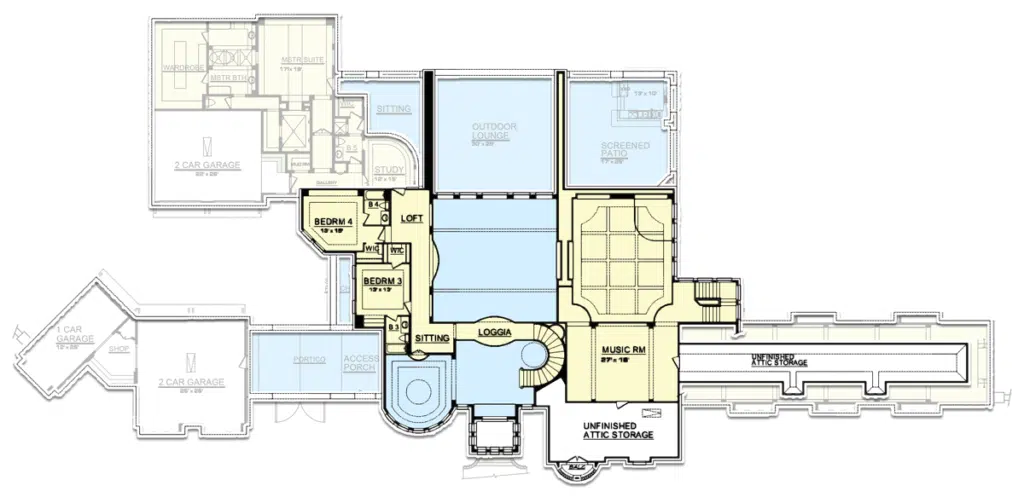
Before we step inside, look at the numbers. The first floor carries 8,123 square feet. The second floor adds 1,669.
That’s an 83/17 split – and it’s deliberate.
Most luxury plans this size stack square footage evenly across two floors, which means you’re climbing stairs constantly just to reach basic rooms. This plan puts nearly everything you need for daily life on one level.
- Master suite
- Kitchen
- Dining
- Great room
- Study
- Guest suite
All on the first floor. The second floor is reserved for bonus space, additional bedrooms, and the entertainment areas that don’t need to be at your fingertips every morning.
That split matters when you’re building, too. At current luxury construction rates of $300 to $500 per square foot, this plan puts you in the $2.9 million to $4.9 million range before land.
Every design decision at this price point either saves you money or costs you money. Concentrating the primary living on one floor simplifies the HVAC zoning and reduces the structural complexity compared to plans that spread the same square footage evenly.
Here’s where the layout gets clever.
The Front Porch That Sets the Tone Before You Open the Door
You approach this home and the front porch tells you immediately what kind of house this is. It’s not a narrow strip of concrete with a welcome mat.
The porch stretches across the facade with the kind of proportions you’d see on a European estate – wide enough to stage furniture, deep enough that you’re sheltered from weather before you ever reach the front door.
The architectural detailing here – the columns, the roofline treatment, the material transitions – does something subtle but important. It signals the scale of what’s behind the door without revealing everything.
Builders call this “progressive disclosure,” and it’s the difference between a home that impresses and one that overwhelms. A house this size can easily look like a commercial building from the street. The porch humanizes the facade.
Most people walk right past this part. But the room behind the front door is what anchors the whole first floor.
The Great Room Where the Ceiling Does Half the Work
You step through the front door and the great room opens vertically before it opens horizontally. The soaring ceilings are the first thing that registers – and that’s by design.

In a plan with over 8,000 square feet on the first floor, the great room needs to feel like the anchor of the house without dwarfing everything around it.
The ceiling height creates that sense of volume without requiring the room itself to eat up a disproportionate footprint. You get the feeling of a grand space while the floor plan preserves square footage for the rooms that actually need it – the kitchen, the entertainment wing, the master suite.
The fireplace wall gives you a natural focal point, and the sight lines from here reach through to the kitchen and dining areas. That open connection is what makes the first floor feel like one continuous living zone rather than a collection of separate rooms separated by hallways.
Take a guess – how many square feet do you think this great room actually is?
Most people who see plans this size assume the great room must be 600 or 700 square feet. The reality is closer to 400. The ceiling height and the open sight lines to adjacent rooms make it feel nearly double its actual footprint.
That’s efficient design at work.
But wait until you see what’s next to it.
The Kitchen Island That Runs the Entire Operation
You round the corner from the great room and the kitchen island hits you first. It anchors the center of the room and serves as the traffic controller for the entire first floor.
This isn’t a decorative afterthought. The island is built for function – it includes a dedicated veggie sink, which tells you the designer was thinking about how a real cook actually works.
The main sink handles dishes and cleanup. The veggie sink on the island handles prep. Two people can work this kitchen simultaneously without crossing paths or competing for sink access.
That dual-sink layout isn’t standard on most plans, even at this price point. Builders will tell you adding a second sink to an island runs about $1,200 to $2,500 depending on the fixture and plumbing routing – but it transforms how the kitchen operates for holidays, dinner parties, or any time you’ve got more than one person cooking.
The kitchen opens directly to both the great room and the dining area. That three-way connection means whoever is cooking is never isolated from the conversation. In a home designed for entertaining, that’s not a luxury – it’s a layout requirement.
Here’s where the plan does something most luxury homes don’t.
The $75,000 Room That Most Visitors Will Never Want to Leave
A home bowling alley isn’t a gimmick. It’s an engineering project.
A regulation bowling lane requires approximately 100 feet in length – 16 feet for the approach, 60 feet of lane, and the rest for the pin deck, pinsetter machinery, and a rear service aisle. The ceiling needs a minimum of 10 feet of clearance. The width for a single lane runs about 14 feet including service space on both sides.
This plan doesn’t just shove a bowling lane into a basement corner.
It dedicates an entire entertainment wing to the experience – the bowling alley, a lounge directly adjacent, and a game room within steps. The three spaces work as a unit. You finish a frame, grab a drink at the lounge, check the score on the game room screen.
The flow is designed for a group to spread across the wing without losing the social connection.
Here’s the cost reality that makes this feature genuinely impressive. A single-lane residential bowling alley runs $75,000 to $175,000 installed, depending on the pinsetter type and customization.
String pinsetters – the dominant choice for residential installations now – cost $8,000 to $12,000 and run quieter with 75% fewer moving parts than commercial free-fall machines. The lane surface, ball return, scoring system, and installation add the rest.
At a build cost of $2.9 to $4.9 million for the whole house, the bowling alley represents roughly 2% to 6% of the total investment. That’s the kind of math that makes it easier to justify than most people expect.
This next room surprised even me.
The Dining Room Where the Bay Window Changes Everything
Adjacent to the kitchen, the formal dining area does something unusual. Instead of a flat wall of windows, this plan installs a round bay window that pushes the dining experience outward toward the front of the home.
The bay window isn’t just decorative. It adds usable square footage to the room – typically 15 to 25 square feet depending on the depth of the bow.
More importantly, it wraps the natural light around three sides of the seating area rather than casting it from a single direction. Morning meals get eastern light. Evening dinners get the warm ambient glow of a setting sun diffused through multiple panes.
From a builder’s perspective, a round bay window like this one costs roughly $3,000 to $8,000 more than a standard flat window of the same width. The structural framing is more complex and the roof treatment above it requires custom work.
But it’s one of those details that photographs beautifully and makes the room feel like a destination rather than a pass-through.
The dining room anchors one end of the entertaining triangle – kitchen to dining to great room. All three connect without hallways. That’s what makes this first floor work for large gatherings.
I saved the most important room for a reason.
Master Suite That Lives 40 Feet From Everything and Everyone
You’ll find the master suite on the main level – and the placement is strategic. It sits in its own wing, separated from the entertainment areas and the guest bedroom suite by distance and layout.
That separation matters in a house this size.
A 9,792-square-foot home is going to have activity happening in multiple zones simultaneously. Someone bowling at 10 PM shouldn’t be audible from the master bedroom. This plan uses the sheer distance of the first floor’s 8,123-square-foot footprint to create acoustic separation without relying entirely on soundproofing.
The suite itself is scaled to match the rest of the house. You feel the room’s proportions the moment you walk in – the ceiling height, the window placement that pulls in natural light from multiple angles, the floor space that lets you move without navigating around furniture.
A main-level master suite in a two-story plan adds approximately 5% to 8% to resale value compared to plans that place the master on the second floor. Aging-in-place buyers specifically seek out this configuration, and it’s becoming a non-negotiable feature in luxury homes above $2 million.
But the room attached to it might be even more impressive.
The Ensuite Bathroom That Could Charge Admission
You step from the master bedroom into the ensuite and the first thing you feel is the change in atmosphere. The materials shift. The light quality changes.
The proportions tighten slightly in a way that feels intentional – more intimate than the bedroom, more private than any other room in the house.
The ensuite in this plan goes beyond the standard dual-vanity-and-soaking-tub formula. The fixture layout, the separation between wet and dry zones, and the floor space allocated to the walk-in shower area all suggest this was designed by someone who understands that a luxury bathroom isn’t about cramming in more features.
It’s about giving each feature enough room to breathe.
At current material costs, a luxury master bathroom in a home this size typically runs $50,000 to $120,000 for finishes alone – tile, stone, fixtures, glass enclosures, heated floors. The plumbing rough-in for dual vanities, a freestanding tub, and a multi-head shower system adds another $8,000 to $15,000.
These numbers add up fast, but in a home valued north of $3 million, the master bath is one of the three rooms that buyers scrutinize most closely.
Now here’s what the floor plan doesn’t show you.
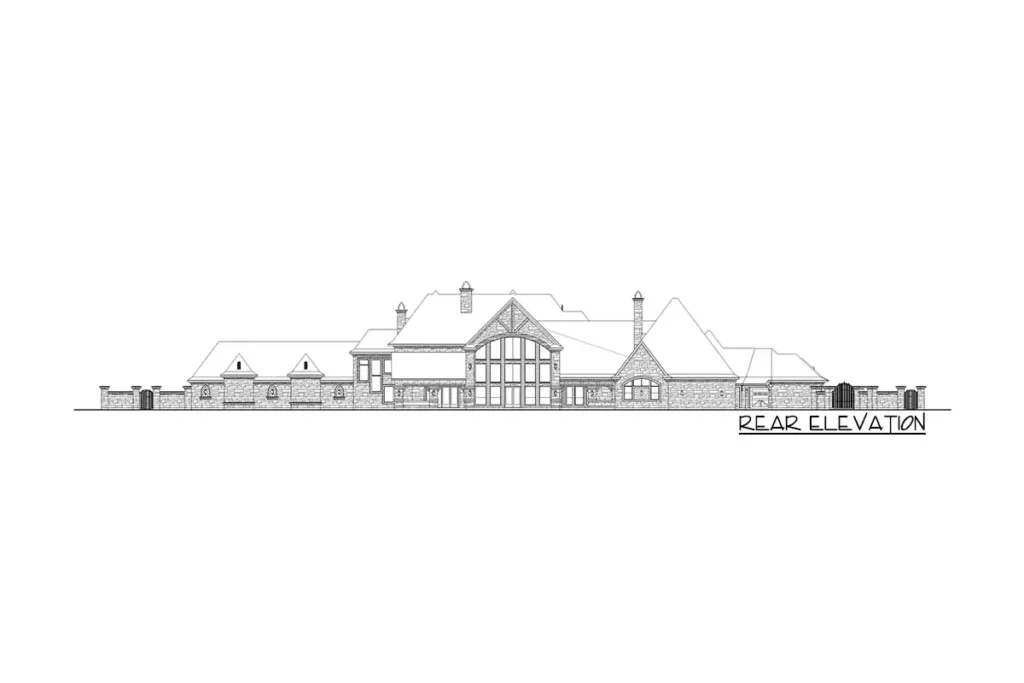
The Music Room and Study That Protect Your Sanity in 10,000 Square Feet
A house this size can feel like a hotel if every room is designed for socializing. This plan avoids that trap by including two rooms specifically built for solitude – a music room and a study, both on the main level.
The study sits near the master wing, which makes it a natural extension of the private zone. You can work from home without crossing through the entertainment areas or the kitchen traffic pattern.
The music room provides acoustic separation for anyone who plays an instrument or simply wants a quiet space to listen.
These aren’t afterthought rooms. In plans above 7,000 square feet, dedicated quiet rooms are what prevent the house from feeling cavernous when only one or two people are home. They give you a reason to be on the main floor that doesn’t involve the kitchen or the great room.
There’s also a second bedroom suite on the main level. This isn’t a converted closet with a pullout couch – it’s a full guest suite with its own bathroom. Visitors get privacy without climbing stairs, and you keep the second floor entirely for family use or additional entertainment.
Builders will quietly tell you this is the smartest part of the plan.
The 5-Car Garage and Workshop Connected by the Detail Everyone Misses
Five car bays plus a dedicated workshop. That alone would make most car enthusiasts stop scrolling.
But the real design move here is the portico.
A portico is a covered walkway connecting the garage wing to the main house. Without it, a 5-car garage attached directly to a 10,000-square-foot home would dominate the facade and make the house look like it was designed around the cars. The portico creates visual separation. From the street, the garage reads as its own structure even though it’s functionally connected.
How much does a 5-car garage with a workshop actually cost?
At typical construction rates, the garage wing alone represents roughly $80,000 to $120,000 of the build budget. The workshop adds dedicated electrical service, higher-capacity outlets for power tools, and often a separate HVAC zone. That pushes the total closer to $100,000 to $140,000.
The workshop space isn’t wasted even if you never touch a power tool. Homeowners routinely convert workshops into:
- Climate-controlled storage
- Home gyms
- Hobby rooms
The electrical and ventilation infrastructure is already there. That kind of built-in flexibility is what drives resale value in a property like this.
The Outdoor Lounge That Turns the Backyard Into a Private Resort
The outdoor lounge is partially screened and includes its own kitchen. That’s not an afterthought patio with a built-in grill.
It’s a fully conceived outdoor living room designed for year-round use.
The partial screening is key. Full screening blocks airflow and makes you feel boxed in. No screening means bugs and weather dictate when you can use the space. Partial screening gives you the flexibility to enjoy open air on mild days while still having protection when you need it.
The outdoor kitchen extends the entertaining footprint of the house beyond the walls. When you’re hosting a large group, the indoor kitchen handles the heavy cooking and the outdoor kitchen handles drinks, appetizers, and casual prep.
Two kitchen zones means your guests naturally split between indoor and outdoor spaces instead of crowding into one area.
Outdoor kitchens with gas lines, running water, and countertop space add $15,000 to $40,000 to a luxury build. But in homes above $2 million, they’re nearly expected. Listings without outdoor kitchens in the luxury market often sit longer and sell for 3% to 5% less than comparable properties that include them.
BONUS: The One Number That Tells You Whether This Plan Is Worth Building
Here’s the calculation most people skip.
Take the total heated square footage – 9,792. Divide by the number of bedrooms – 4. That gives you 2,448 square feet per bedroom.
For comparison, the average American home allocates about 500 to 600 square feet per bedroom. This plan gives each bedroom nearly five times that ratio.
What that really means is that this isn’t a 10,000-square-foot house with 10 bedrooms crammed inside. It’s a 10,000-square-foot house where 60% or more of the space is dedicated to living, entertaining, and specialized rooms.
That ratio is what separates a luxury home from a big home.
Size alone doesn’t create luxury. The proportion of shared and specialized space to sleeping space does. This plan gets that balance right.
Would you build this as-is, or would you modify the second floor layout first?