
Would you like to save this?
The color had a name that belonged on a salad, and somehow it ended up on the toilet.
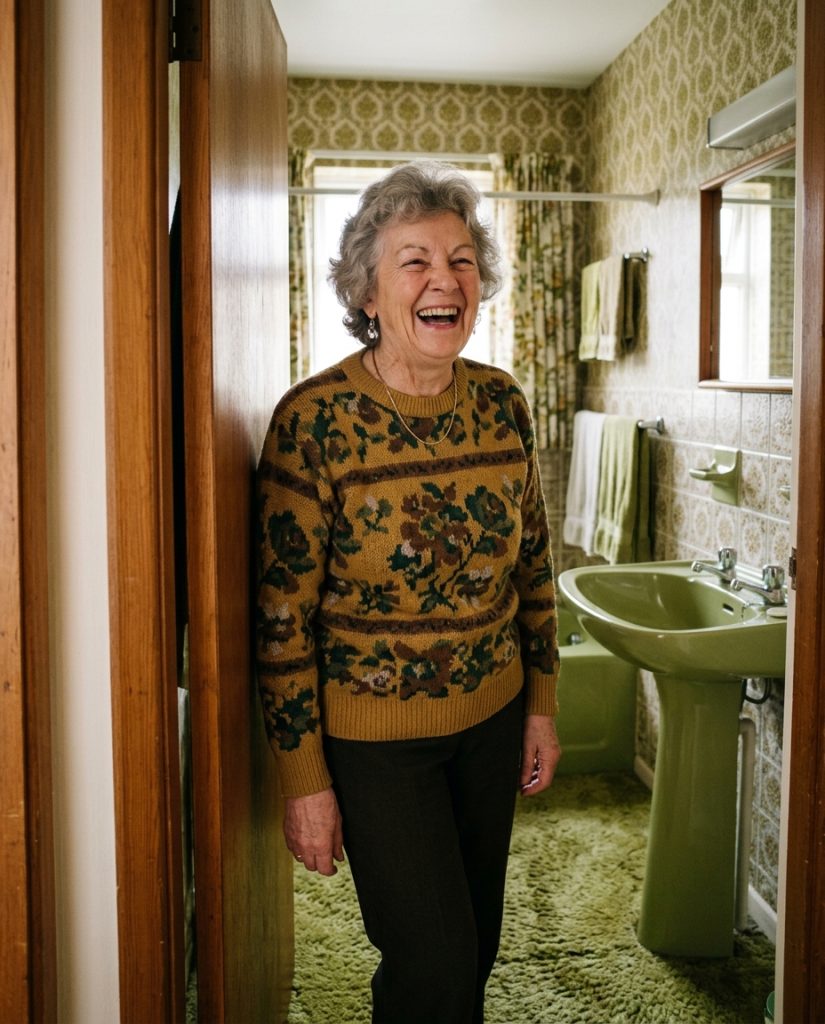
I grew up with a bathroom like that, and I can still picture every piece of it. The sink and the tub and the tank all matched, the floor went soft underfoot, the whole room pulled together like somebody planned it, because somebody did. Back then it read as pure style.
None of it would pass today. And at the time my family would not have traded a single piece of it.
Here is a warm look back at the things that filled those rooms, and why we loved every strange one.
You Carpeted The Floor And Felt Fancy About It
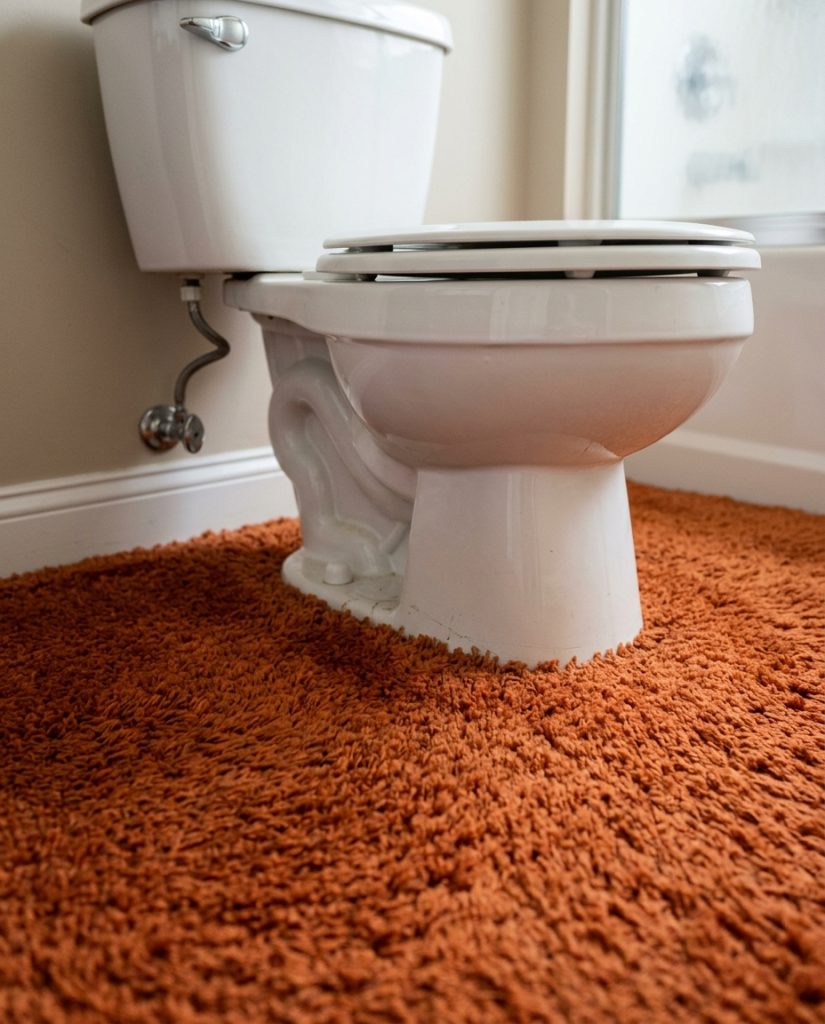
Here is the thing people forget. Carpet in the bathroom was not laziness. It was a choice you paid extra for.
Our pile got cut and fitted snug around the toilet base like real tailoring, and stepping out of the tub onto warm fibers instead of cold tile felt like money. The colors ran dark on purpose, burnt orange and deep gold and forest green, dense enough to hide whatever a wet room throws at a floor. My bare feet sank in and the room felt cozy in a way no tile ever managed.
Then the math caught up. The wettest room in the house, wrapped in something that holds water.
Steam, drips, and shower overspray soaked in and stayed, and the warm damp pile turned into a quiet science experiment under our toes. By the 1980s tile and vinyl were already shoving it out, and by the 1990s the whole idea read as a cautionary tale.
We loved it while it lasted. Our noses, eventually, did not.
Your Toilet, Tub, And Sink Were All Avocado
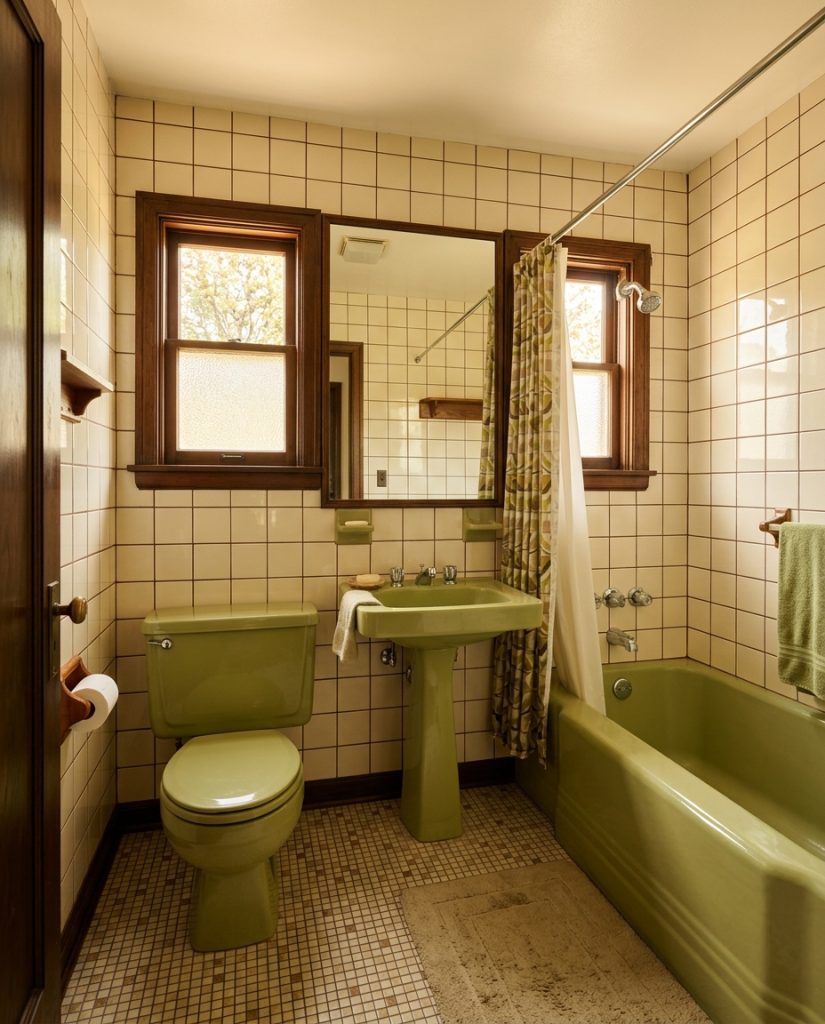
Avocado arrived in 1969 and harvest gold followed in 1970, and within a few short years they had taken over American bathrooms completely.
Pink hung on from the decade before, rust showed up for the bold, and powder blue softened the whole thing for people who wanted calm. Our toilet, our sink, and our tub all matched, head to toe, in a color named after a salad ingredient, and it looked deliberate because it was.
Here is the part most people never knew. A colored suite was not what the builder slapped in. White was the default and the cheap option.
To get avocado or harvest gold you ordered it from a catalog, waited weeks for delivery, and paid for the privilege. So when my mother got her matching set, she had chosen it on purpose, the way you would choose a car color.
The trend held strong until the mid 1980s, when white quietly walked back in and never left. That salad green, though, lives forever in my memory.
The Fuzzy Toilet Lid Cover Set
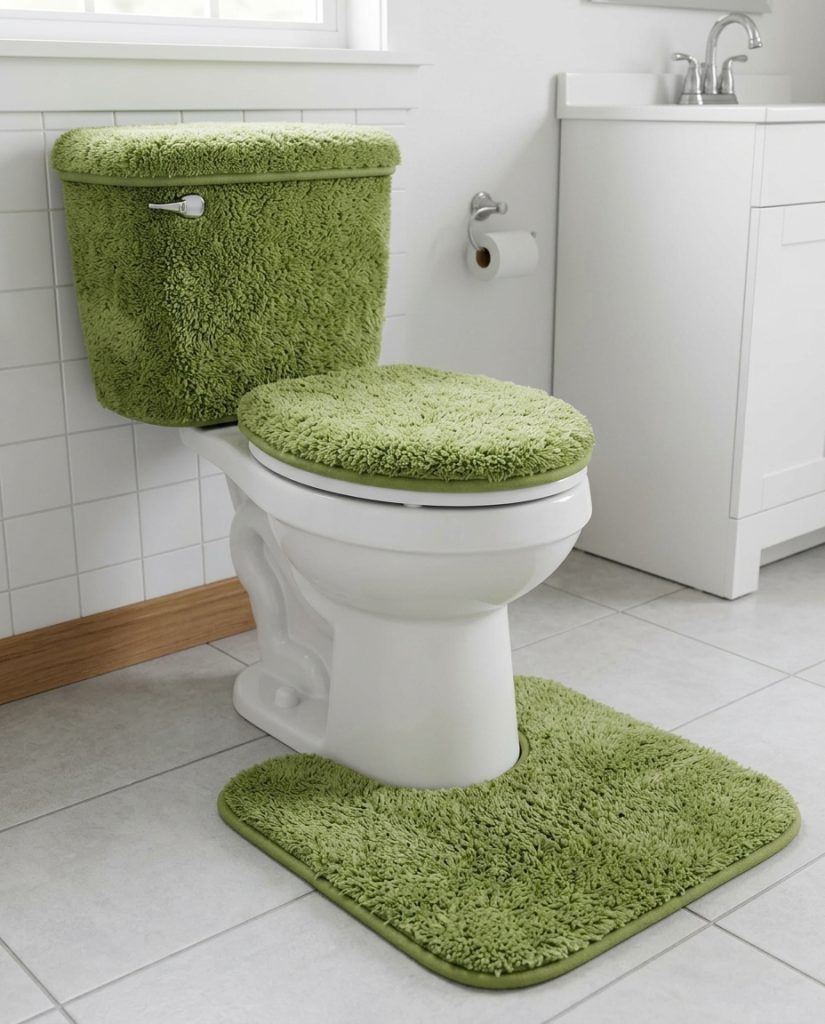
There was a fuzzy lid cover, a fuzzy cozy stretched over the tank, and a contour rug that hugged the base, and they all matched because they came together.
My mother bought the whole three piece set in a clear plastic zip bag at Sears, in rust or avocado or powder blue or that specific pink, and the entire bathroom came into agreement in one purchase. The lid cover had a quilted diamond pattern with piped edges that felt oddly like the bench seat of a Buick.
People had reasons, sort of. The cover gave you a washable surface over the part of the toilet everyone worried about, and it added comfort and a little decoration to a room that was otherwise hard and shiny.
The contour rug, meanwhile, did the real work, soaking up every splash like a sponge that never quite dried. We thought we were being clean. We were, in fact, building a tiny humid ecosystem around the base of the toilet and tucking a soft blanket over the lid.
YOU’LL ALSO LOVE25 Things About Your Home That Visitors Notice in the First 10 Seconds (But Never Tell You)
It was sweet. It was also a lot.
But the fuzz was only half of what was underfoot.
You Had A Whole Family Of Matching Bath Mats
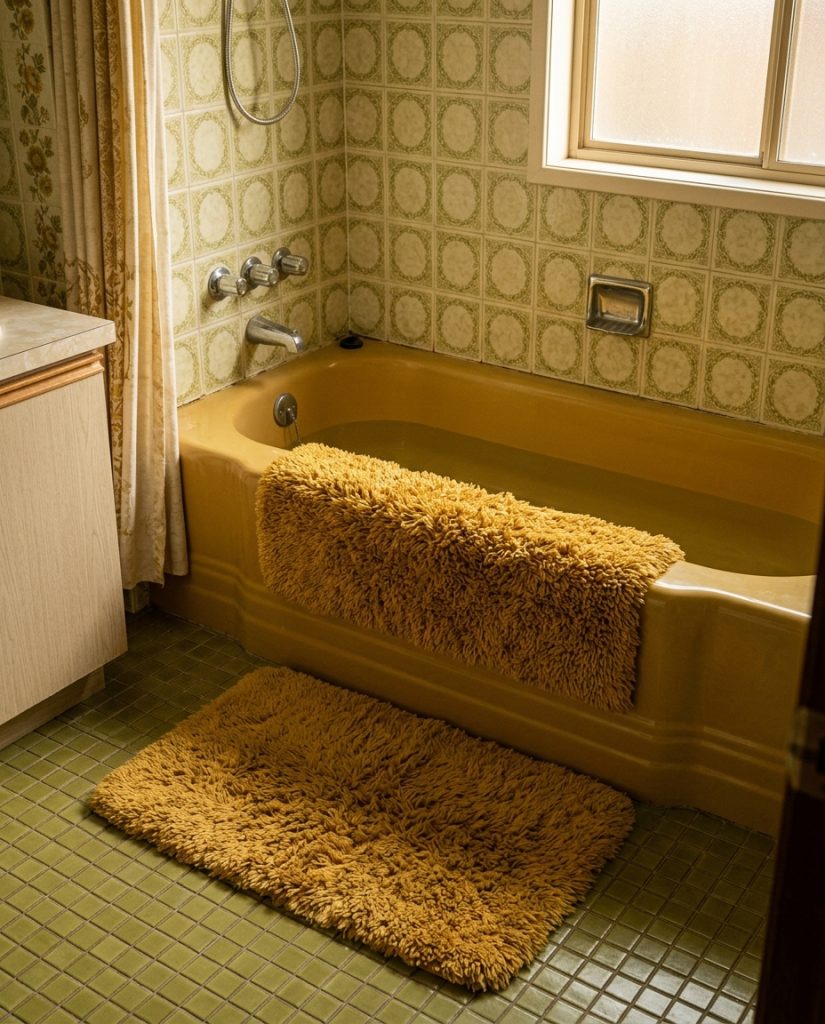
If the contour rug at the toilet was the headliner, the shag bath mats were the supporting cast, and we had a whole troupe of them.
One sprawled in front of the tub, a smaller one parked at the sink, sometimes a third stationed at the door, all in the same fat pile in the same warm color. Stepping out of a hot bath onto two inches of dense shag was genuinely wonderful, a small daily luxury that cost almost nothing and felt like everything.
The trouble was drying time. Pile that thick, in a room full of steam, held moisture for hours, so the mat I stepped on at night was often still faintly damp the next morning.
We shook them out, we hung them over the tub edge, we rotated them like crops. We did not mind. The softness was worth the ritual, and there is a part of every one of us that still misses landing on something warm instead of a cold hard floor.
Your Walls Were Mirrors With Little Gold Veins
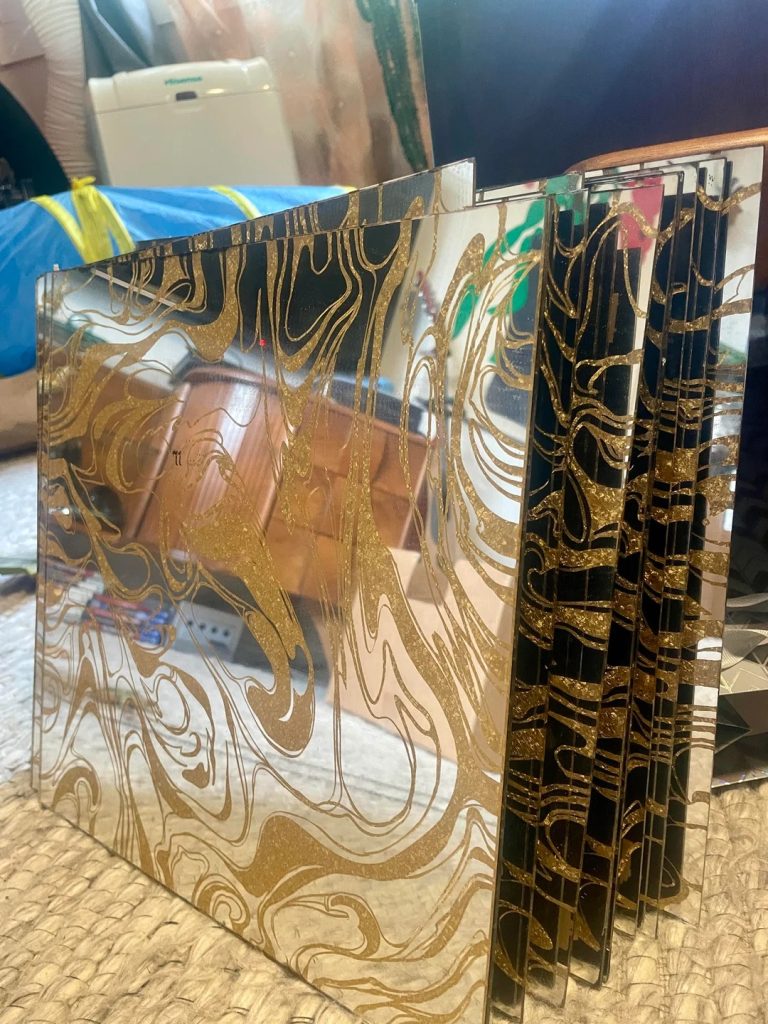
Somewhere around the middle of the decade, people started gluing mirrors to the walls, and not plain ones.
These came as square tiles shot through with gold veining, antiqued so the reflection looked faintly amber, and you covered an entire wall behind the vanity with them. The gold veined look had actually peaked a little earlier, around 1966 and 1967, then rode straight into the seventies and landed in bathrooms everywhere. A whole wall of them caught the light and threw it around, and for a moment the room shimmered.
The promise was space. Mirrors double a room, so a wall of mirror should make a small bathroom feel grand.
The reality was that they also doubled everything else, every toothbrush, every water spot, every bottle crowded on the counter, reflected back at you in soft gold. And taking them down later was its own saga, because the mastic adhesive behind each tile gripped the drywall like it had a grudge.
They were dazzling and impractical in equal measure, which honestly describes most of this list.
Speaking of impractical, the tub deserves its own moment.
The Sunken Tub You Stepped Down Into
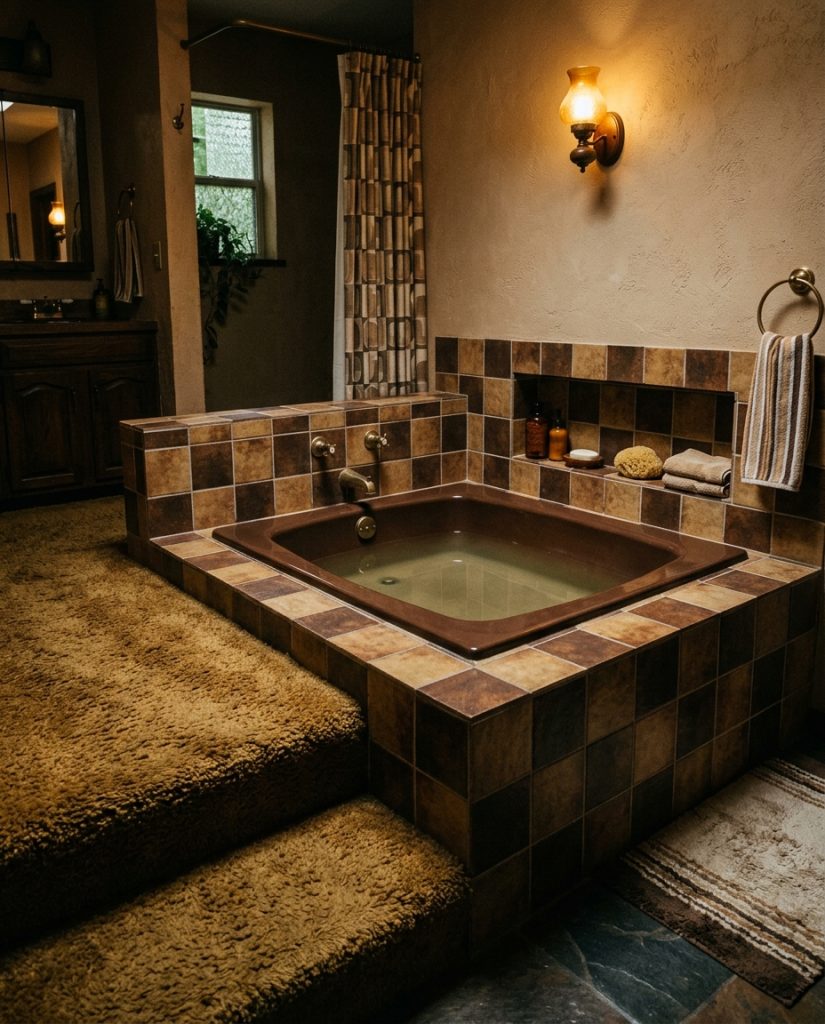
The sunken tub was the showstopper, the feature my aunt mentioned to guests before they even asked.
Steps into hot water, surrounded by tile in chocolate brown or burnt sienna or tan, with a little built in ledge for a candle and a bottle of something. It borrowed its whole personality from the conversation pit in the living room, that same seventies instinct to sink the floor and make a cozy hollow you settled into. Lowering yourself in felt like descending into a private spa, and honestly, few modern tubs have ever matched that feeling.
The catch arrived with age, both the tub’s and yours. A hole in the floor full of water is a wonderful place to soak and a genuinely tricky place to climb out of, especially on wet tile with nothing to grab.
By the 1990s sunken tubs had fallen out of favor, pushed aside partly by accessibility worries and partly by building codes that frowned on a sudden drop in the bathroom floor. The dream of stepping down into warm water gave way to the practical wisdom of not stepping down at all.
We understand why. We still kind of want one.
A Folding Plastic Door Clattered Across The Tub
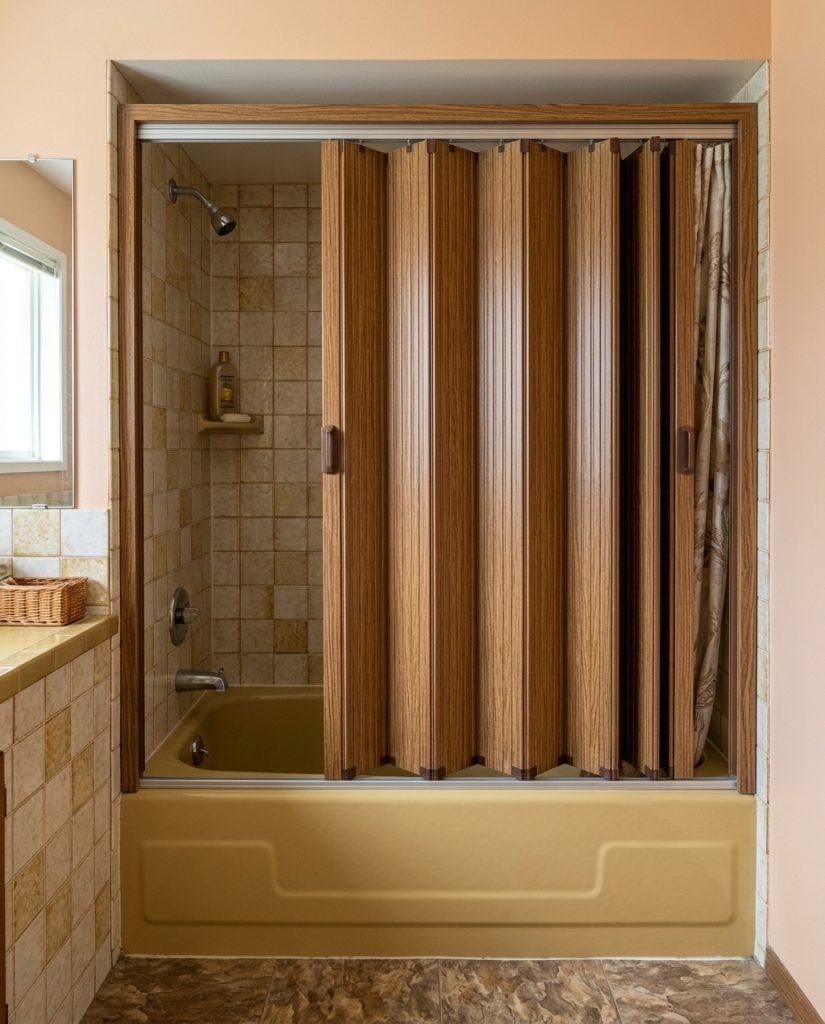
Before everyone had a heavy glass slab, a lot of tubs were guarded by a folding plastic door, the accordion kind that pleated open and closed on a track.
Ours was a cloudy ribbed vinyl, and plenty of others wore a faux woodgrain print to match the paneling elsewhere, and all of them announced your every move with a soft clatter as they folded. I pushed it aside, climbed in, and dragged it back across, and it sort of sealed and sort of did not.
That was the deal you made. The folding door was light, cheap, and it kept most of the water in most of the time, which in 1974 was plenty.
Water still found the gaps and crept onto the floor, which, you will recall, was carpeted, so the two worst ideas in the bathroom worked together as a team. The panels yellowed, the track collected grime in its little grooves, and the whole thing developed a personality.
We replaced them the first chance we got. Part of me misses the clatter.
Macrame Dangled In The Corner Dripping Slightly
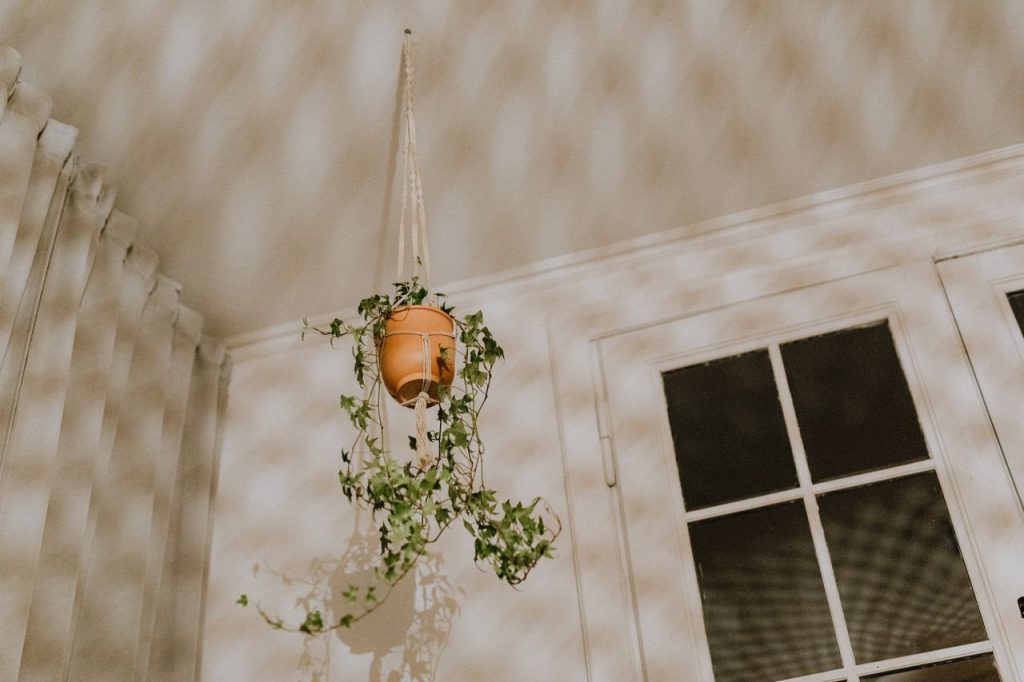
No seventies bathroom was complete without something knotted hanging from a brass ceiling hook.
Macrame was everywhere that decade, a riot of jute cords tied into elaborate hangers, sometimes with wooden beads, sometimes shaped into an owl staring down from the wall. In our bathroom it cradled a glazed ceramic pot, and the steam from the shower became the plant’s own little tropical climate, leaves trailing down beside the mirror.
Here is the quiet rule of bathroom plants that every household learned the hard way. Spider plants loved it, soaking up the humidity and throwing out babies on long stems. Ferns died, every single time, no exceptions, no middle ground.
YOU’LL ALSO LOVE30 Things in the 1970s Living Room That Would Confuse Anyone Under 30
So the corner either flourished into a small jungle or staged a slow green funeral, depending entirely on what you hung up there. The hanger itself, knotted by hand at somebody’s kitchen table, was half the point.
It was warm and homemade and a little bit damp, and it is the thing on this list that people remember most fondly.
That fondness does not extend to the next corner of the room.
A Scale Sat In The Corner Judging Everyone
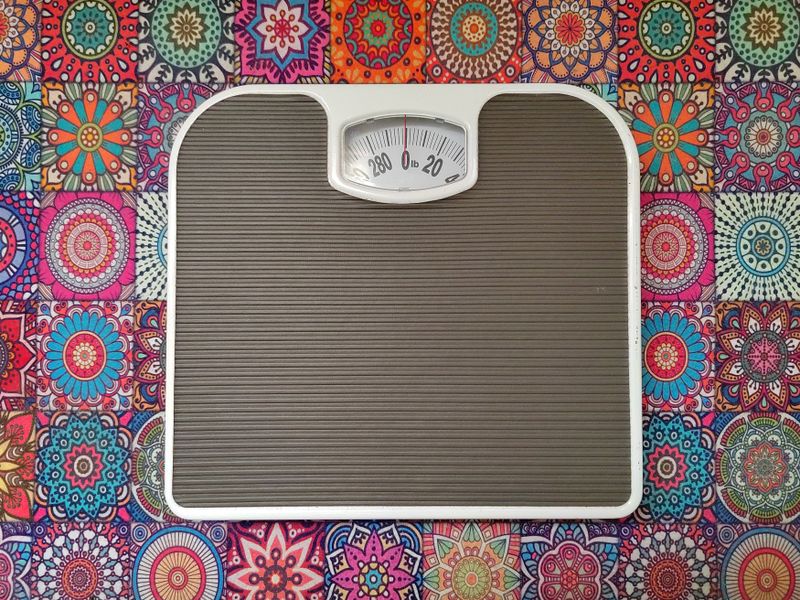
Tucked in the corner, usually in harvest gold or that same avocado, sat the scale, a heavy little disc with a big round dial and a needle that swung when you stepped on.
There were no batteries, no glowing numbers, just a spinning wheel behind a window and a verdict delivered in the morning light. It was a fixture in the way the toilet was a fixture, a permanent resident everyone pretended not to consult.
This was peak scale, genuinely.
By the early 1970s Americans were buying more than six million bathroom scales a year, a number so large the market simply ran out of new people to sell to and hit zero growth by the end of the decade.
The dial design itself went all the way back to 1917, when the first one sold for seven dollars and fifty cents, and by the seventies that round face was a standard part of the morning. It judged us in gold tone enamel, day after day, and we kept it anyway.
Some things never change, only the color does.
Round Bulbs Glowed In A Strip Over The Mirror
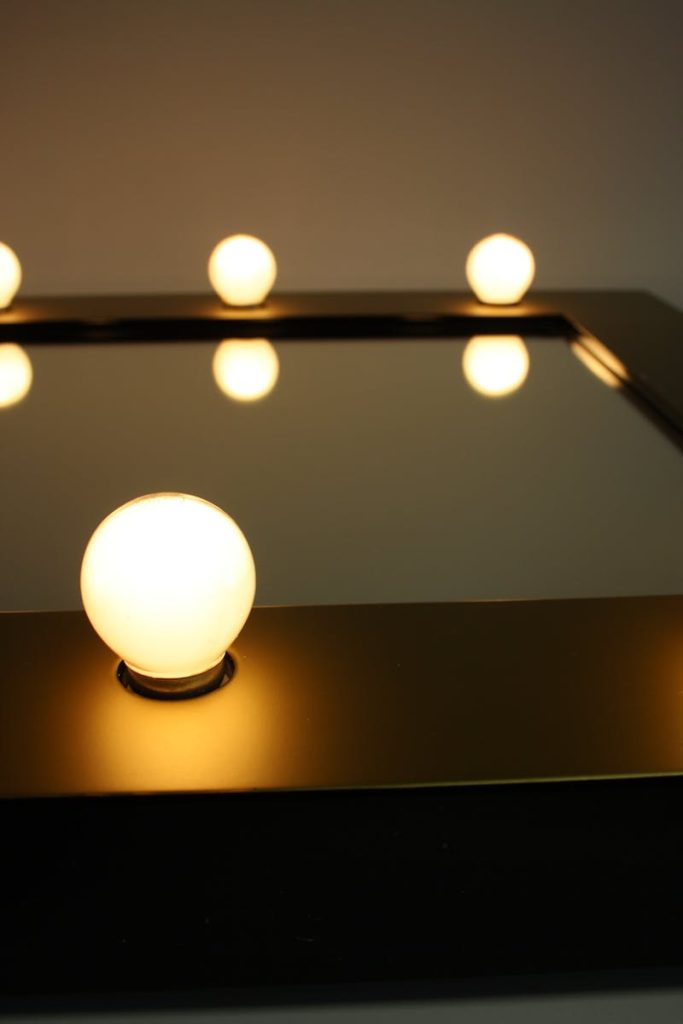
Above the mirror ran a strip of glowing globes, frosted orbs about the size of softballs, mounted on a band of brass or chrome that stretched the width of the vanity.
Ours had four bulbs, the ambitious ones had eight, and when you flipped the switch the whole row warmed up and surrounded your reflection in light. The look came straight from theatrical makeup mirrors, the kind in a dressing room backstage, and it landed in home bathrooms through catalogs like Sears and Montgomery Ward starting around 1968.
The feeling was the whole appeal. Standing there in a cone of warm globe light, I felt a little like a performer getting ready for a show, and the bathroom briefly became glamorous.
The bulbs threw real heat, they burned out one at a time so the row always had a gap waiting to be fixed, and the energy bill said hello. None of that mattered.
There is something about a row of round lights over a mirror that still says getting ready, still says occasion, and it remains one of the few things on this list that quietly came back.
Your Countertop Pretended To Be Marble With Gold Flecks
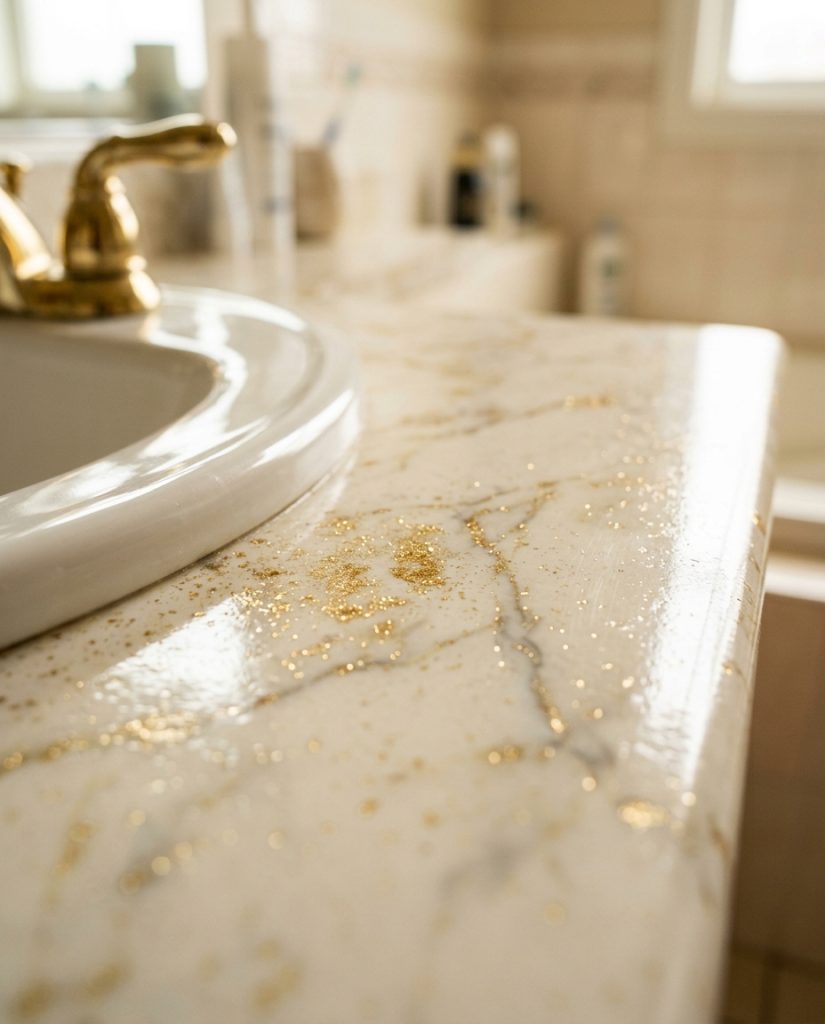
The counter looked, from a distance and in the right light, like marble.
Up close it was laminate, a cream surface with swirling fake veins and, the signature touch, tiny gold metallic flecks suspended in the finish that caught the light and sparkled. Formica had introduced marble look patterns back in the early 1960s, but the gold fleck versions surged in the seventies, when a little sparkle was exactly what everyone wanted on a bathroom counter.
It was, in its own way, democratic. Real stone was for people with real money, and this gave everyone else the glitter and the swirl for the price of a sheet of laminate.
The illusion only broke at the edges, where a thin brown seam line revealed the truth of the material underneath, and at the corners, where the same veining pattern repeated a little too neatly. We did not look that closely. We had a sparkly marble counter and we were thrilled, and the gold flecks twinkling under the globe lights felt like the future had arrived.
The future, it turned out, was tinted brown.
Smoked Bronze Glass Hid The Whole Shower
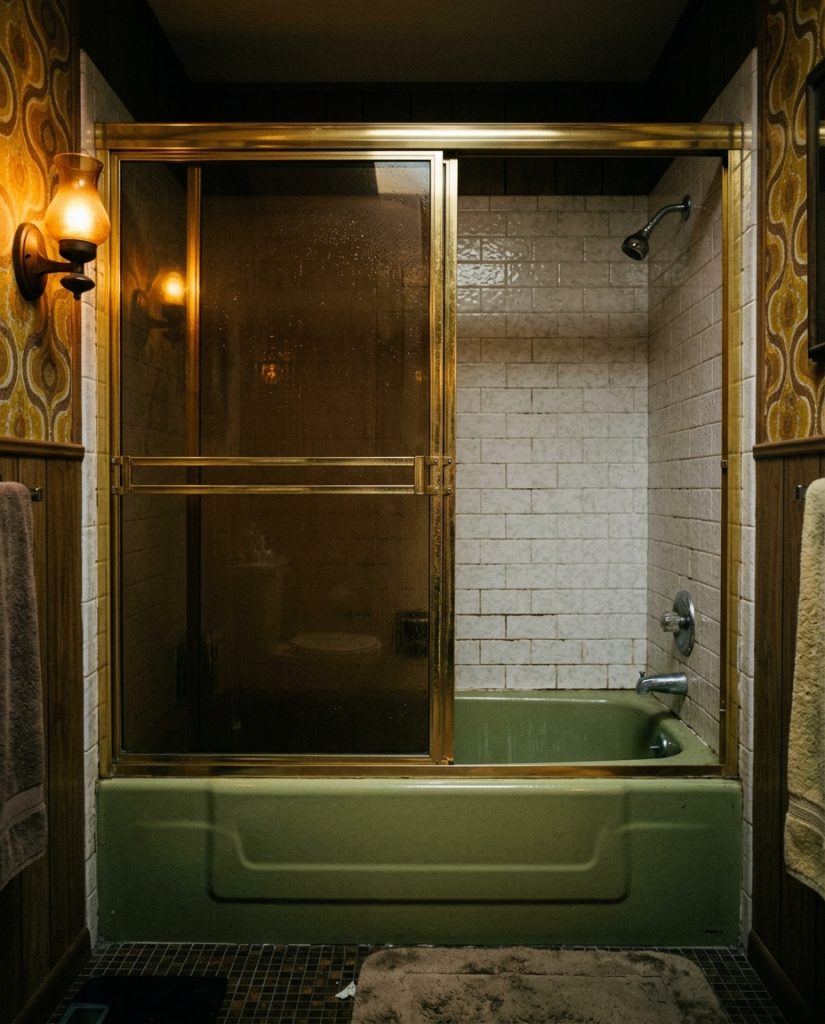
When the folding plastic door finally gave way to glass, the glass was rarely clear.
The sophisticated upgrade was smoked glass, a thick panel tinted bronze or gray, framed in gold or chrome and sliding on a track. Step behind it and the whole world went sepia, your shampoo bottles and the tile and your own hand all softened into a warm brown haze. After years of crinkly plastic, a solid tinted panel felt like a genuine step up in the world.
The tint was the point and also the problem. It hid the inside of the shower from view, which felt tidy and private, but it also dimmed the light in there to a permanent dusk, so you showered in a bronze twilight whether it was noon or midnight.
The metal track collected mineral deposits in its channel and the gold frame eventually showed its chrome underneath. Still, there was a weight to those doors, a seriousness, and sliding one closed felt like the bathroom had grown up a little.
We traded sepia for clear eventually. The bronze had a certain mood.
A Heat Lamp In The Ceiling Cooked You Pink
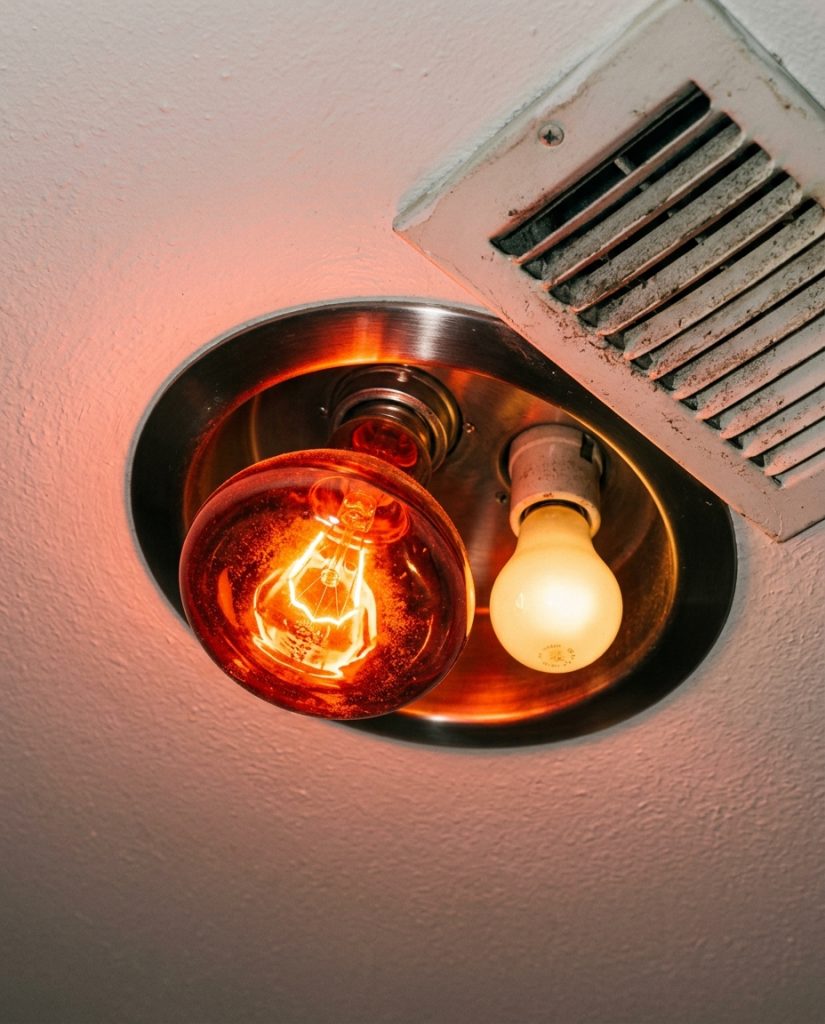
High in the ceiling, often tucked into the same housing as the fan and a regular bulb, lurked a heat lamp, a red tinted bulb that poured infrared warmth straight down onto whoever stood beneath it.
YOU’LL ALSO LOVE11 Neighborhood Rules Every Kid Knew in the ’80s That No Parent Would Allow Today
On a freezing morning I flipped the switch, the ceiling glowed a soft red, and a warm cone settled over my shoulders as I stepped dripping out of the tub. It was, on a cold day, pure genius, and stepping into that warmth is a sensation a lot of us would happily relive.
The execution had its quirks. The heat lamp usually shared a row of nearly identical switches with the fan and the light, so getting the right combination on the first try was a small daily gamble, and you spent a moment squinting at the switches like a safecracker.
The red glow gave the whole room a faintly theatrical tint, and standing under it too long left the top of your head toasty and the rest of you still cold. But on a January morning, that red bulb was the most welcome thing in the house, and the memory of it still feels warm.
Bold Floral Wallpaper Covered The Walls
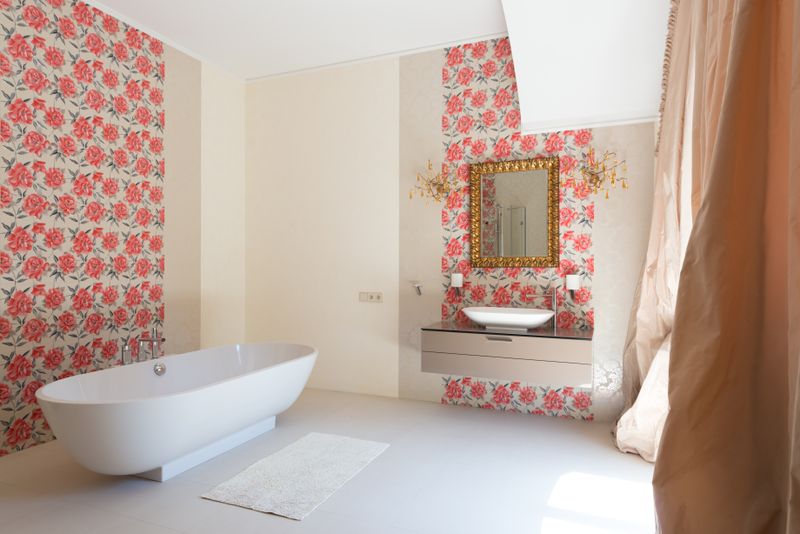
The powder room, that little half bath off the hall, was where the seventies let its hair all the way down.
The walls disappeared under wallpaper, and not subtle wallpaper, dense fields of enormous blooms, cabbage roses and tropical flowers in pink and coral and gold, climbing every surface from floor to ceiling. Step into a tiny powder room papered like that and you felt like you had climbed inside a flowered gift box, surrounded on every side by petals.
There was a real charm to the boldness. A small room is the one place you can get away with a pattern that loud, because you are only ever in it for a minute, and the seventies understood that completely and committed without flinching.
Over the years the seams began to lift near the ceiling and the paste yellowed along the edges, and the once vivid flowers faded at different rates above and below the towel bar. But for a good long while, that little room was the most daring square footage in the house, and stepping into all those flowers still feels like a hug.
Even The Toilet Seat Was Made Of Wood
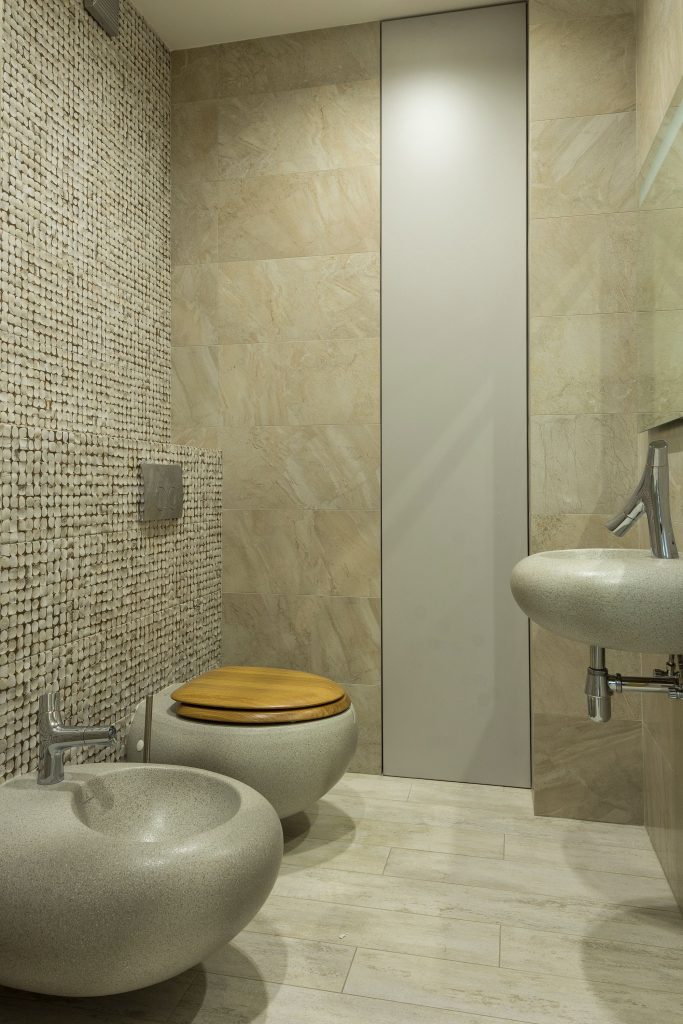
Of all the things to make out of wood, the seventies chose the toilet seat, and chose it proudly.
Oak or walnut, lacquered to a deep shine, with brass hinges that gleamed and caught the light like a piece of jewelry. It was meant to read as a touch of class, a little warmth and craftsmanship in a room full of cold porcelain, and against an avocado toilet a glossy wood seat genuinely looked like an upgrade. Somebody decided the bathroom needed furniture, and this was it.
Wood, of course, has opinions about a bathroom. The lacquer crackled over the years into a fine web of lines, the seat ran cold in winter and warmer in summer in a way plastic never did, and the brass hinges slowly loosened until the whole thing drifted a few degrees off center and clacked when you sat.
You tightened it, it loosened again, and the two of you reached an understanding. It was heavier and handsomer than anything we use now, a small piece of woodworking where you least expected it, and there is something almost touching about how seriously it took itself.
Fake Wood Paneling Wrapped The Walls
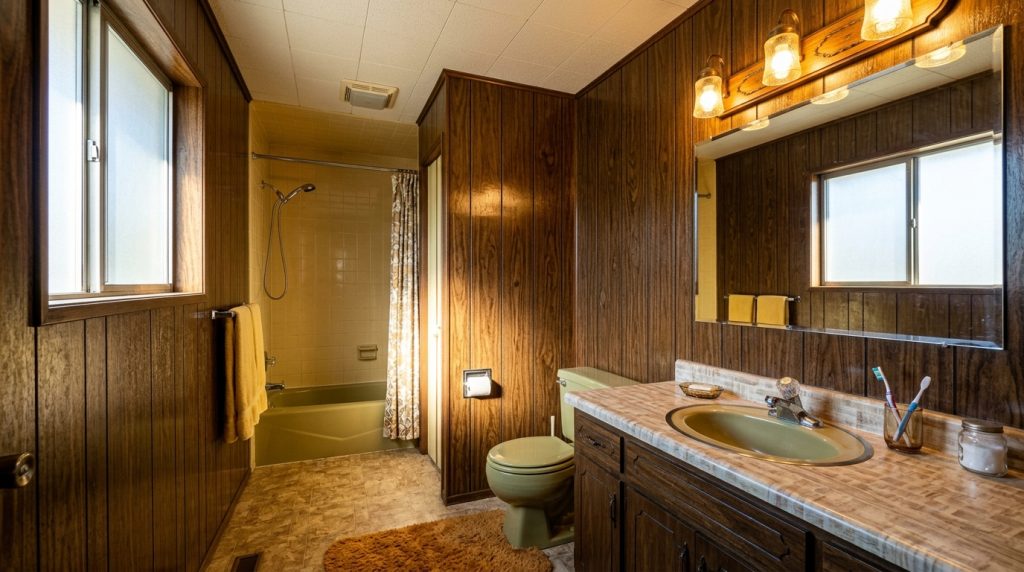
The paneling did not stop at the family room. It marched right down the hall and climbed the bathroom walls too, dark sheets of printed woodgrain with thin grooves cut every few inches to mimic real planks.
One brand ruled that wall, a baked finish hardboard built to shrug off moisture and steam, which is exactly why it ended up in the wettest room in the house. It went up fast, it hid a multitude of sins, and it made the whole room feel like a cozy little lodge.
The look held on a long time, stretching from the postwar boom all the way into the early 1980s before anyone admitted it had overstayed.
Up close the illusion thinned out, the same knot repeating down the wall a little too often, the grain a touch too perfect to be a tree. Behind it the real wall did whatever it wanted, and steam found the seams the way it always does.
We thought it looked rich. It looked like a station wagon.
Your Medicine Cabinet Was Heavy Enough To Hurt
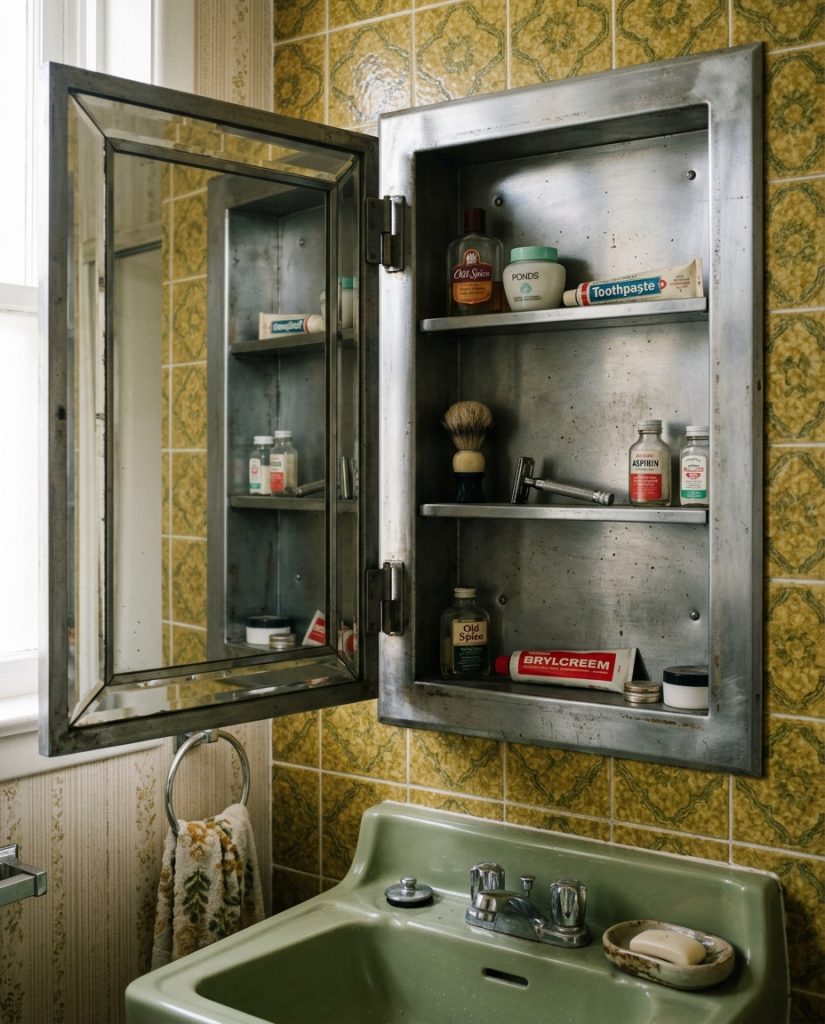
The medicine cabinet of that era was not the flimsy plastic box we buy today. It was steel, recessed deep into the wall between the studs, with a mirrored door that swung on a real hinge and shut with a solid metal clack.
Those old cabinets were genuinely heavy, made by the same handful of companies for decades, and a lot of them had a mirror on the front and a second little sliding cosmetic door tucked below for lipstick and pills. The shelves were steel too, painted white, and they rusted at the corners where the toothbrush dripped.
I opened ours a hundred times a day without thinking, the mirror catching my half awake face every morning.
The hinge eventually loosened so the door drifted open on its own, and the steel edge inside was sharp enough to catch a knuckle if you reached in fast. We kept it for thirty years anyway, because it was bolted into the wall and nobody was about to wrestle it out.
It outlasted three coats of paint and two of us.
Two Handles Meant You Mixed Your Own Warm Water
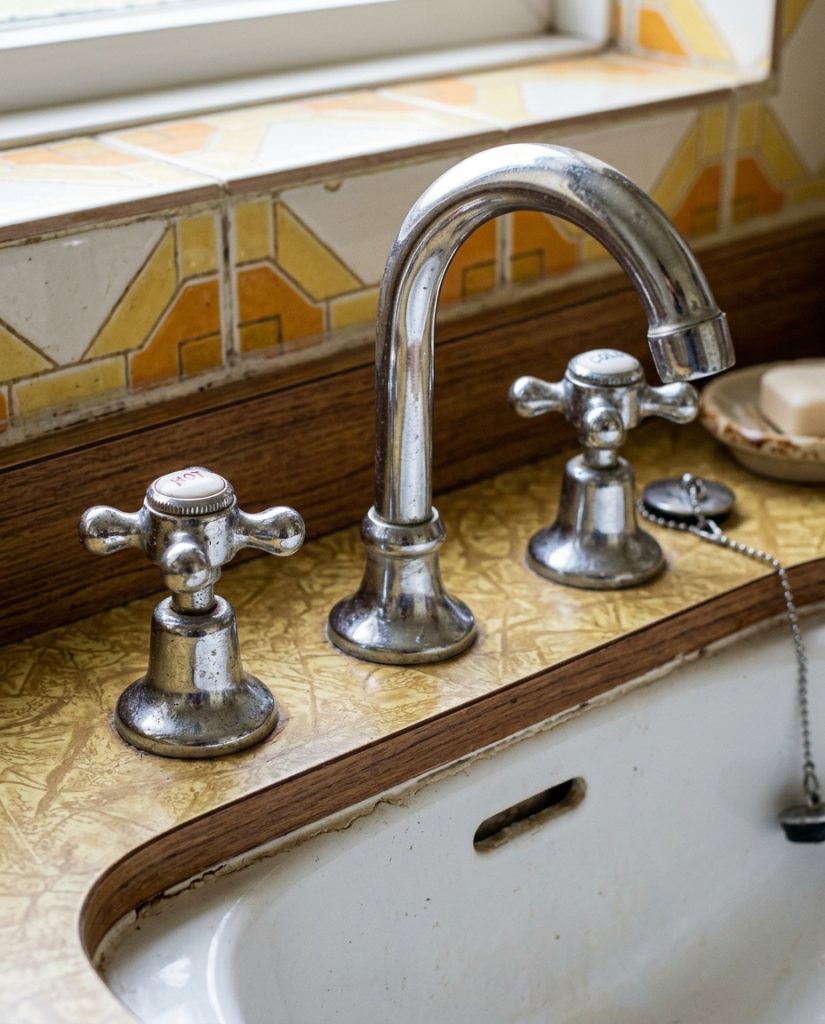
Warm water was not a setting you selected. It was a result you negotiated, every single time, with two separate handles that lived a good eight inches apart on the deck of the sink.
One handle ran scalding and one ran freezing, the spout poured them out separately, and you cupped your hands under the stream to blend them into something you could actually stand. Turn the hot a little, add a touch of cold, test it, adjust, and by then the soap was already dripping off your wrists.
These widespread sets needed three drilled holes and gave the sink a spread out, tailored look that people thought was elegant.
The single lever faucet that swiveled to any temperature with one nudge was already out there, slowly winning, and once you tried one you understood. The two handle ritual was a small daily arithmetic problem nobody missed once it was gone.
YOU’LL ALSO LOVE25 ‘Common Sense’ Home Rules Everyone Followed in the 80s That Would Get You Laughed At Today
Still, you got good at it. My hands just knew.
Little Rubber Flowers Gripped The Floor Of The Tub
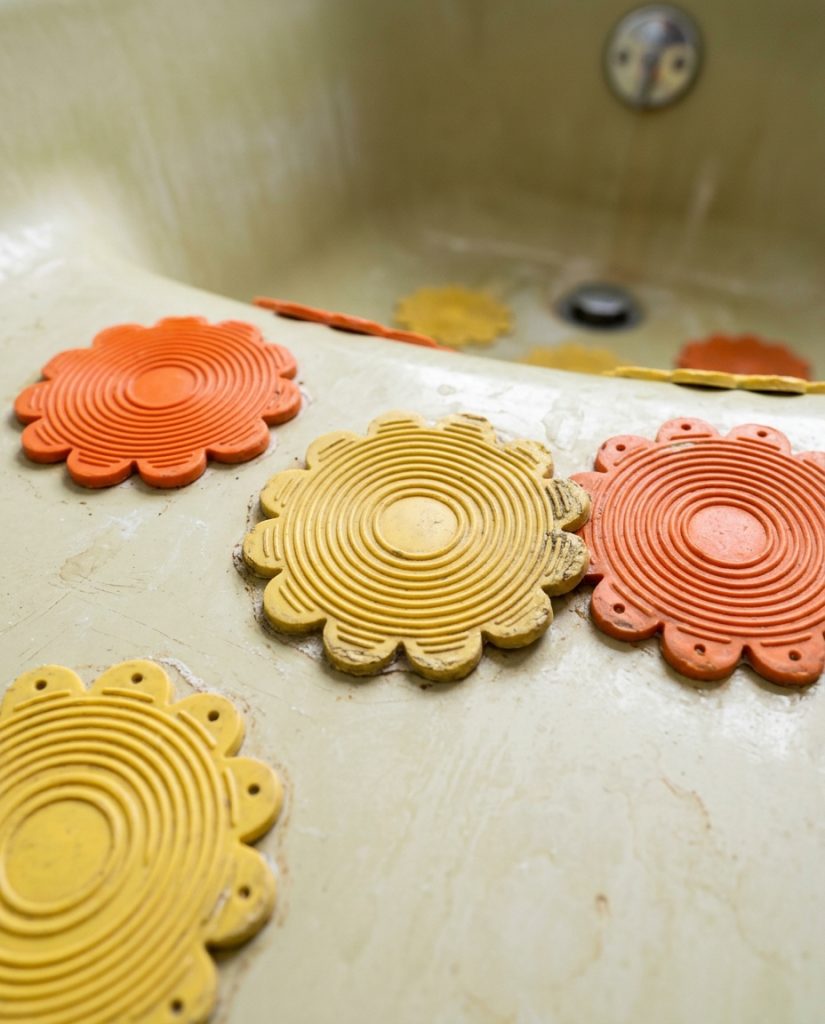
Down in the bottom of the tub bloomed a little garden, five or six rubber flowers stuck to the porcelain in a loose scatter, each one ridged on top to grip your wet feet and keep a kid from going down hard.
These daisy shaped decals showed up everywhere in the late sixties and early seventies, sold in bright bags in pink and orange and yellow, and my mother pressed them onto the tub floor where they promised safety and delivered it, mostly. They were cheerful and practical at the same time, which felt very modern.
The trouble lived underneath. The adhesive ring trapped water against the porcelain, and over the months a dark shadow crept out from the edge of every flower.
Peeling one off years later revealed a perfect daisy silhouette stained into the tub, a ghost flower that no amount of scrubbing would lift. We bought them to be safe and clean, and they left a permanent flower bed behind.
The shapes changed. The shadow never did.
A Soap Dish Sat Sunk Into The Tile Wall
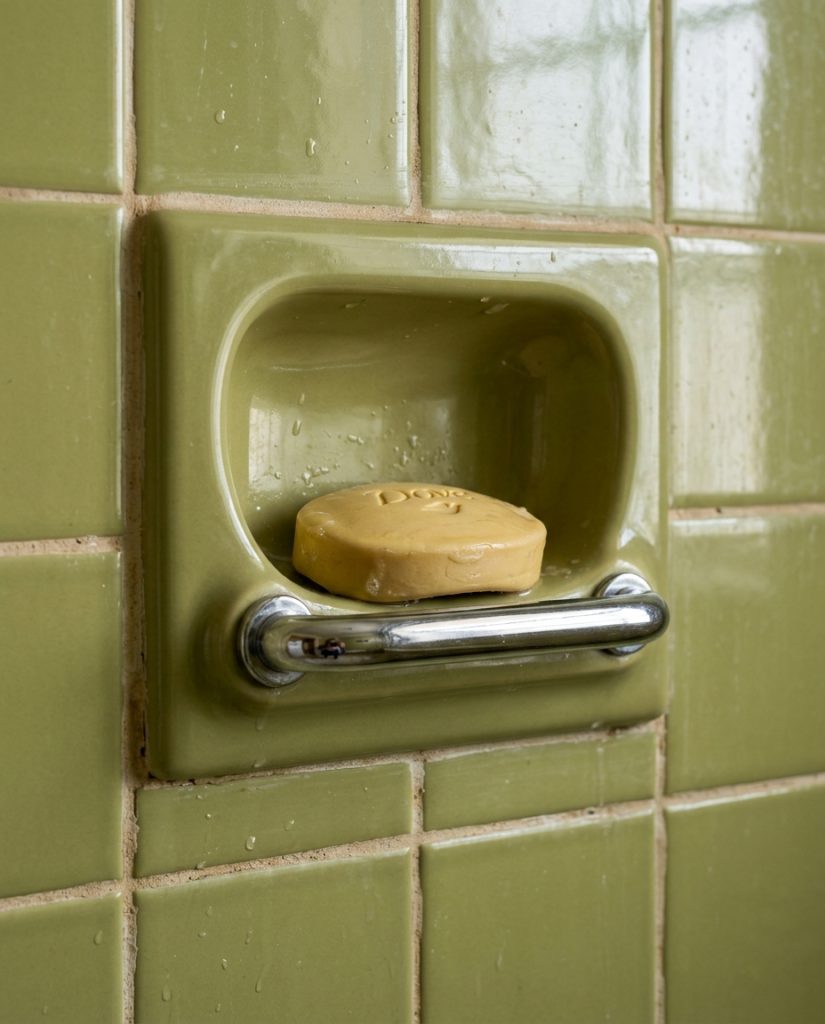
The soap did not sit on a dish you could move. It sat in a dish that was part of the wall, a glazed ceramic basin mortared right into the tile, color matched to the tub so it disappeared into the surround like it had grown there.
Most of these built in dishes came with a small bar across the front, a little ceramic loop molded right in, and everyone called it a soap grip while quietly using it to haul themselves upright in a slick tub. It was a grab bar that nobody would admit was a grab bar, because admitting it meant admitting the tub was dangerous.
These tile in fixtures came in dozens of colors, mud set into the wall during construction, meant to outlast the house.
Would you like to save this?
The catch was permanence. The ceramic loop cracked if you actually trusted your full weight to it, and a broken one meant tearing into the tile to fix it. The recess collected a gray sludge of soap scum in its corners that resisted every cleaner made.
It was built to last forever. It mostly did.
Ruffles Spilled Down A Priscilla Shower Curtain
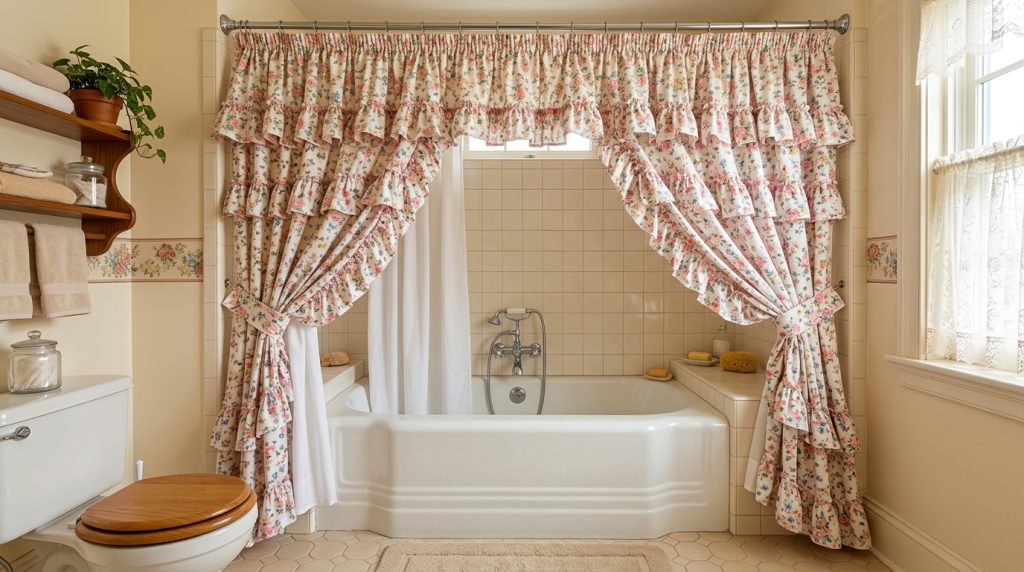
Somebody looked at the bedroom window with its frilly curtains and decided the bathtub deserved the same treatment. So the shower curtain grew a personality, a gathered valance ruffling across the top and the whole thing pulled back at the sides with little fabric ties.
This was the Priscilla look brought to the tub, all flounce and floral print, a frothy cascade of fabric that framed the bath like it was a four poster bed. There was usually a clear plastic liner hiding behind the pretty part, doing the actual waterproofing while the ruffles took the credit.
The fabric was nylon or a soft poly blend, in cabbage roses or tiny sprigged flowers, and it puffed out from the rod in layers.
The damp was the problem, as it always was in that room. The bottom hem of all that fabric wicked up bathwater and never fully dried, the ruffles drooped, and the floral print spotted with mildew along the folds. We thought a bath needed dressing up. We dressed it in something that could not handle a bath.
It was beautiful for exactly one season.
Everything On The Counter Matched In Glazed Ceramic
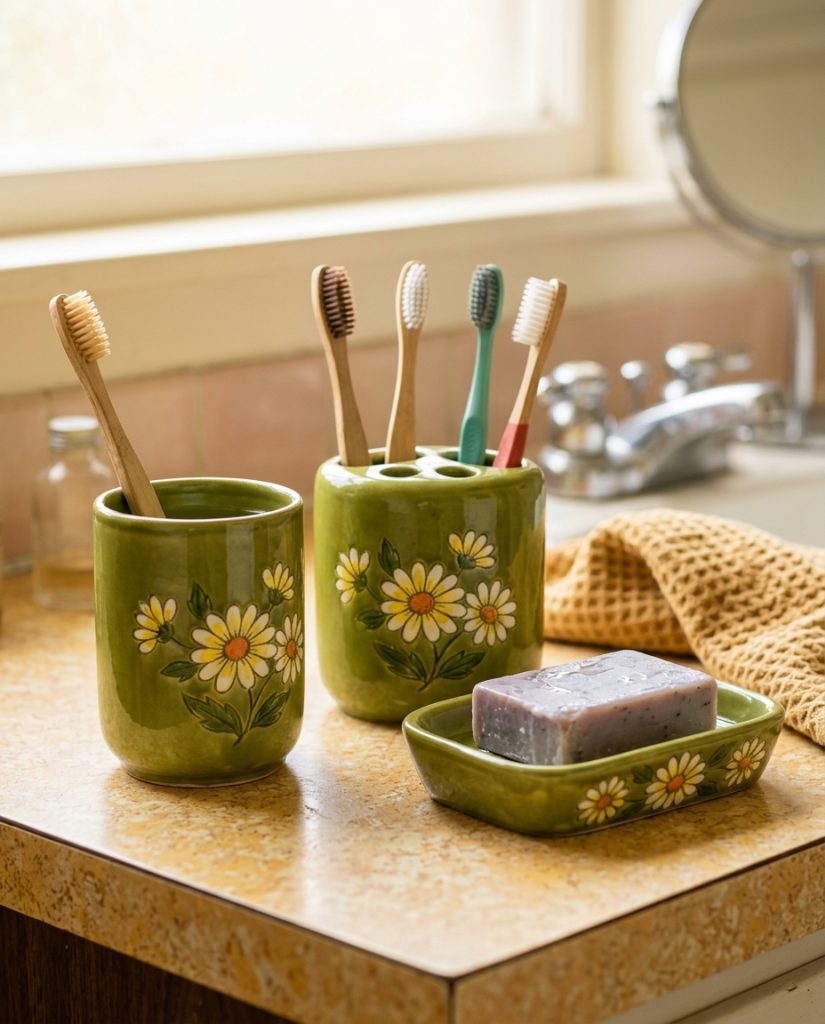
The counter did not hold a random collection of containers. It held a coordinated team, a tumbler and a soap dish and a toothbrush holder that all matched in the same glaze, usually avocado or harvest gold, often with a little daisy or mushroom painted on the side.
You bought the set as a group, boxed together, and it turned the vanity into a tiny showroom of matching ceramic, the toothbrush holder with its four little holes lined up like soldiers and the tumbler you rinsed and spat into every night. There was usually a fourth piece, a covered dish for cotton balls, that half the households skipped. Mine did.
The avocado motif became the signature of the whole decade, the color a kind of badge.
The pieces were heavy and chipped at the rim, the toothbrush holes grew a crust at the bottom that you tried very hard not to think about, and the tumbler always smelled faintly of toothpaste no matter how you washed it. We loved the matching look. The holes haunt me still.
One chipped, and the spell was broken.
Paper Cups Pulled One By One From A Wall Box
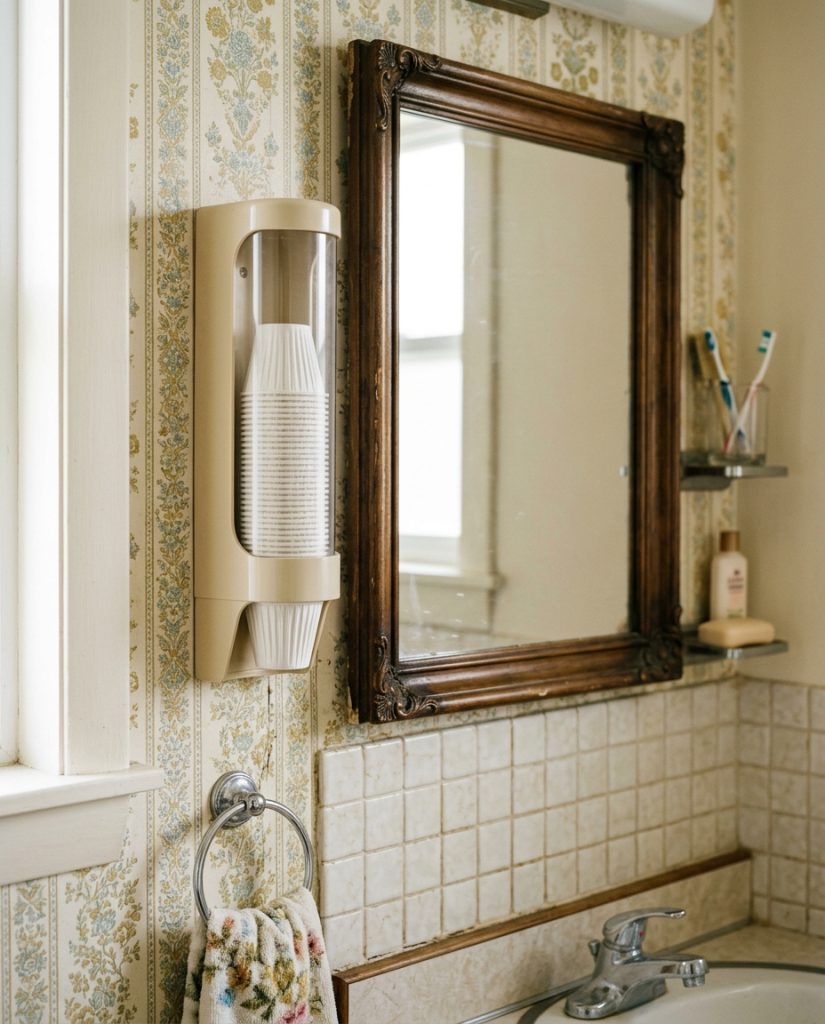
Mounted on the wall by the sink hung a little dispenser, and from the bottom of it you pulled one small pleated paper cup at a time, the kind that held about three swallows of water and collapsed if you squeezed too hard.
The whole point was germs, believe it or not, because the dispenser was sold as the hygienic answer to the shared family drinking glass that sat by the sink growing science. One cup each, used once, tossed out, and nobody passed anything to anybody. My parents loved that the kids could reach it and help themselves.
The cups came in stacks of a hundred and fifty, in waxy white or printed with little flowers, and the dispenser ran dry at the worst moments.
The math was rough on the planet and the wallet, a paper cup for every sip, a small mountain of them in the wastebasket by Sunday. The little waxed cups also went soft if you dawdled, dribbling down your chin. We thought we were being so modern and clean. We were making a lot of trash to avoid one shared glass.
Refilling it was somehow always somebody else’s job.
Tiny Embroidered Towels Hung There For Looks Alone
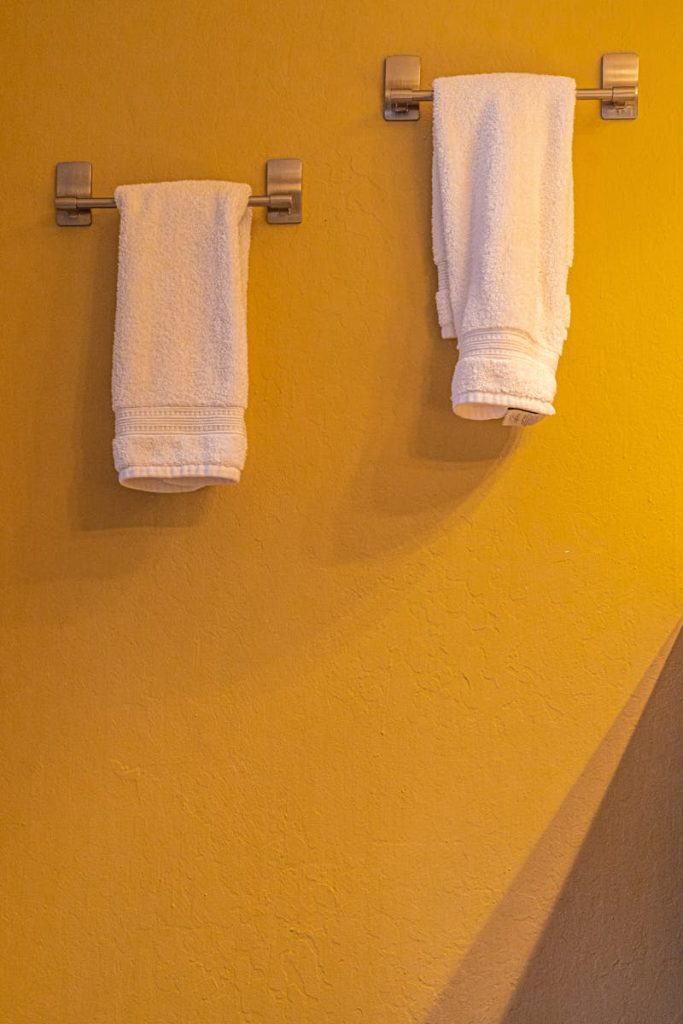
By the sink hung the prettiest towels in the house, small ones, fringed and embroidered with flowers or a monogram, folded into perfect thirds and arranged just so. And you were absolutely not allowed to use them.
These were the guest towels, a category of object that existed purely to be looked at, a holdover ritual where the nice linens came out for company and the family dried its hands on whatever else was around. Use one by accident and you heard about it, because now the display was ruined and a real towel had to take its place.
The seventies flooded the market with them in avocado and gold and orange, fringed and trimmed and frankly a little useless.
The whole thing was a gentle social fiction, towels that worked perfectly well held hostage for visitors who often did not use them either, too polite to disturb the arrangement. So everyone air dried or wiped their hands on their jeans, and the pretty towels hung there, eternally clean. We kept up the performance for years.
Nobody ever actually dried a hand on one.
Soaps Shaped Like Petit Fours Were Never For Washing
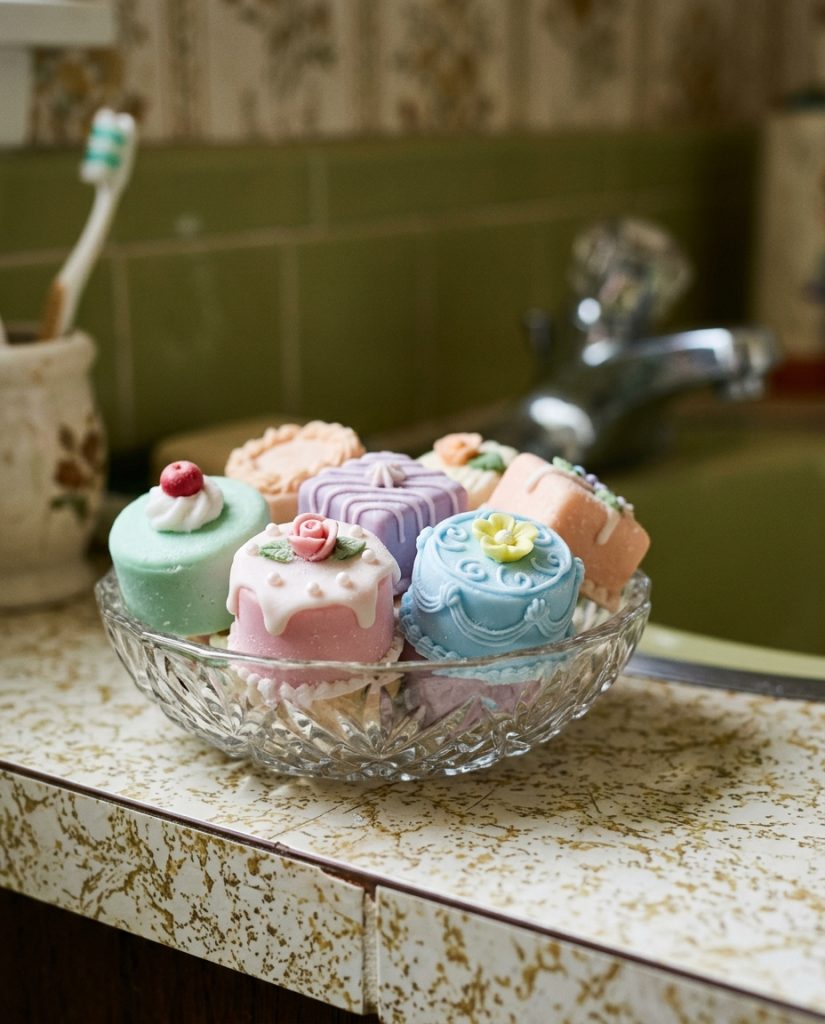
In a little dish on the back of the toilet sat what looked like a plate of tiny cakes, pastel soaps molded into petit fours and shells and flowers, eight little jewels lined up and perfuming the whole room.
You were not supposed to use these either, of course, because they belonged to the same museum as the guest towels, decorative soap that sat untouched for years slowly hardening into scented stone. One famous maker sold them by the boxful, and a set could outlast a presidency without ever once meeting water.
They scented the air with something floral and powdery, a smell that meant company was coming or a grandmother lived here.
The cruelty was the temptation, soaps shaped like candy that a child desperately wanted to touch and a guest felt too guilty to lather. So they sat and faded, the pastel colors going chalky, the carved edges softening with dust, pure decoration in a room built for function. We bought soap we forbade ourselves to use.
That powdery smell still means somebody’s good bathroom.
Dad Got A Bar Of Soap On A Rope Every June
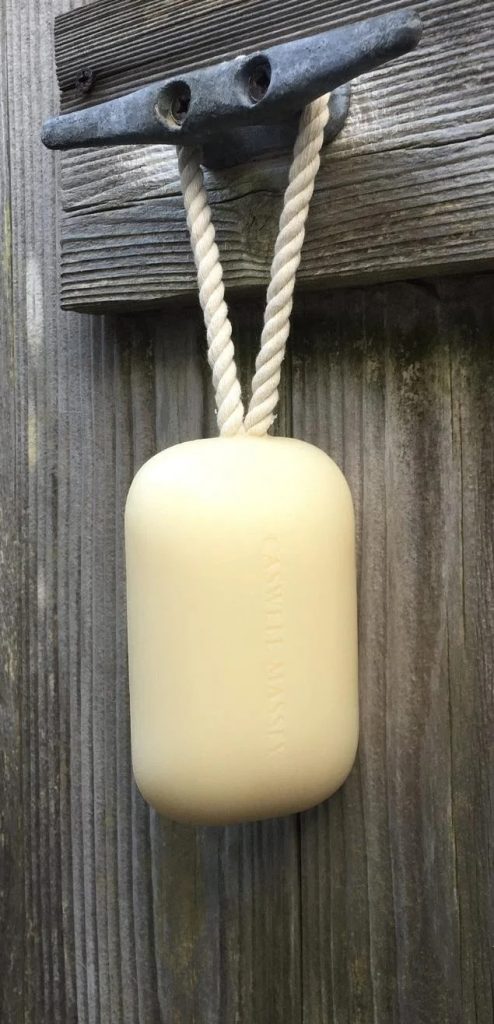
Hanging from the shower head or a hook was a bar of soap on a loop of rope, a chunky oval with a cord baked right through it so you could hang it up or, the original idea, wear it around your neck so it never hit the floor.
This was the gift my dad got when no one had a better idea, a Father’s Day standby that one company turned into a whole empire, offering more than a dozen shapes and scents molded around a rope. It was cheap, it was guaranteed to get used, and a kid could afford it with allowance money.
The concept went back decades, born from the simple wish to keep a bar from dissolving into mush in the bottom of the wash water.
The rope itself got slimy and gray over time, soaking up soap and never drying, and the bar wore down to a thin sad disc still gamely clinging to its cord. Hanging it around your neck in the shower felt ridiculous, so most of it just dangled from the hook. We gave it every June anyway, with real affection.
Dad acted surprised every single time.
Bumpy Frosted Glass Let In Light But Not The Neighbors
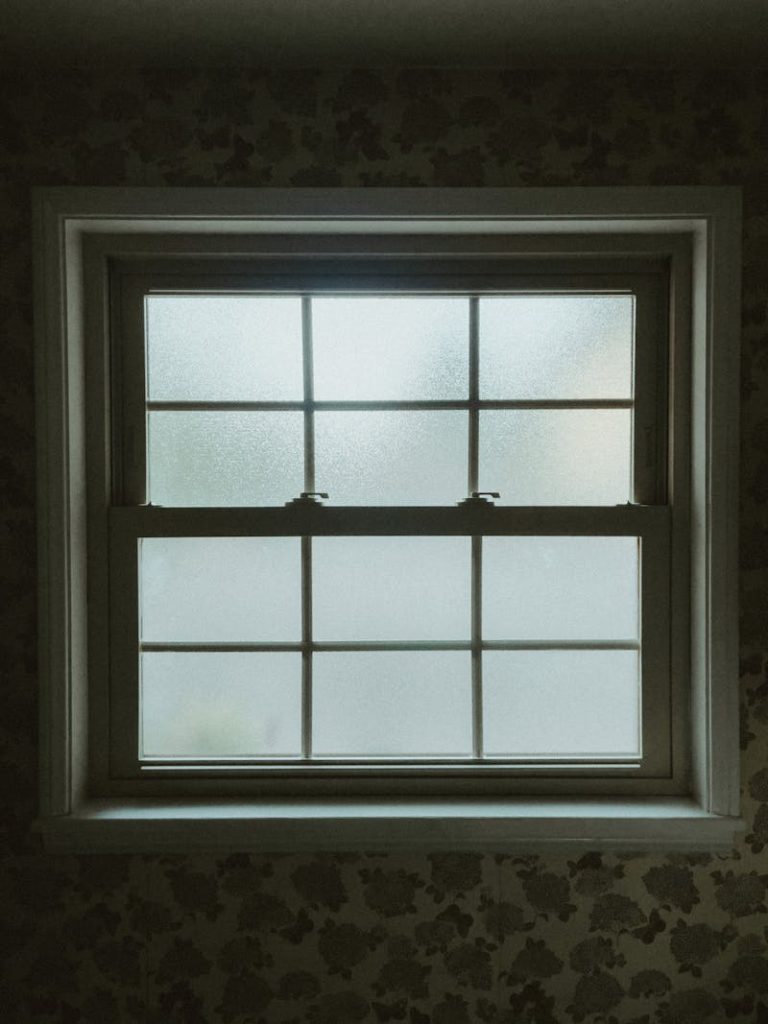
The bathroom window was never clear glass. It was textured, rippled or pebbled or pressed with a busy pattern that scattered the light into a soft glow and turned the world outside into a vague smear of color.
This obscure glass did one job perfectly, letting daylight pour in while making absolutely sure the neighbor could not watch you towel off. The patterns had real names and catalog numbers, pressed into the hot glass at the factory, and some of the bubbled versions even muffled sound a little as a bonus.
I grew up knowing exactly how the morning light looked broken into a hundred wobbly pieces through that pane.
The downside was that it scattered the view both ways, so you never got a clean look at the weather or the yard, just a blurry impression of green or gray. Cleaning it was a chore, every textured dimple holding onto grime and water spots. We traded a clear view for privacy without thinking twice, and honestly it was the right call.
That wavy morning light is pure childhood.
A Wall Heater Glowed Orange And Roared To Life
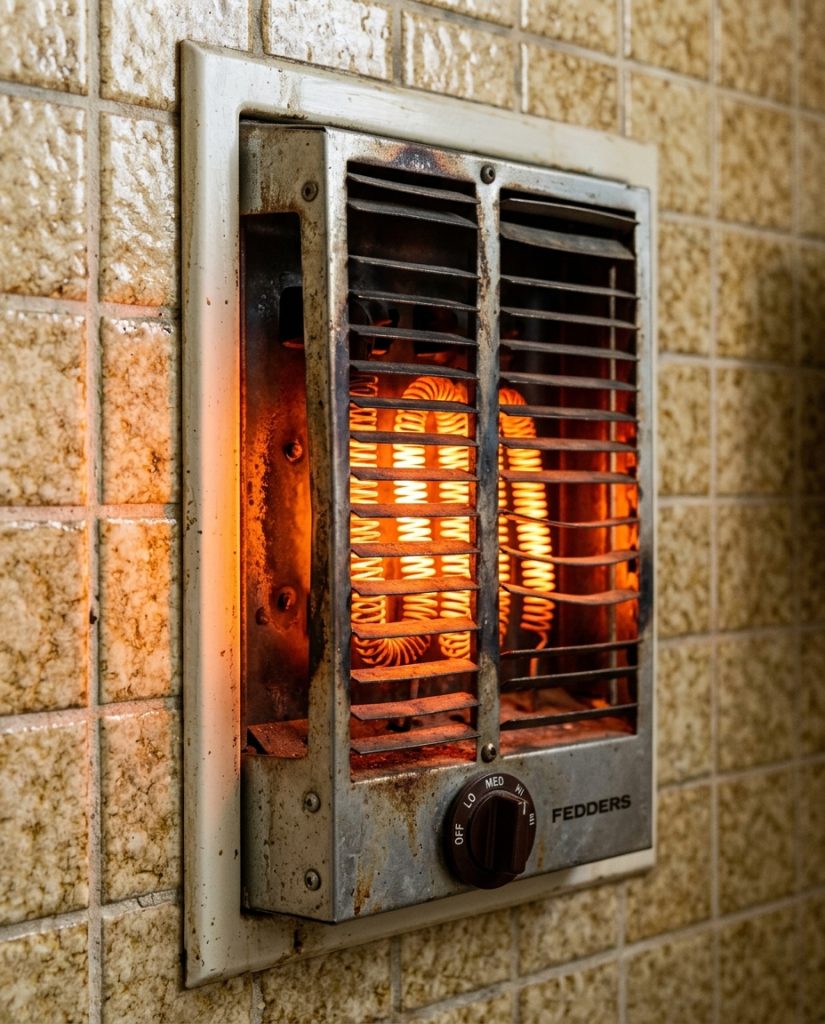
Set into the wall, usually low and near the door, was a metal grille that hid an electric heater, and on a freezing morning I flipped its switch and waited for the coils behind it to bloom orange and the little fan to roar.
That heater was the only warm thing in the room before the radiator caught up, blowing a tight stream of hot air at my shins while the coils glowed bright enough to see through the grille. One brand in particular put these in bathrooms across the country, often paired with a fan and a light in the same unit.
The warmth was real and immediate, a blast of heat you stood over while the rest of the house was still cold.
The quirks were many. It dried out the air, the fan rattled like it had something loose, and the metal grille got hot enough to brand a curious finger. It also ate electricity in great gulps, glowing away while the meter spun. We loved it on a January morning and feared the bill in February.
Standing over that orange glow is winter, bottled.
Your Lamp Swung From A Chain Across The Ceiling
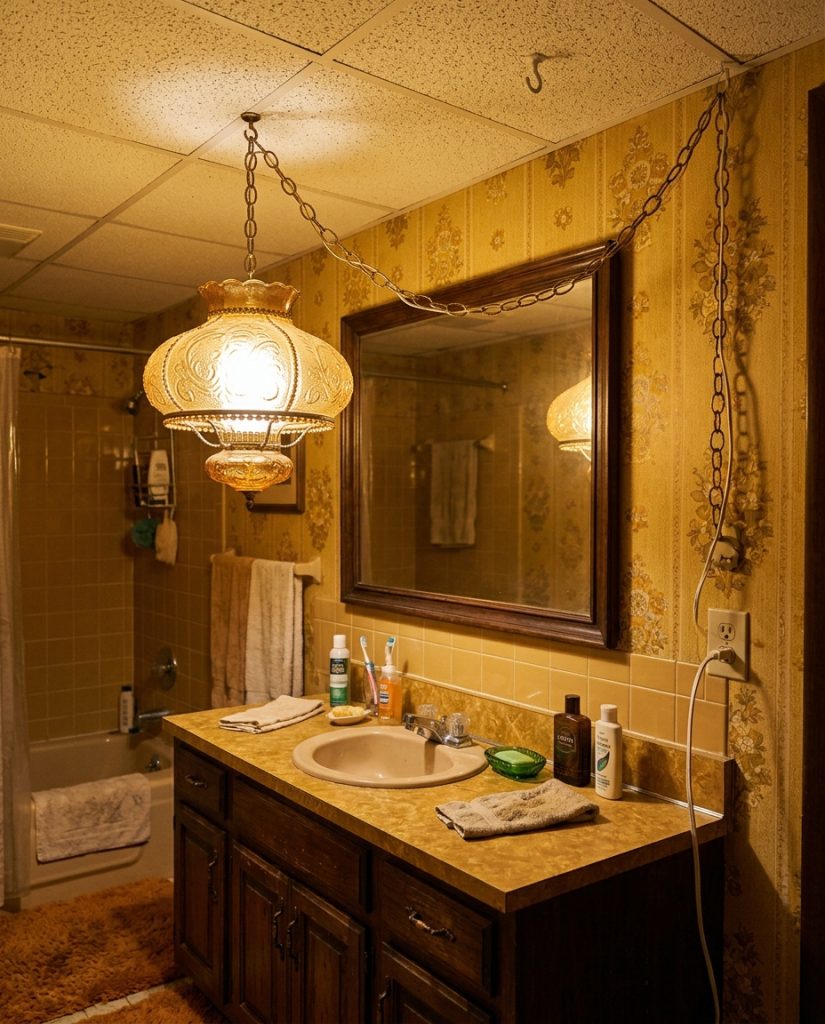
Not every fixture was wired into the ceiling. Some hung from a chain, a swag lamp, plugged into a wall outlet with a long cord that climbed the wall and crossed the ceiling on hooks to reach wherever you wanted the light to dangle.
This was lighting you installed with a hammer and a hook, no electrician required, just a decorative chain and a plug, so you could hang a warm glowing shade right over the vanity or in the corner without paying anyone. The shades got wild, scalloped fabric, colored glass, macrame, hanging in the corner like jewelry.
It let a renter add a real light fixture without touching the wiring, which felt clever and a little rebellious.
The reality was a cord stapled across your ceiling in plain sight, the chain collecting dust on every link, the whole rig swaying if you bumped it. In a steamy bathroom a plugged in lamp on a chain was also a quietly questionable idea. We thought it looked bohemian and free. It looked like an extension cord with ambitions.
The glow, though, was genuinely lovely.
Wicker Crept In From The Sunroom And Stayed
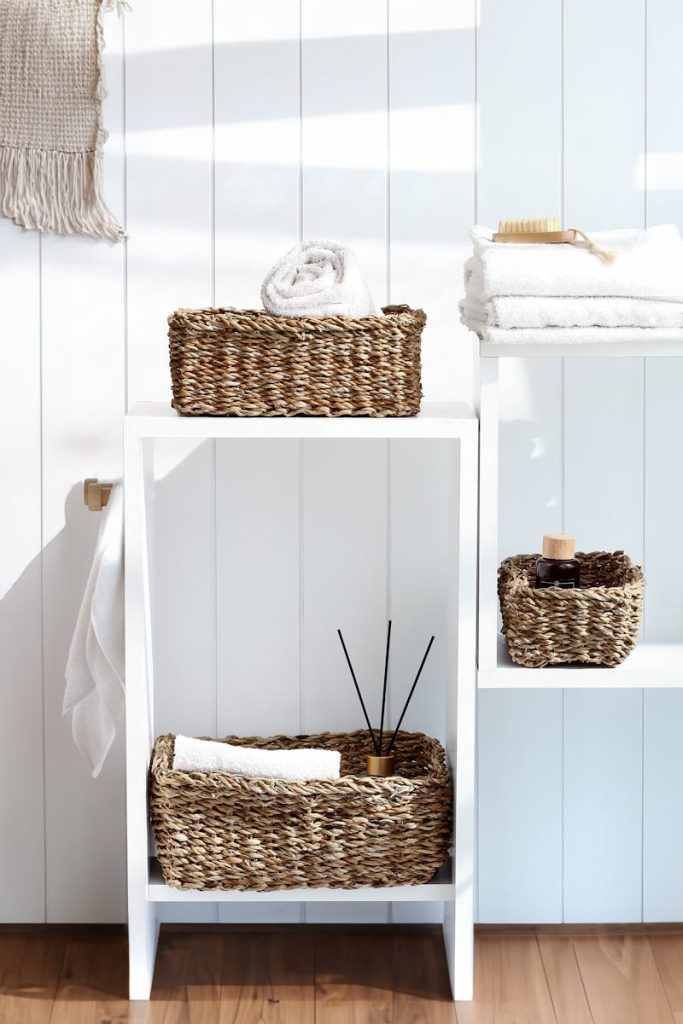
The bathroom slowly filled with woven things, a wicker shelf for the towels, a rattan wastebasket, a little hamper with a creaky lid, maybe even a peacock chair wedged into the corner holding a plant and a magazine.
Rattan was inescapable that decade, a bohemian obsession that drifted out of the sunroom and colonized every other room in the house, and the bathroom got its share of the woven baskets and shelves that said relaxed and natural and a little tropical. It paired perfectly with the macrame and the hanging plants already in there.
The texture was warm and organic against all that cold tile and porcelain, a softness you could feel.
The flaw was obvious to anyone but us. Wicker and a wet room are mortal enemies, the natural fibers drinking up the steam, softening, graying, and eventually unraveling at the joints where the weave was tightest. The hamper grew musty, the shelf sagged. We brought the sunroom into the bathroom because it looked free and easy, and the bathroom slowly ate it alive.
Damp wicker has a smell you never forget.
Bonus
Here is the one almost nobody knows about. Open the medicine cabinet in a lot of these bathrooms and you would find a thin slot at the back, usually labeled for used razor blades.
The idea was tidy. You unscrewed a fresh double edged blade, dropped the old one through the slot, and it vanished into the wall. What nobody mentioned was where the blades went, which was nowhere.
They simply piled up inside the wall cavity, year after year, sliding down behind the plaster into a growing little heap of rusting steel. That slot was standard equipment from the 1950s right up to the late 1970s, which means countless walls in countless homes quietly hold decades of razor blades to this day, a strange time capsule waiting for whoever opens that wall next.
We threw nothing away. We just moved it somewhere we could not see it, which, come to think of it, was the whole decade’s approach to the bathroom.
Which of these did your childhood bathroom have, and which one do you secretly miss the most?