
Would you like to save this?
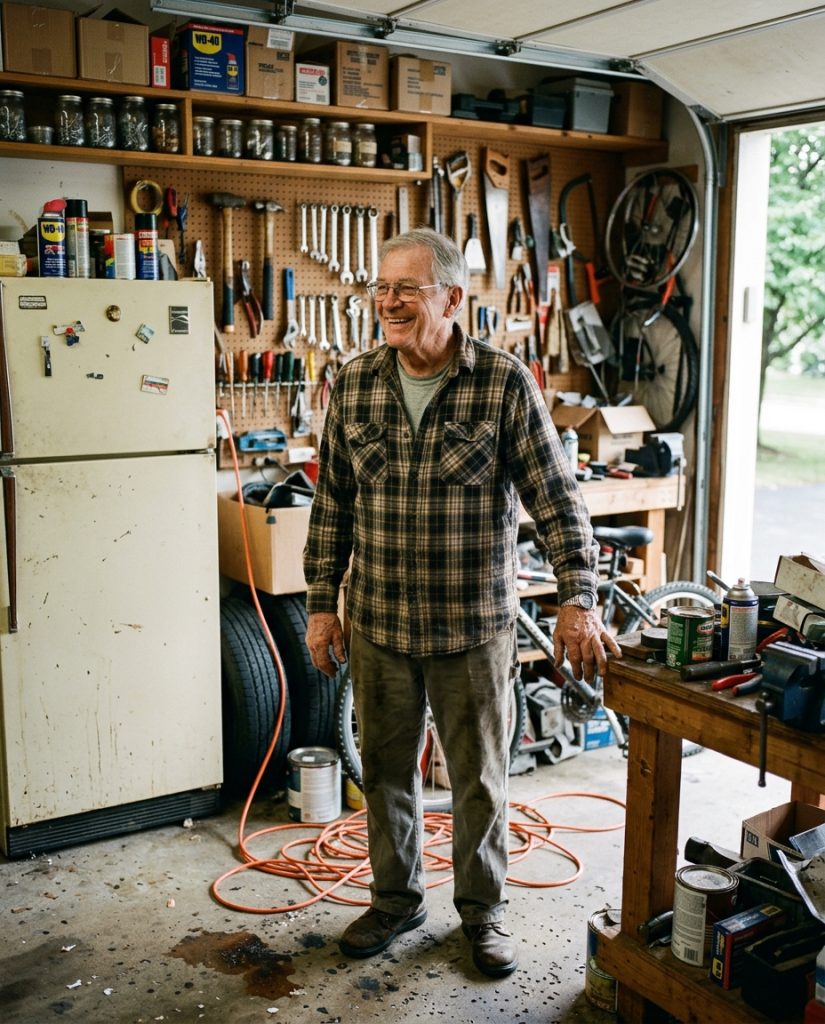
A garage in the eighties had a smell you could find blindfolded. Warm motor oil, sawdust, and whatever was quietly fermenting in the back of that second fridge.
I can still walk into my dad’s garage in my mind and find every corner of it. It was where we kept the bikes, the tools, the holiday boxes, and half the projects nobody ever got around to finishing.
For a lot of us, more weekends happened out there than anywhere inside the house.
So come walk through it with me, and see how much of yours you still remember.
Pegboard With a Painted Outline for Every Tool
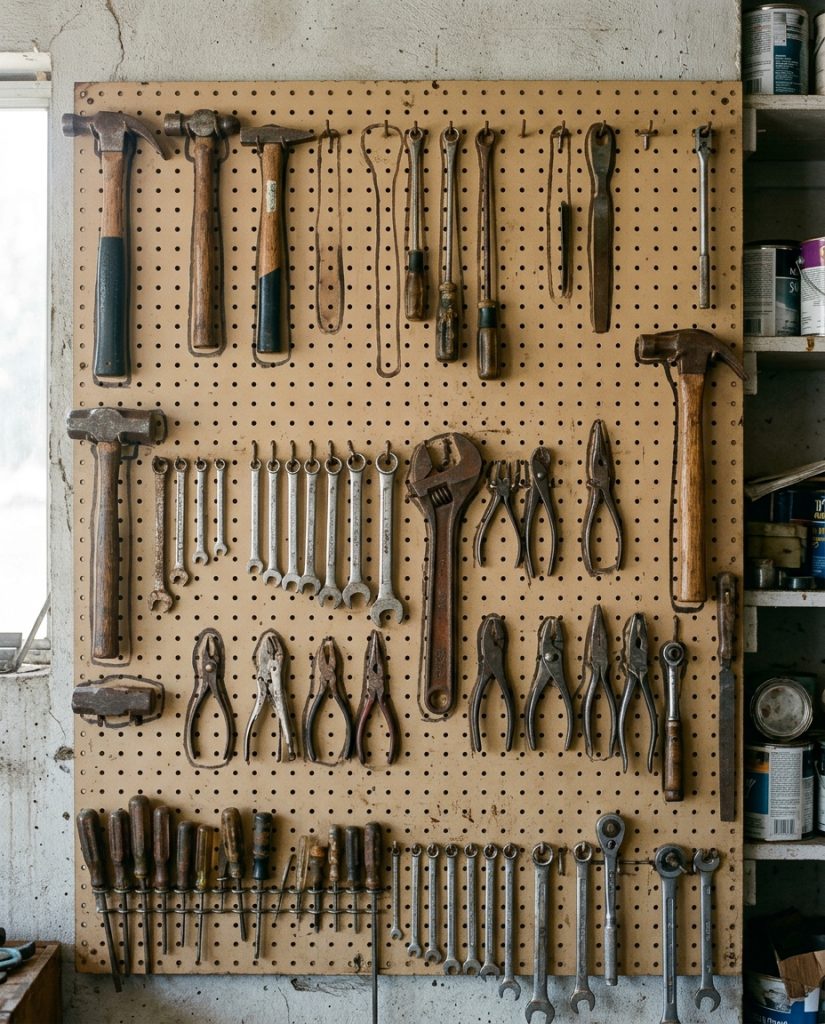
That pegboard was always the same pale tan, sold in four foot by eight foot sheets with a hole punched every single inch.
And if your father was serious about it, he did the thing that separated a real workshop from a junk wall. My dad traced every tool. A painted silhouette of the hammer, the level, the channel locks, so the second anything went missing you could see the empty shape staring back at you.
It was an honor system enforced by spray paint. I borrowed the needle nose pliers exactly once, left the outline empty for a week, and heard about it at dinner.
That little ritual taught a whole generation that there was a right place for everything. Tally so far, one.
Right below that wall sat the surface where every project actually happened.
A Homemade Wooden Workbench Built From Scraps
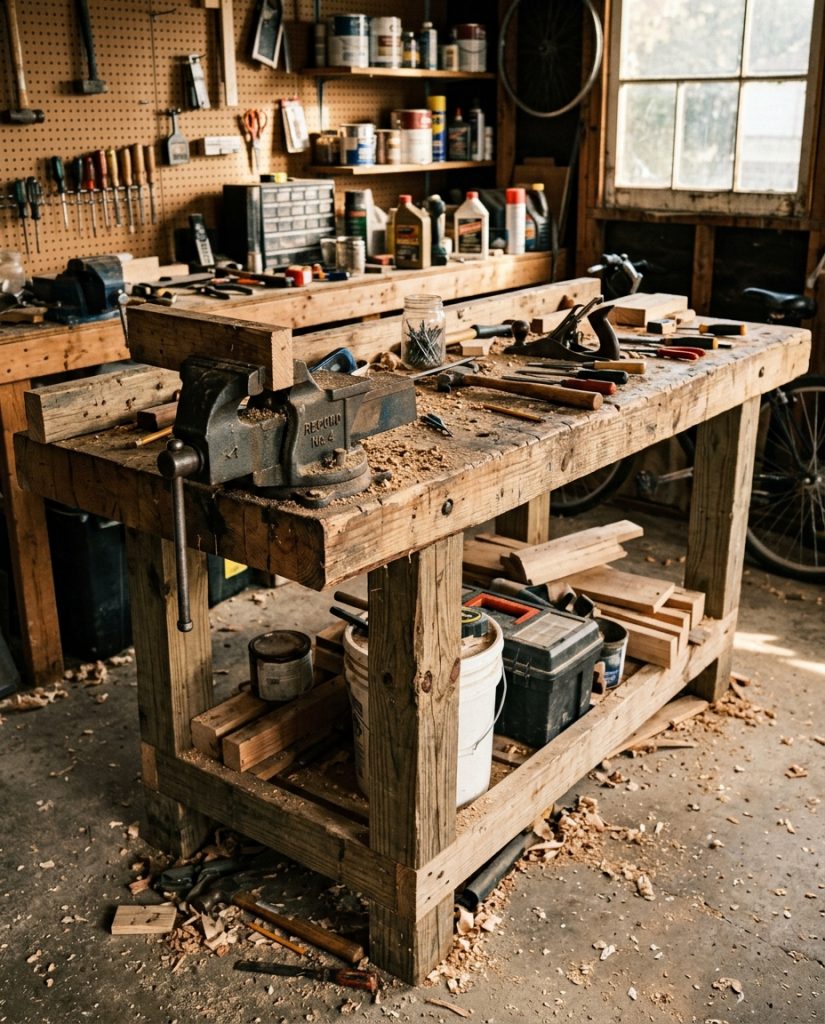
Here is the truth about the workbench. You could not buy one that mattered.
The bench that meant something was built, usually out of whatever lumber survived the deck project or the fence project or the addition that only ever got half finished. The frame was always overbuilt by roughly three hundred percent, joined with the kind of long lag bolts that suggested your dad expected it to support a small car.
I can still run my hand across that top in my memory and feel every dent from twenty years of projects, the dried glue ridges, the spot scorched by a soldering iron.
It was the command center for every ambitious Saturday. If yours had a bench heavy enough to lean on with your full weight, that is two.
Speaking of weight, the next thing in the corner could survive a direct hit.
A Refrigerator That Refused to Die
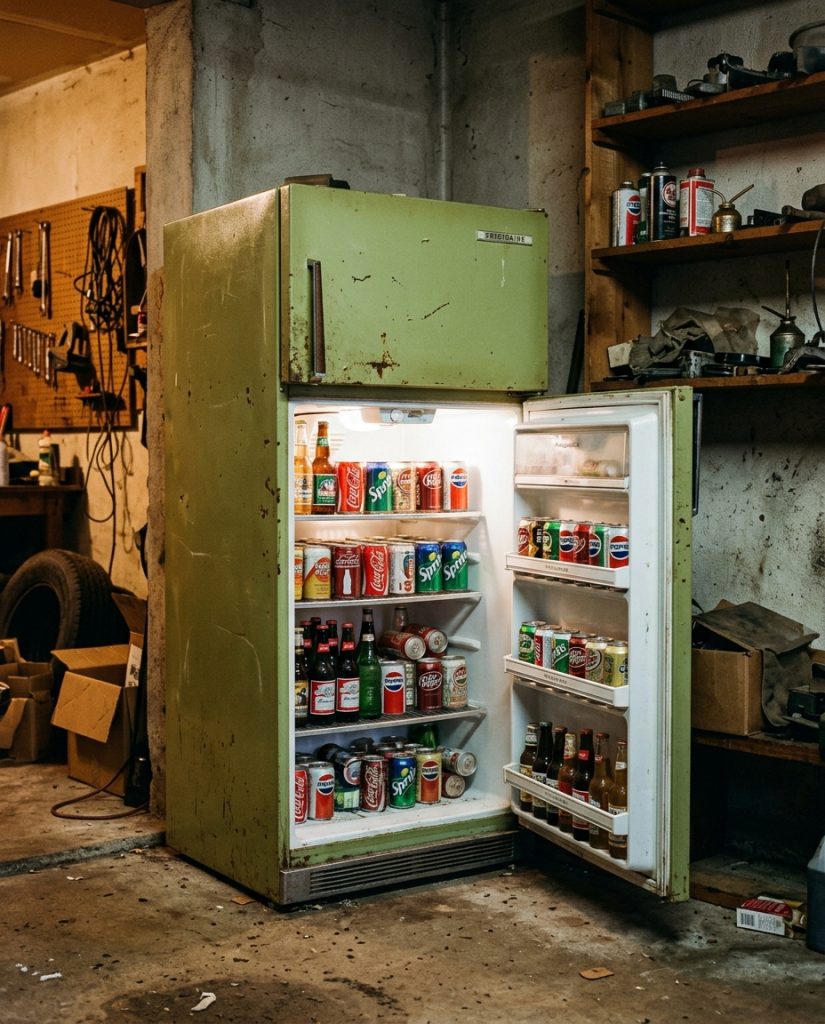
The garage fridge was never bought for the garage. It was the old kitchen model, the avocado green or harvest gold one that got replaced upstairs and exiled out here instead of hauled to the dump.
And something strange happened in exile. It became indestructible.
YOU’LL ALSO LOVE25 Things About Your Home That Visitors Notice in the First 10 Seconds (But Never Tell You)
Ours ran for another fifteen years without a single complaint, humming through summers that hit a hundred degrees, and somehow it kept the cans colder than the newer one in the kitchen ever managed. It held the overflow groceries, the Thanksgiving turkey that would not fit, the orange soda, and the beverages that were strictly off limits to anyone under a certain age.
Opening it made that heavy thunk and rush of cold. If your family had the second fridge, that is three.
Take a guess at the next one, because most people forget it was even out there.
A Deep Freeze Packed for the Apocalypse

Beside the fridge, low and humming and wide as a coffin, sat the chest freezer.
This was where the family bought in bulk before bulk was cool, a half side of beef wrapped in white butcher paper, bread loaves stacked four high, freezer pops that took both hands and a prayer to reach. I had to lean in so far my feet nearly left the floor, and the cold air would fog up around my face while I dug for the popsicles my mom swore were down there somewhere.
Take that guess now. How old was the oldest thing in there? Most people say a year.
The honest answer in most houses was closer to three years, a foil package nobody could identify and nobody dared to throw out.
If your garage had the deep freeze, that is four. The next thing on the wall was pure summer.
Bicycles Hanging From the Rafters Like Trophies
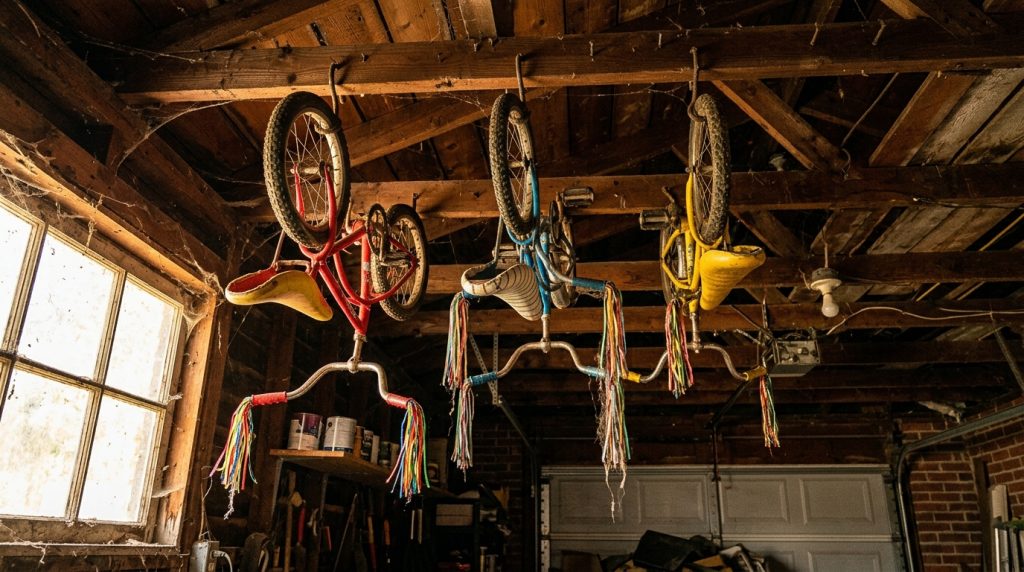
Look up. The bikes lived on the ceiling, hung by their front wheels on a pair of those big coated steel hooks my dad screwed into the joists.
Banana seats, rainbow tassels streaming off the handlebars, a license plate with somebody else’s name on it. In December they hung up there like sleeping bats, tires slowly going soft.
Then came that first warm Saturday in spring, and every garage on the block opened at once, and the bikes came down, and the whole neighborhood emptied into the streets until the streetlights came on.
Pumping those soft tires back up with a stubborn hand pump was the official sound of summer starting. If your bikes spent winter overhead, that is five.
The next one is the most dangerous thing on this entire list, and that is not an exaggeration.
Lawn Darts the Government Actually Outlawed
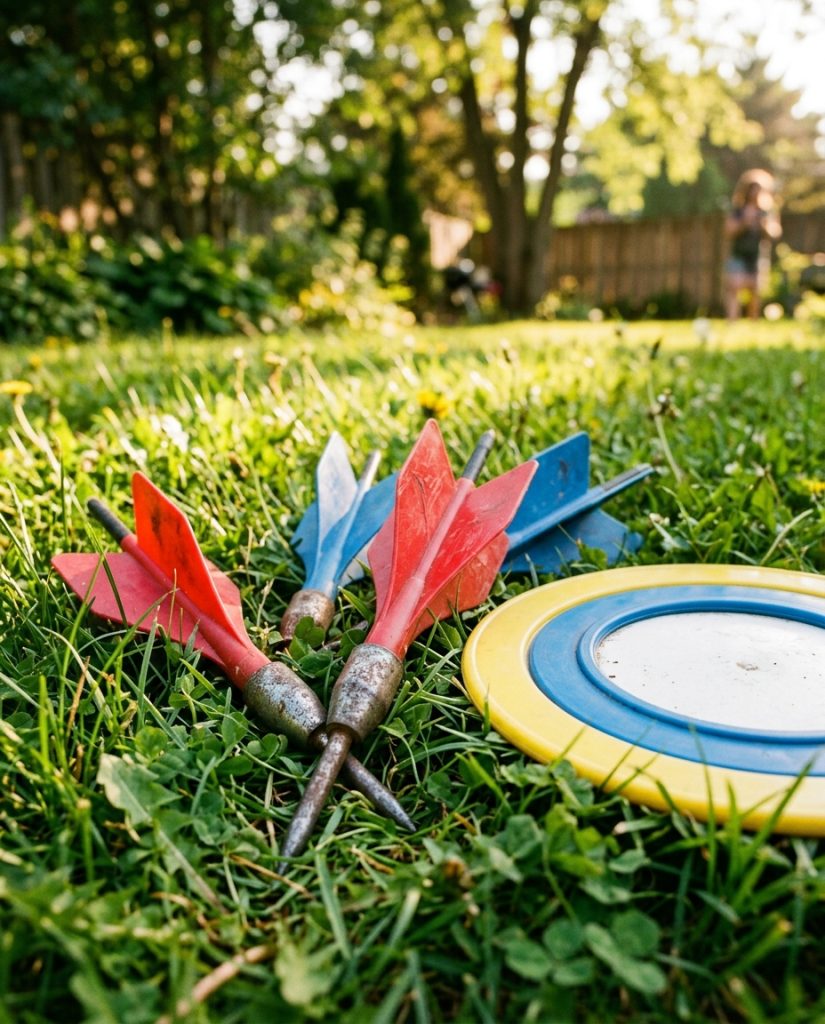
Here is the one that got banned. Lawn darts, or Jarts, were weighted spikes of solid metal with fins on the back, and the whole game was throwing them high into the air toward a ring on the grass while children stood nearby.
What could go wrong did.
Between January 1978 and December 1986, lawn darts sent an estimated 6,100 people to the emergency room.
And 81 percent of those hurt were children fifteen or younger.
After a seven year old girl named Michele Snow was killed by an errant dart in April of 1987, the Consumer Product Safety Commission banned them outright. They were pulled from store shelves the week before Christmas in 1988.
If a set of these lived in your garage, and let us be honest, plenty did, that is six. The next item is what you played while you waited out the rain.
A Boom Box That Doubled as the Garage Radio
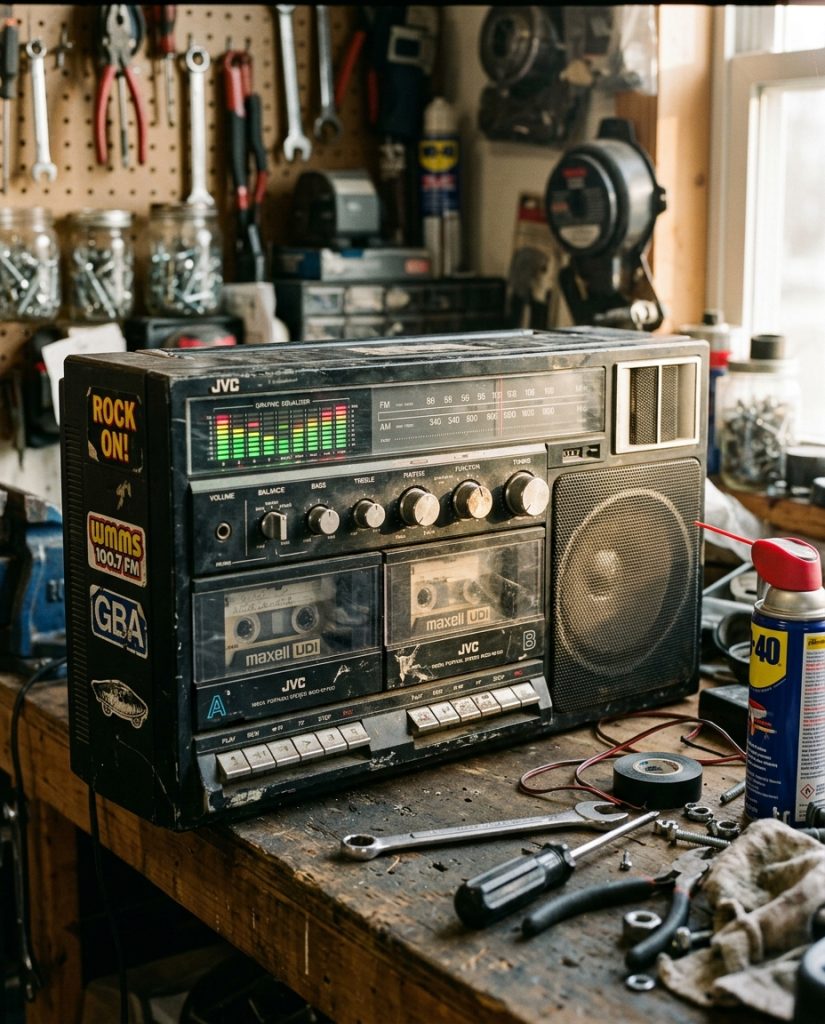
Every garage had its sound, and in the eighties that sound came out of a boom box the size of a small suitcase.
Twin cassette decks, a row of sliding graphic equalizer knobs nobody fully understood, and a telescoping antenna bent at an angle that somehow caught the classic rock station best.
The garage was the one place the volume rules did not apply, so it played loud while my dad worked or while I waited out a thunderstorm with the big door open watching the rain hit the driveway.
That second cassette deck was secretly the best feature in the house, because it let me dub a copy of a friend’s tape and build the perfect mix.
YOU’LL ALSO LOVE30 Things in the 1970s Living Room That Would Confuse Anyone Under 30
If a boom box held down a corner of your bench, that is seven. The next thing was the smallest container that held the most history.
Coffee Cans Full of Fifty Years of Hardware
[IMAGE: row of old metal coffee cans on a shelf filled with assorted nails screws and washers their lids visible]
Every nail your family ever owned ended up in one of these. The smartest dads screwed the lids to the shelf above so the cans hung underneath.
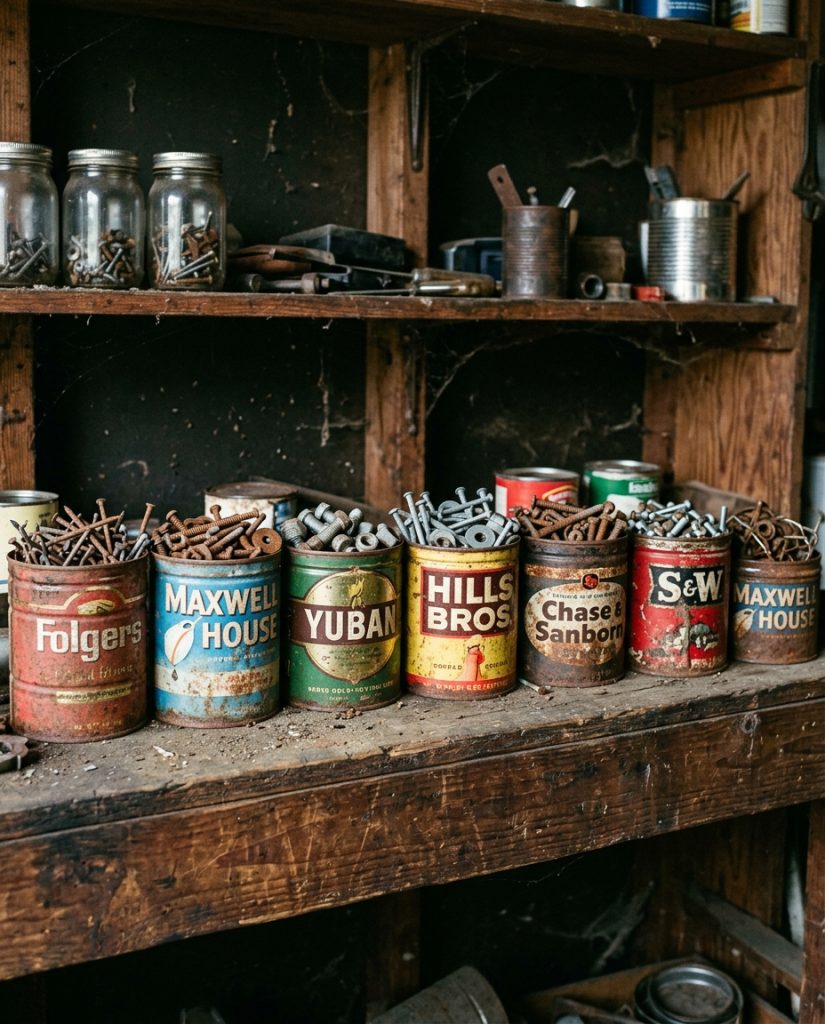
Nobody in the eighties bought a little plastic organizer with neat labeled drawers. We had coffee cans.
The empty steel one, lid pried off, became the permanent home for every loose nail, screw, washer, bent cotter pin, and mystery bit of hardware the family accumulated across decades. Shake one and you heard fifty years of half finished projects rattling around.
The genuinely clever fathers took it one step further with a trick worth stealing today. They screwed the metal lid to the underside of a shelf or a ceiling beam, then twisted the full can up into it, so the jars hung underneath in a neat row and never took up shelf space.
You could see exactly what was inside and grab one with one hand.
If your garage had the coffee can hardware system, that is eight. The next can on the shelf was practically a member of the family.
A Blue Can of WD-40 Born From Rocket Science
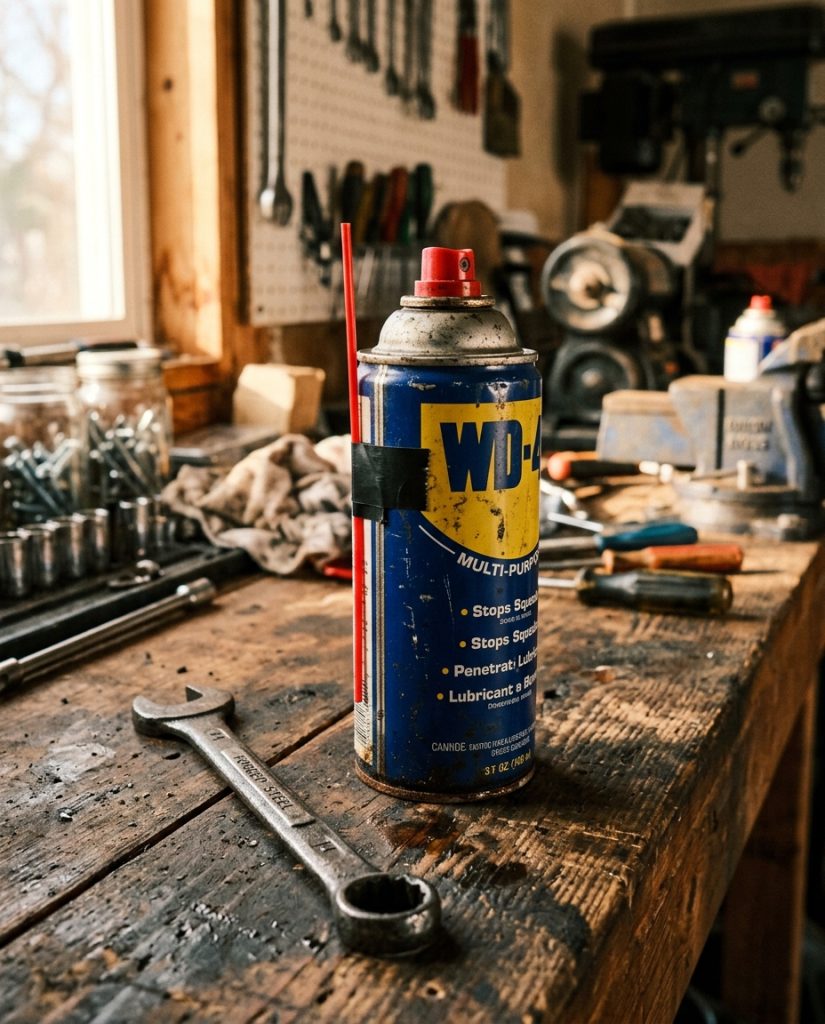
Every garage had the blue and yellow can, and it solved roughly nine hundred problems a year. Squeaky hinge, stuck bolt, a lawn mower that would not turn over, a bike chain gone stiff.
Here is the part almost nobody knew while they were spraying it.
That formula was invented back in 1953 by a tiny outfit called the Rocket Chemical Company in San Diego, a staff of three people trying to stop rust on aerospace parts.
The name is literally a lab note. Water Displacement, fortieth formula, because the first thirty nine attempts failed.
Its first real job was protecting the outer skin of the Atlas missile from corrosion, and workers liked it so much they smuggled cans home in their lunchboxes. It hit store shelves in 1958 and never left a garage again.
If you had a can within arm’s reach, that is nine. The next item ran your entire Saturday.
A Gas Mower That Owned Your Saturday Morning

The gas mower was less a tool than an alarm clock for the whole street.
Around nine on Saturday morning, one engine would cough to life, then another two yards down, until the entire neighborhood was a chorus of two stroke engines and the smell of cut grass and gasoline hung over everything.
Starting it was a ritual all its own. My dad would set the choke, grip the pull cord, and yank it three times while it sputtered and threatened to flood, and dads everywhere muttered the same words under their breath on the fourth pull.
Beside it sat the red metal gas can with the long flexible spout that never poured without spilling a little. The mower lived right by the door so it could roll straight out.
If your Saturdays smelled like gasoline and clippings, that is ten. The next thing on the floor never washed away.
Oil Stains That Told the Whole Family History

Look at the floor. That constellation of dark blotches on the concrete was a permanent record, a map of every car the family ever parked in that spot.
Each stain marked an oil change done at home on a creeper, a leaky valve cover nobody got around to fixing, a transmission that wept quietly all winter.
My dad tried everything to lift them. Cat litter ground in with a boot heel to soak up the fresh stuff, a stiff wire brush, dish soap, the powdered driveway cleaner that promised miracles.
None of it ever fully won. The stains just faded to ghosts and waited.
Walk into any garage from that era today and you can still read the history written in oil on the floor. If your slab had a few permanent shadows, that is eleven. The next thing kept watch over the bench.
A Bikini Calendar Nobody Was Allowed to Mention
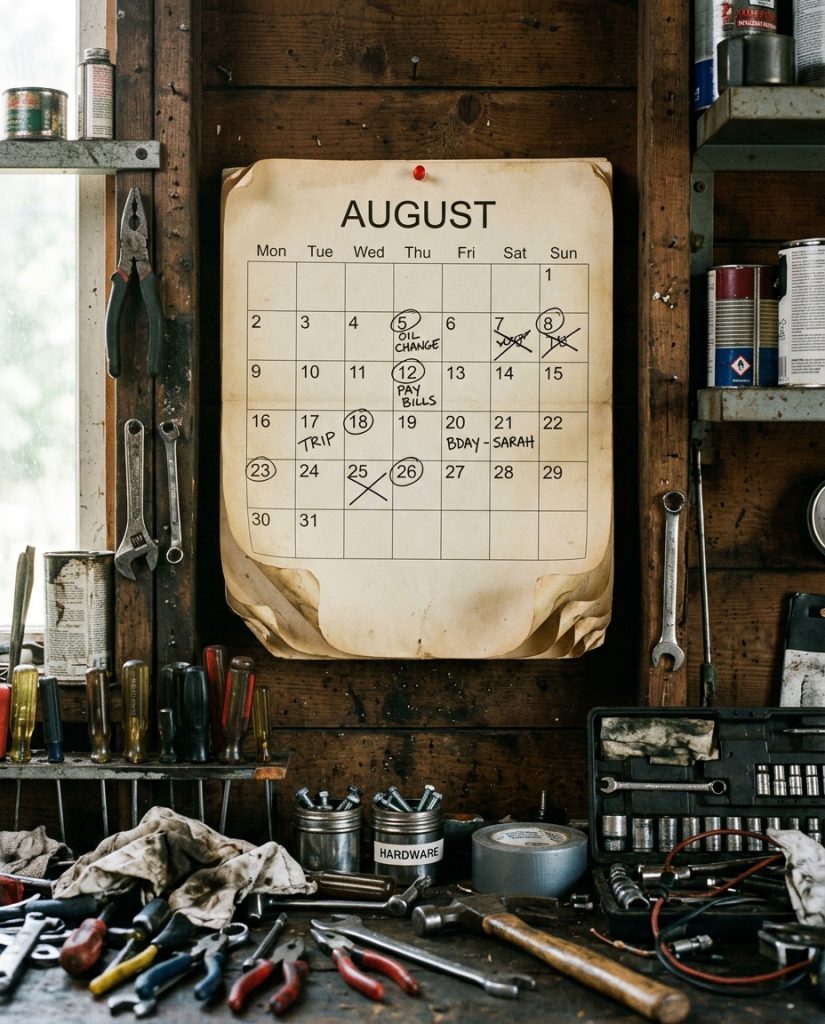
Tacked to the wall above the bench, curling at the corners, hung the garage calendar.
YOU’LL ALSO LOVE11 Neighborhood Rules Every Kid Knew in the ’80s That No Parent Would Allow Today
Sometimes it was a freebie from the auto parts store or the tire shop, sometimes it was the slightly racy kind that mom rolled her eyes at and everybody silently agreed not to discuss. Either way it was the official record keeper of garage life.
The squares filled up with pen scribbles in my dad’s blocky handwriting, the date of the last oil change, a reminder to rotate the tires, somebody’s birthday, the day the firewood was getting delivered.
Half the time it was a year or two out of date and still hanging there because nobody bothered to take it down. It was decor and database in one curling sheet of paper.
If a calendar watched over your workbench, that is twelve. The next thing came down from the attic once a year.
Christmas Stored in Crumbling Cardboard Boxes
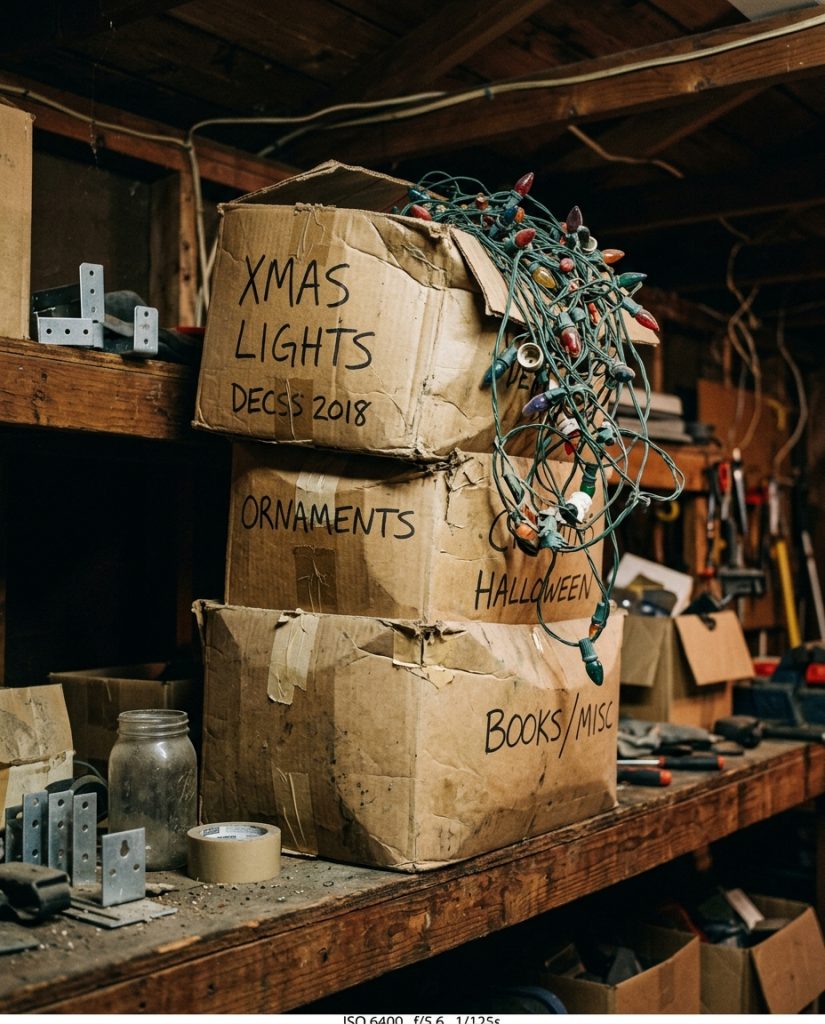
Up on the high shelf, sagging and soft from years of damp, sat the holiday boxes.
They were labeled in thick marker, sometimes just XMAS in my mom’s handwriting, and they came down exactly once a year in a small family ceremony. Inside was the whole archive. The tangled strand of big colored bulbs where at least half were burnt out, the plastic Halloween pumpkin from October waiting its turn, the ornaments wrapped in old newspaper from a Christmas three years back.
The boxes themselves were always one move away from total collapse, corners crushed, tape gone yellow and brittle.
Untangling that knot of lights on the garage floor, then testing each bulb, that was the real opening ceremony of the holidays.
If your decorations hibernated in the garage, that is thirteen. The next thing kept you company during long projects.
A Tiny TV With Rabbit Ears for the Big Game
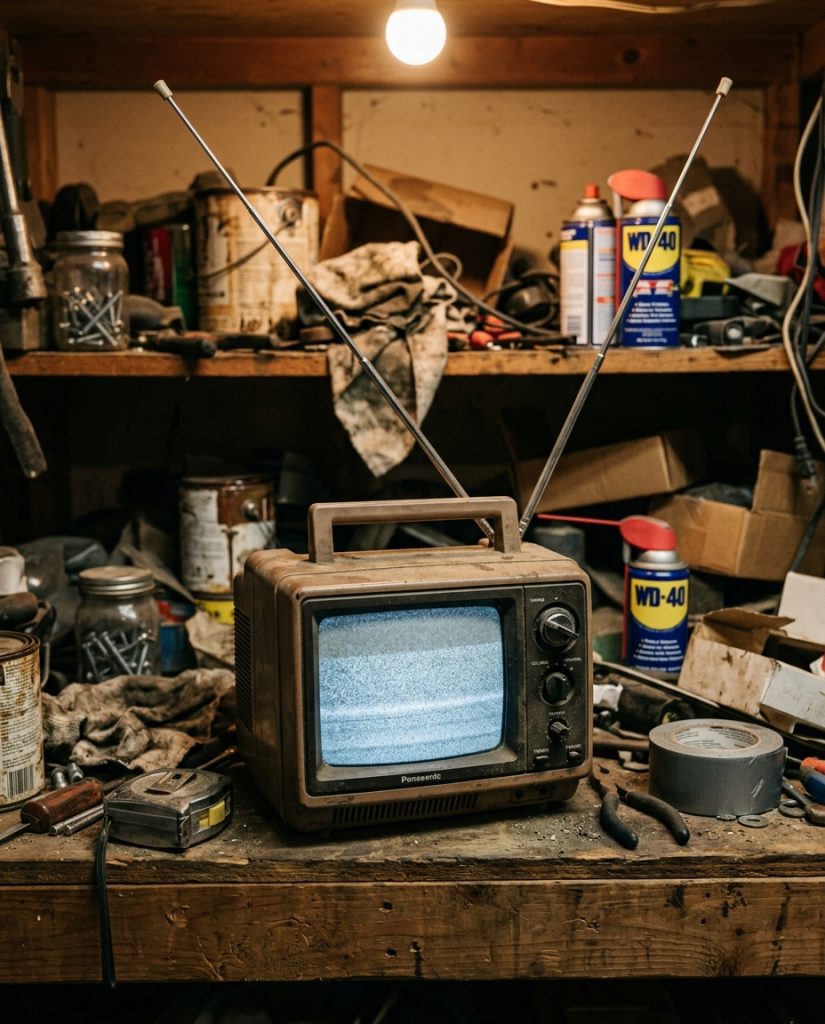
Out on a shelf, usually small and usually black and white, sat the garage television.
This was how my dad kept up with the ball game while he worked, or how we watched cartoons while he tinkered. The picture came in over a pair of telescoping rabbit ear antennas that demanded constant negotiation.
You twisted one up, angled the other sideways, draped a wad of aluminum foil over the tip, and if you found the magic position you absolutely could not let go or touch anything.
Sometimes the best reception required a human standing in one exact spot holding the antenna, which is how more than one kid got drafted as a living aerial during the fourth quarter. I was that kid more than once.
It crackled and rolled and you loved it anyway. If a little TV lived in your garage, that is fourteen. The last one is the one that probably started it all.
A Workshop Project That Never Quite Got Finished
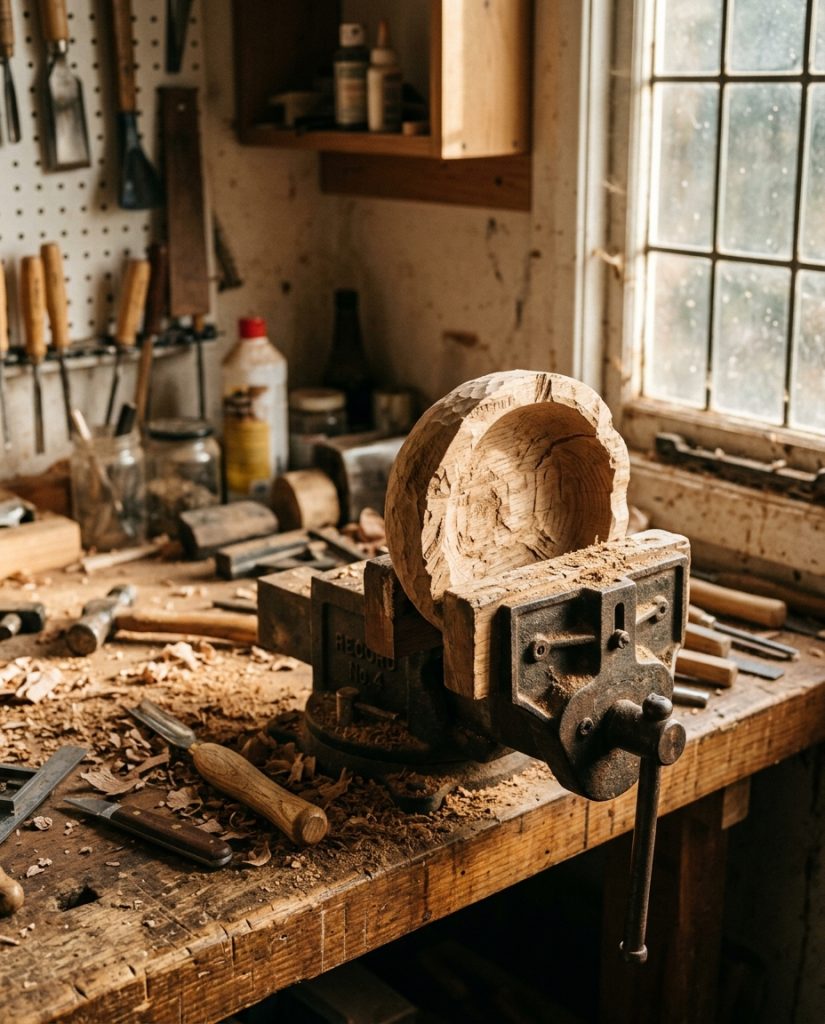
Here is the last one in the first half, and it is the heart of the whole place.
Every real garage had a project in progress that never quite crossed the finish line. A birdhouse, a spice rack for mom, a bookshelf, the pinewood derby car the night before the race, a lamp from a kit that came with instructions in three languages. It sat clamped in the vise or pinned under a board, half sanded, waiting for the weekend that kept getting away.
And that unfinished project is exactly why the garage mattered so much. It was the one room in the house dedicated to making and fixing and trying, the place I first held a real screwdriver and felt trusted.
If your family always had something halfway done out there, that is fifteen. And we are only halfway, because the next thing was bolted down so it would never walk off.
Bolted to the Bench Sat a Vise That Never Let Go
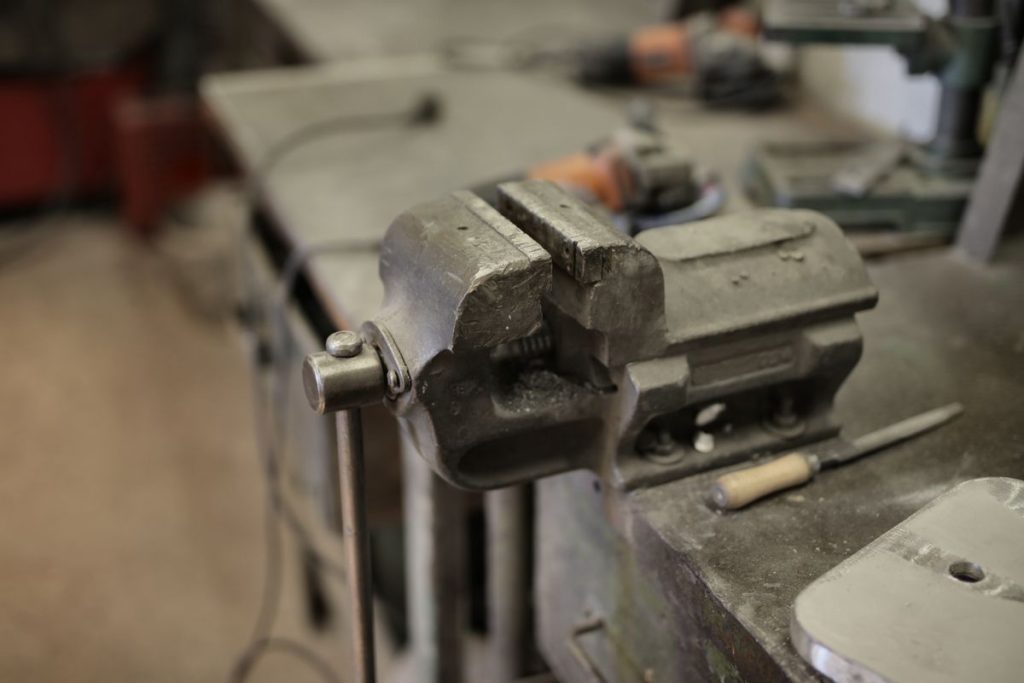
Bolted to one corner of that bench, painted some shade of battleship gray, sat the cast iron vise. It was the strongest handshake in the whole house.
I learned its limits the hard way the first time I cranked the handle too far and the jaws bit down so hard the wood squeaked. It held pipe while you cut it, held a stubborn bolt while you leaned on the wrench, held a model car while the glue set.
Here is the part that gave it its reputation. The bullet shaped design that defined the American workshop vise was first patented on August 1, 1941, four months before Pearl Harbor, and the good ones were cast from ductile iron rated near 60,000 pounds per square inch. That is roughly four times the cheap imports that came later.
A vise like that outlived the bench it was bolted to. If yours had one that could crush a walnut without trying, that is sixteen. The next thing hung on the wall in a lazy coil.
Fifty Feet of Garden Hose Looped on a Nail
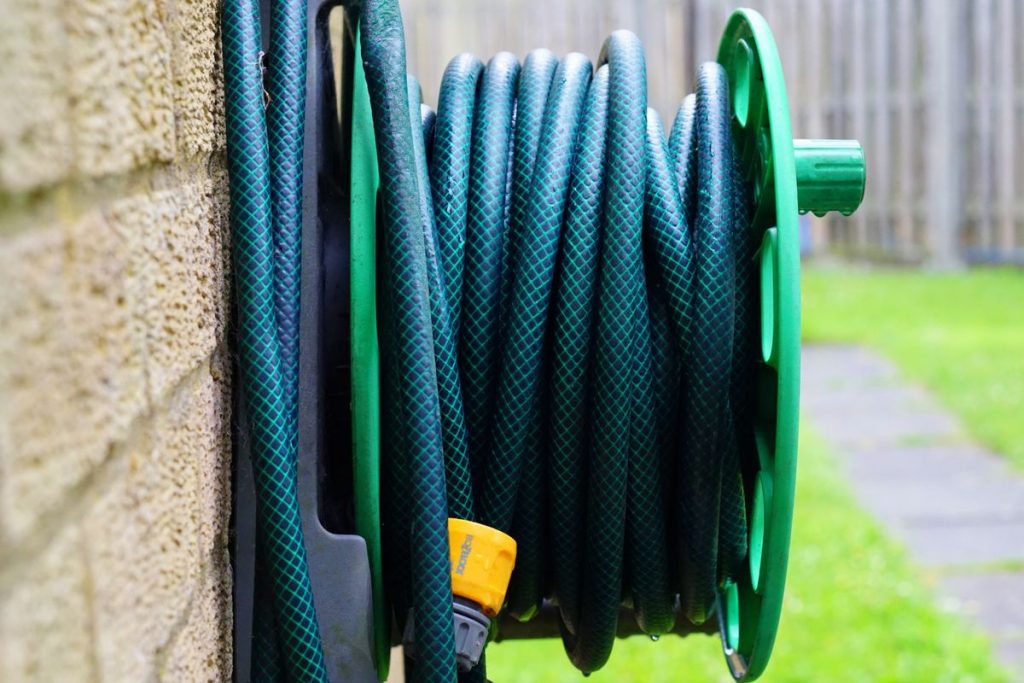
Looped over a fat bent nail by the side door hung the garden hose, fifty feet of it, green and stiff and forever fighting you.
YOU’LL ALSO LOVE25 ‘Common Sense’ Home Rules Everyone Followed in the 80s That Would Get You Laughed At Today
Nobody ever wound it back up right. It went on the nail in lazy uneven loops that slid off the second you grabbed one, and there was always a kink set in behind the brass nozzle that cut the water to a trickle until you walked back and snapped it straight.
The lightweight vinyl hose that hung in every garage only became cheap and common in the 1950s, when synthetic materials finally replaced the heavy rubber kind your grandfather wrestled with. By the eighties it was a fixture, dragged out to wash the car, fill the wading pool, or hand a thirsty kid a warm metallic drink straight off the end.
It cracked at the fittings eventually and got patched with a coupling from the hardware store. If a coiled hose hung by your door, that is seventeen. The next thing in the corner could survive being knocked over by a raccoon.
Galvanized Trash Cans That Outlasted Three Dogs
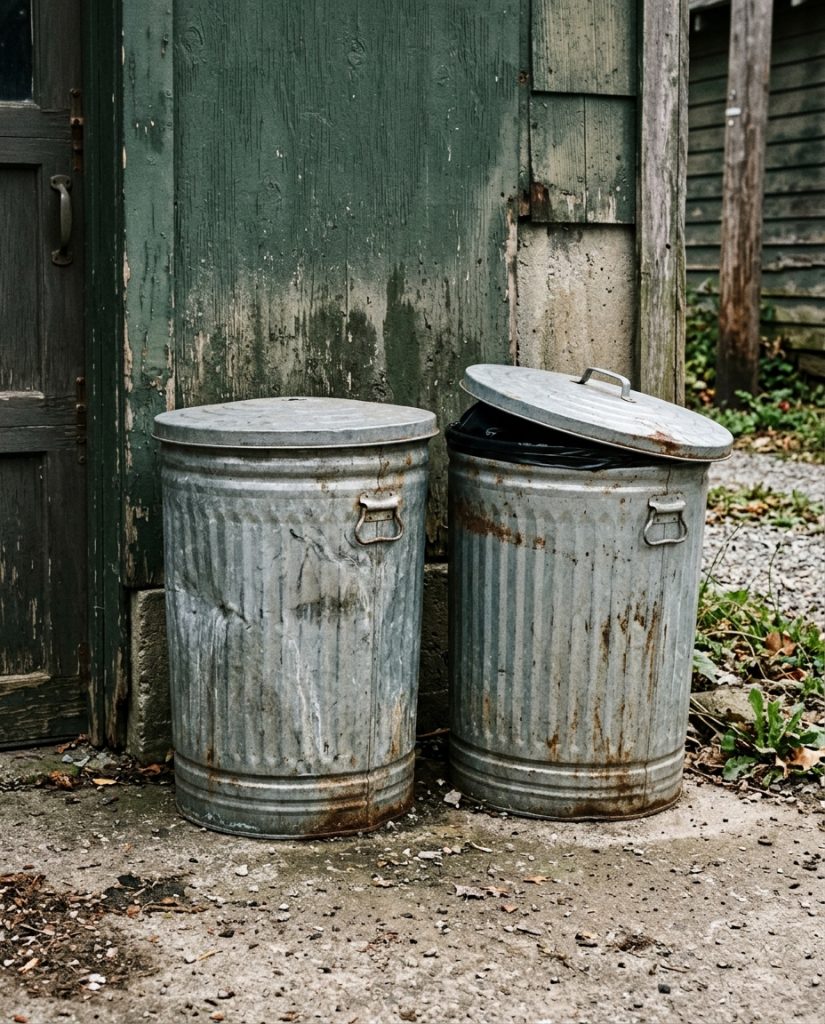
Standing guard by the side door were the metal trash cans, galvanized steel with those deep ribbed sides and a domed lid that clanged like a church bell when it dropped.
These things were genuinely indestructible. The heavy gauge steel and that corrugated body were built to take a beating, shrug off a hard freeze, and keep the raccoons out where a flimsy can would have been tipped and torn open by morning.
The lid was never just a lid. It was a sled when the snow came, a shield in a backyard sword fight, a gong, a makeshift cymbal, and on trash day it sailed off across the driveway like a flying saucer the second the wind caught it.
Would you like to save this?
You hauled them to the curb by the handles and they rang the whole way down. If a pair of those steel cans stood by your door, that is eighteen. The next thing waited in a wooden crate for its reward.
Glass Bottles Waiting in a Wooden Crate for Their Nickel
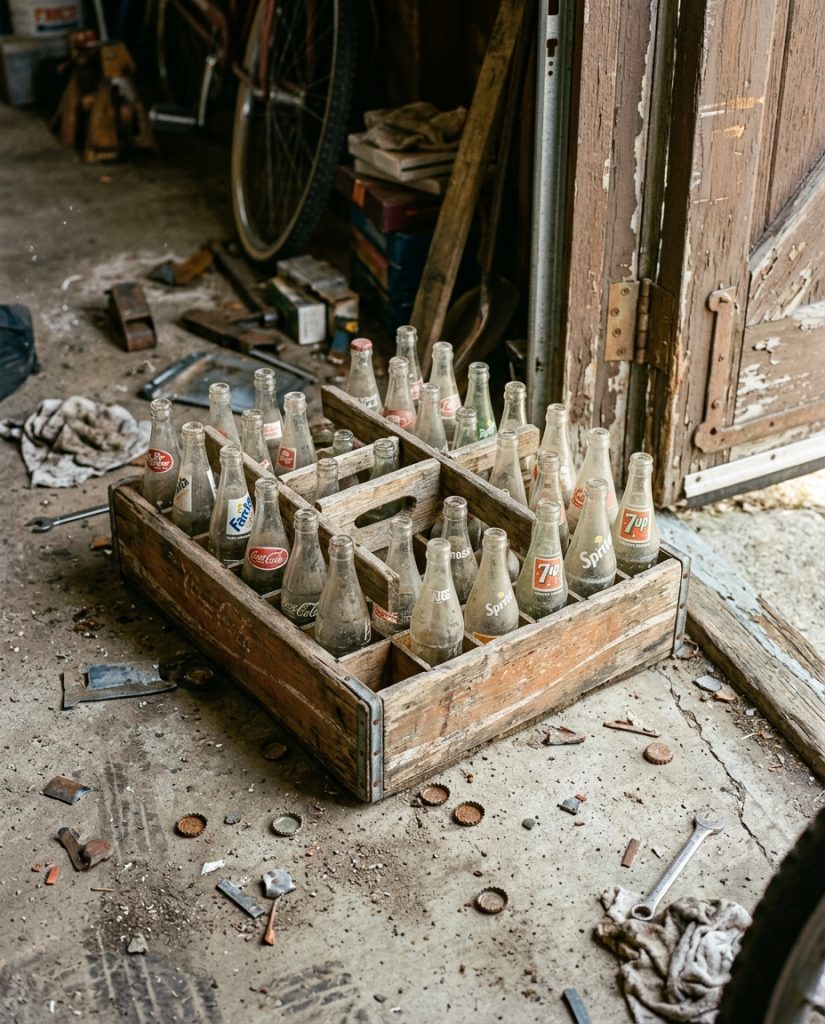
Tucked by the door, half in shadow, sat the wooden crate of empty glass bottles waiting to go back to the store.
That crate was a kid’s first paycheck. Soda came in thick returnable glass that carried a deposit of a few cents a bottle, and you got that money back when you hauled the empties in, which is how I funded more than one comic book and pack of baseball cards.
The deposit system went all the way back to the eighteen hundreds, but the eighties were the last gasp of it for soda. By 1984 only about eight percent of beer was still sold in refillable bottles, and within a few years the crate and the clinking glass quietly gave way to plastic that nobody ever brought back.
You loaded the crate into the trunk and listened to it rattle the whole way to the market. If a crate of empties waited by your door, that is nineteen. The next things folded flat and leaned against the wall all winter.
Webbed Lawn Chairs Folded Flat Against the Wall
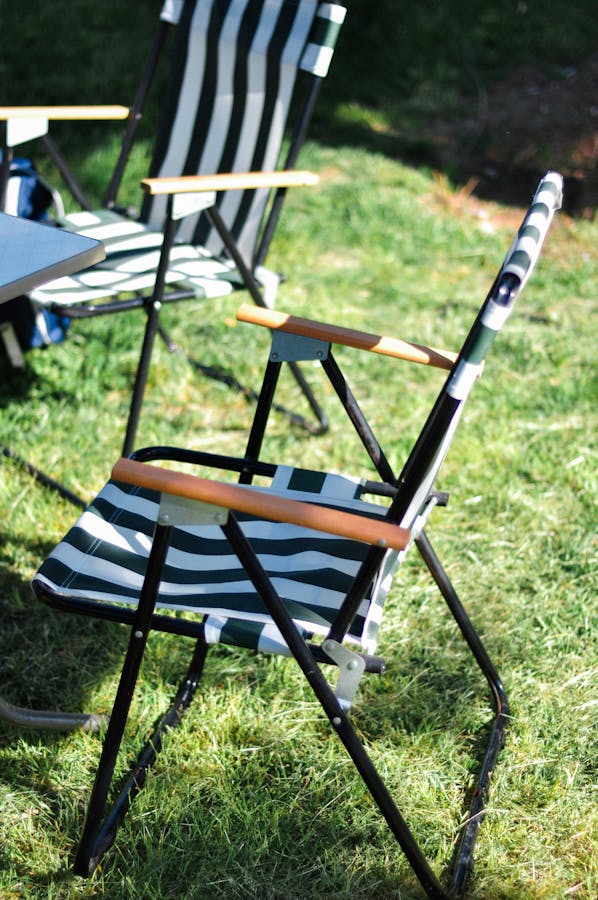
Leaning flat against the wall, stacked four deep, were the aluminum lawn chairs with the woven plastic webbing in faded green and white stripes.
Everybody got pinched by one. They folded with a scissoring action that caught a finger or a fold of skin if you were not careful, and the webbing always had one strand starting to fray that would finally let go and drop somebody straight through the seat at a barbecue.
These chairs have a real pedigree. A Brooklyn outfit run by a World War Two veteran named Fredric Arnold was turning out more than fourteen thousand of them a day by the late fifties, light aluminum frames strung with that wipe clean webbing, and they ruled American backyards until the floppy nylon folding chairs shoved them aside in the nineties.
They weighed almost nothing and lasted almost forever. If a stack of webbed chairs leaned in your garage, that is twenty. The next thing was heavy enough to throw out your back.
A Steel Cooler Heavy Enough to Throw Out Your Back
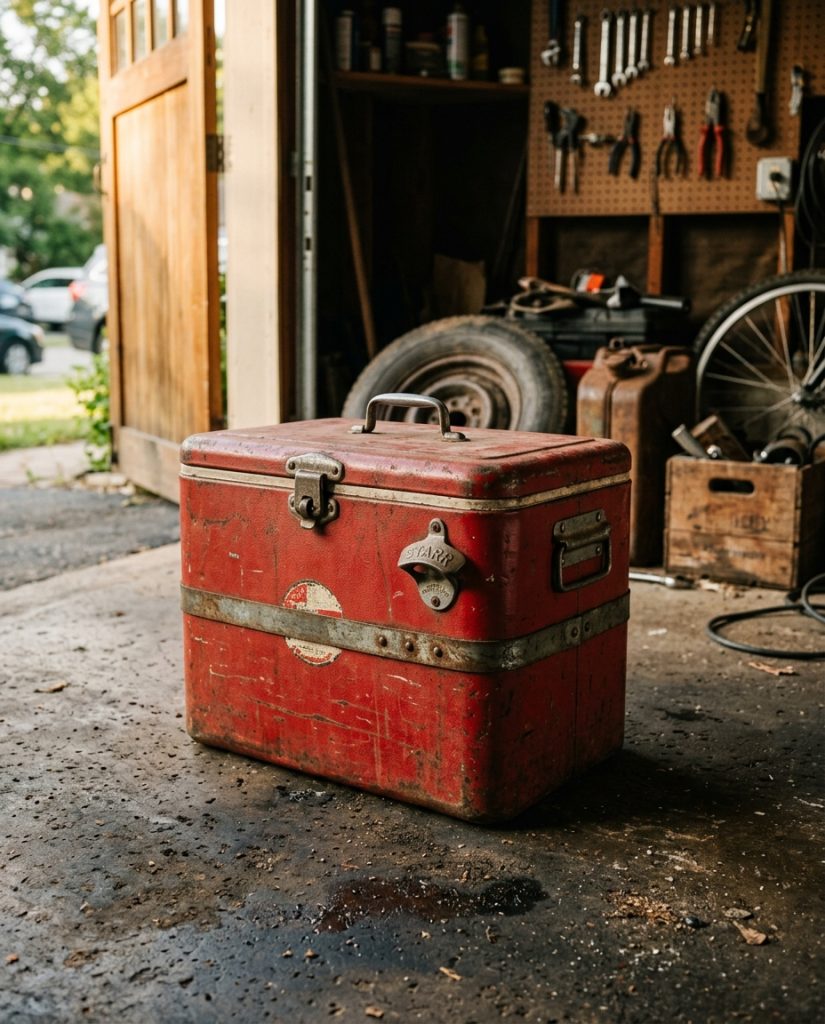
Down on the floor, waiting for the next picnic, sat the metal cooler with the steel band wrapped around its middle.
Empty it was heavy, and full it was a two person job. This was a chest built out of actual steel, not the lightweight plastic that came later, and loaded with a bag of ice and forty pounds of soda it could genuinely wrench your back on the walk to the lake.
The steel banded cooler had been a fixture since 1954, and the design barely changed for decades because there was nothing to fix. It had a built in bottle opener on the side, a tray that fit across the top, and it kept ice for a small eternity in a hot trunk.
That opener on the side wore a notch from a thousand bottle caps. If a steel cooler lived on your floor, that is twenty one. The next things let you slide right under the car.
Two Steel Ramps and the Creeper That Rolled Beneath the Car
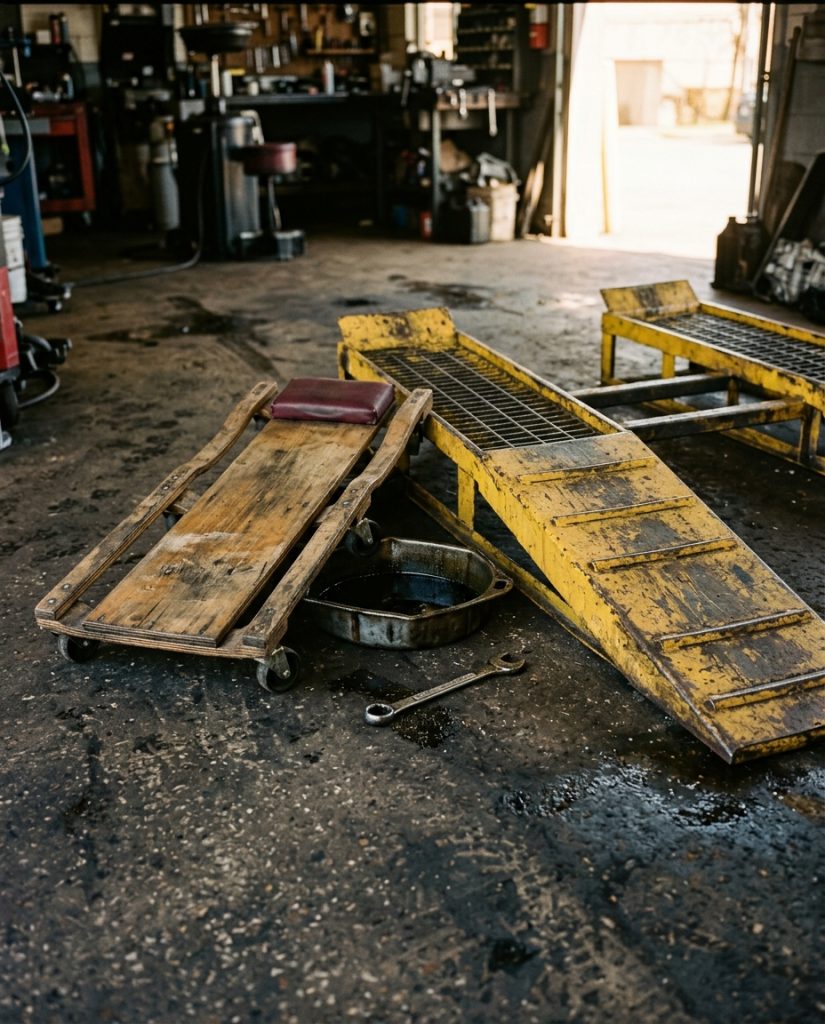
Stacked in the corner sat the pair of steel ramps and the flat wheeled creeper, the home mechanic’s whole operating room.
You drove up onto those ramps by feel and a prayer. Somebody stood out front waving you forward inch by inch, you felt the front tires climb and clunk into the cradle, you yanked the parking brake, and then you laid back on the creeper and pushed yourself under the warm underside of the car.
That creeper was usually a homemade plank on four hard caster wheels, padded with an old sofa cushion if you were lucky, and it rolled you into a world of drips and shadows where a trouble light dangled from the hood and a coffee can caught the old oil.
Sliding out from under with grease to the elbows was its own badge of honor. If ramps and a creeper lived in your corner, that is twenty two. The next thing fought back the winter cold.
A Kerosene Heater That Warmed the Whole Cold Cave
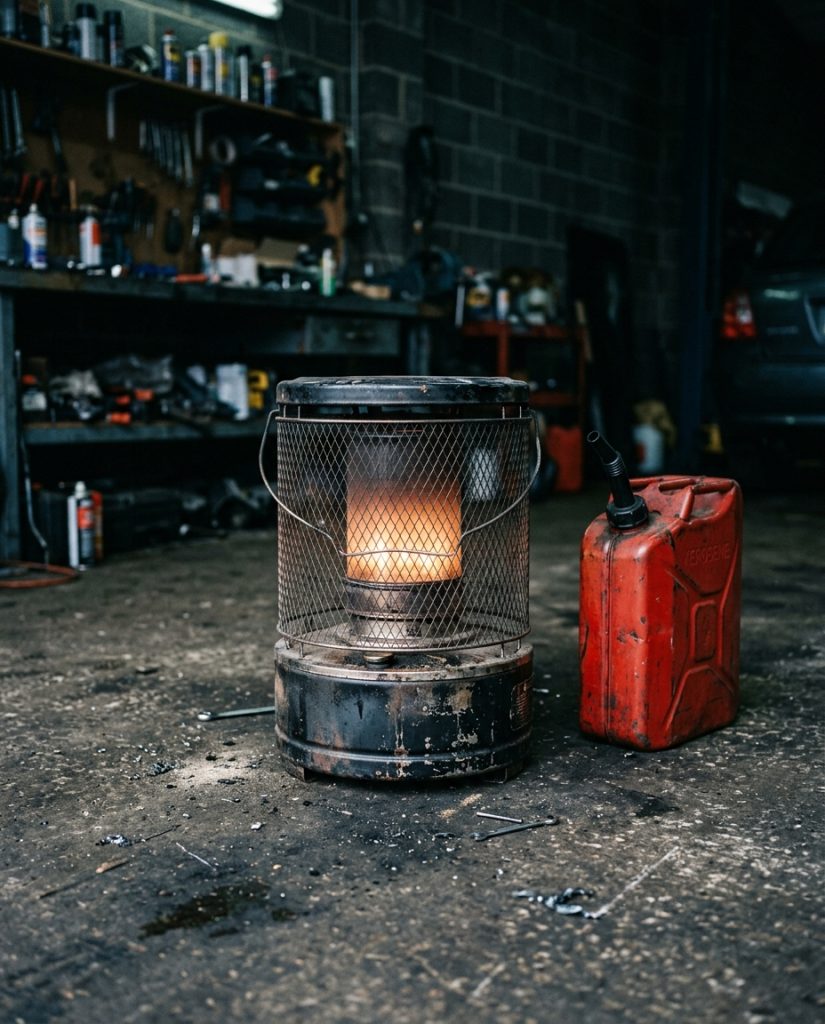
Out in the middle of the floor in January, ticking and glowing orange behind a round metal grille, sat the kerosene heater.
It turned a frozen concrete box into a place you could actually use. A garage in winter was brutal, and that portable heater threw out enough warmth to let my dad tinker on a Saturday without losing the feeling in his fingers, filling the air with that sharp unmistakable fuel smell.
The modern portable kerosene heater only arrived in 1979, right on time for the eighties garage, and it came with a warning most people half ignored. Burning fuel in a closed space eats the oxygen and gives off carbon monoxide, which is exactly why the smart ones always cracked the big door an inch while it ran.
You lit it with a match through the little door and watched the glow climb. If a kerosene heater fought the cold in your garage, that is twenty three. The next thing crackled with voices from miles away.
Breaker Breaker, the CB Radio Crackling on the Shelf
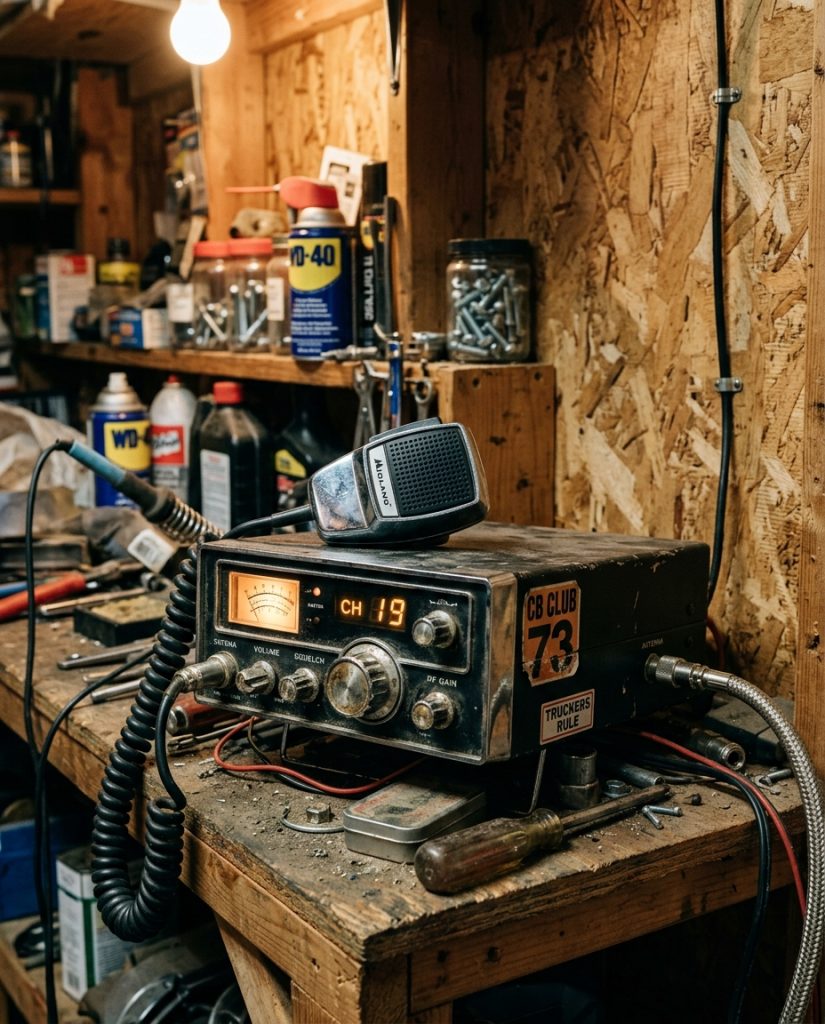
On a shelf by the bench, microphone hanging off a coiled cord, sat the CB radio, still crackling years after its big moment had passed.
For a stretch in the seventies everybody had a handle. Citizens band radio exploded after the oil crisis sent truckers hunting for fuel and speed traps, and the craze got so big that Radio Shack saw its profits double between 1973 and 1976 as families bolted antennas to the roof and made up nicknames for the airwaves.
The fad cooled by the eighties, and the government finally dropped the license requirement entirely on April 28, 1983, but plenty of rigs kept their spot in the garage. I could still key the mic on a quiet night and find a trucker rolling through, a voice from twenty miles off answering back through the static.
That chrome microphone felt important in your hand. If a CB rig sat on your shelf, that is twenty four. The next things came out only when the weather turned warm.
Croquet Mallets and a Badminton Net Tangled in the Corner
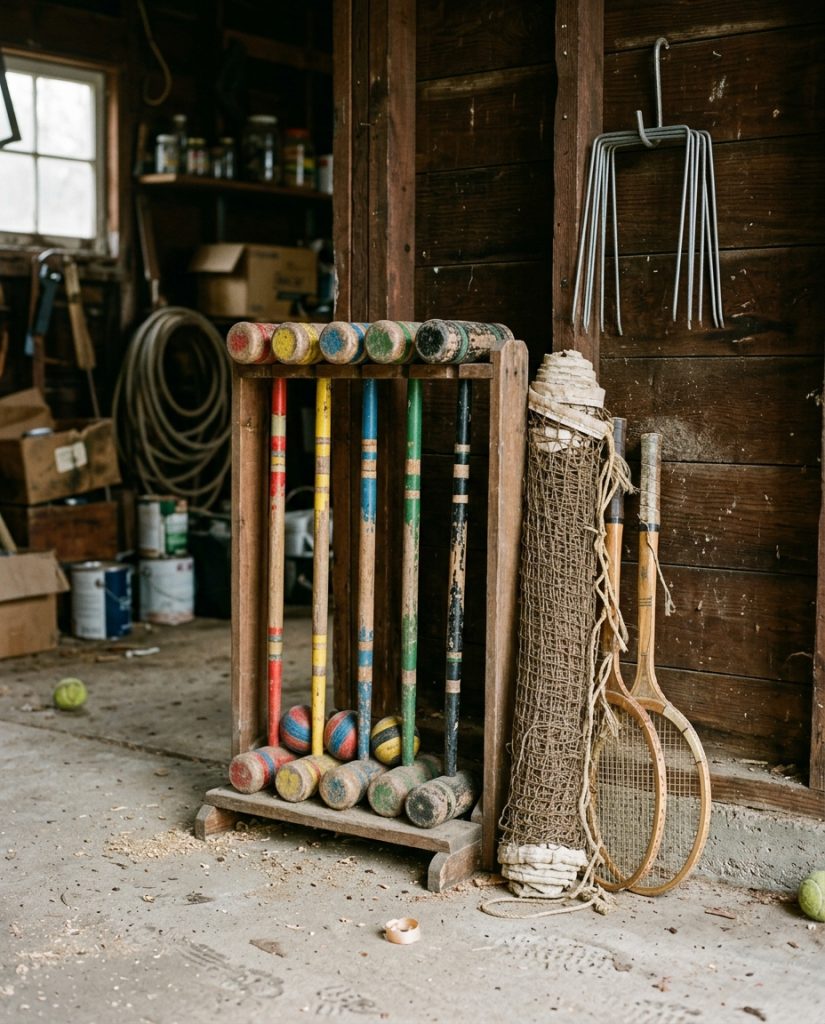
Crammed into a corner, mallets and balls in a wooden rack beside a net rolled around two bent poles, lived the backyard game collection.
Summer came out of that corner. The croquet set with its striped mallets and the badminton kit with its saggy net and warped wooden rackets waited all winter for the first warm weekend, when my dad would pace off the yard and push the wire wickets into the grass in a crooked course.
These games landed in American backyards after the war, when new suburban lawns gave families room to spread out, and the names carried real history. Badminton is named for the English country estate where guests of a duke played it in the eighteen seventies, long before it ended up tangled in your garage.
Half the wickets were always lost and somebody always nudged their ball with a sneaky foot. If these games waited in your corner, that is twenty five. The next thing folded up against the wall like a giant book.
A Ping Pong Table Folded Up Like a Bookend
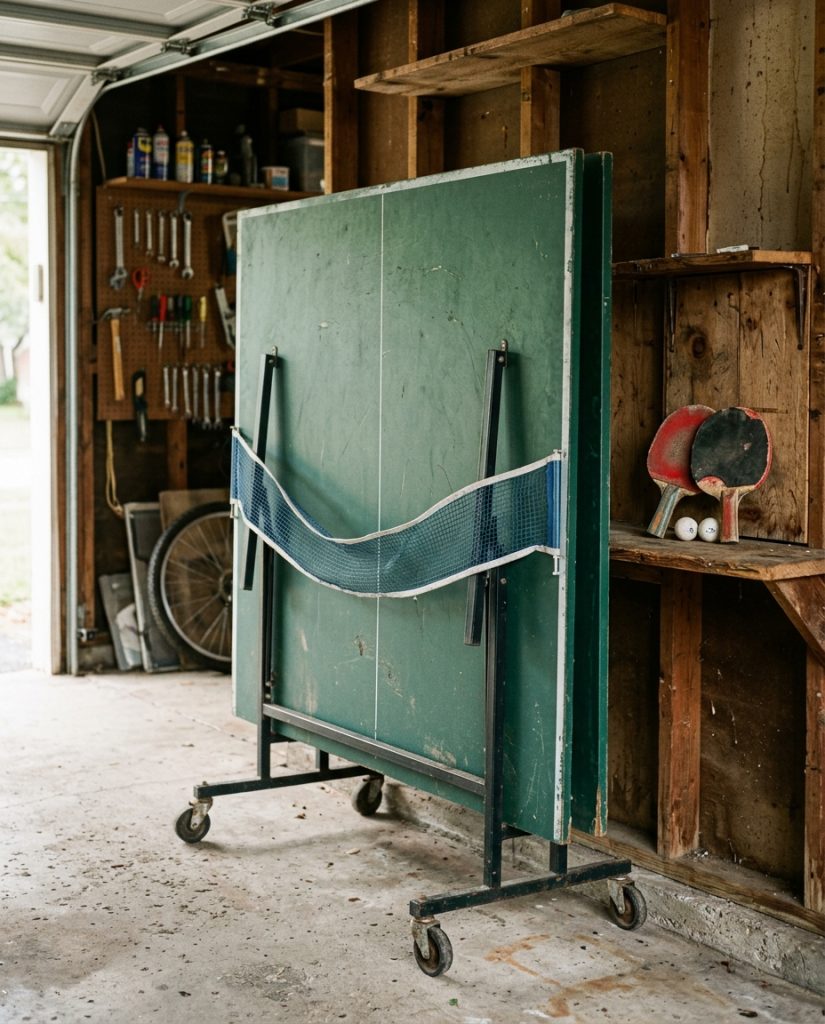
Standing on its end against the wall, both halves folded up like a giant green book, was the ping pong table.
Setting it up was a whole event. It took two people to roll it out and unfold it, and the second it was level the cars got banished to the driveway for the weekend while a tournament took over the whole bay, balls pinging off the water heater and skittering under the workbench.
Table tennis had been a basement and garage staple since the years right after the war, the kind of cheap fast game a family could play in any spare square of concrete. The paddles always had a chunk of rubber peeling at one corner and at least one ball wore a permanent dent that made it wobble.
I chased that one good ball into every dusty corner of the garage. If a ping pong table leaned against your wall, that is twenty six. The next things stacked up in the corner once a year.
Snow Tires Stacked Waist High in the Corner
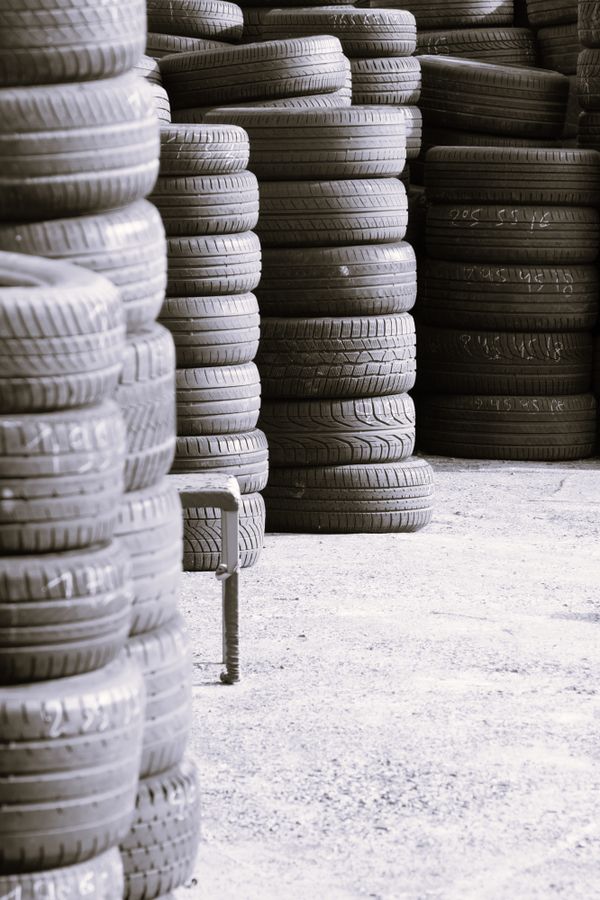
Over in the corner, marked with faded chalk so they went back on the right corners, sat the seasonal stack of snow tires.
Twice a year the whole family did the tire dance. In late fall the chunky snow tires came down off the stack and went on the car, and in spring they came back off and got piled up again, each one chalked with a letter so it returned to the same wheel it left.
Back then the all season tire was a big knobby noisy thing, and drivers who saw real winter kept a dedicated set of snows just for the cold months. There was even an unwritten rule about the pile itself, because a stack more than four tires high gets top heavy and topples, so four was the magic number in the corner.
You rolled each one out by hand and bounced it across the floor. If a chalked stack of tires wintered in your corner, that is twenty seven. The next thing opened up like an accordion.
A Metal Toolbox That Opened Like an Accordion
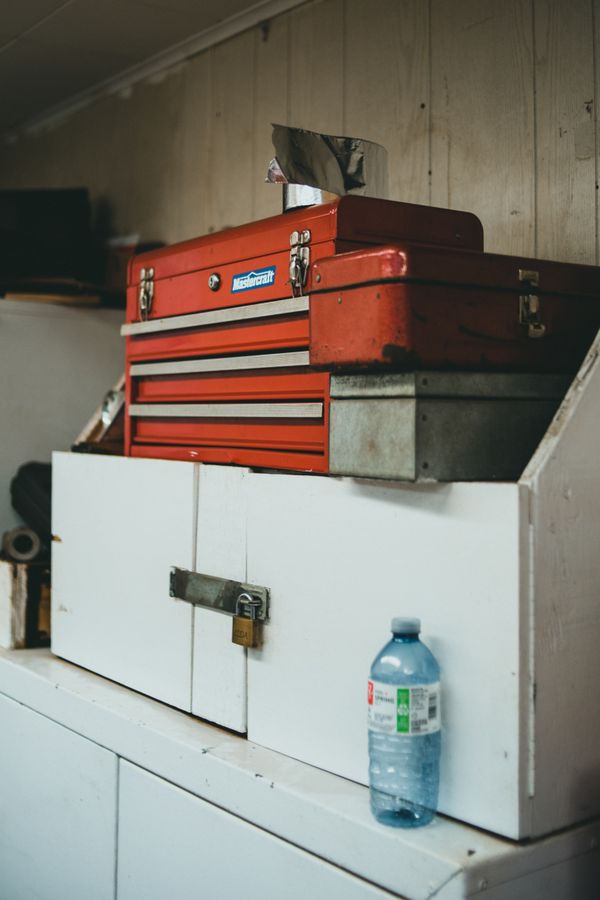
Sitting on the bench with a worn chrome latch, the kind of box that swung open in tiers, was the steel cantilever toolbox.
One pull on the handle and it bloomed open. The hinged trays cantilevered out and up like steps, each one cradling its own row of sockets and screwdrivers and open end wrenches, and a serious dad could tell at a glance the moment a single tool had gone missing from its slot.
This was the grab and go box, the tackle box style carryall that brands like Craftsman and Kennedy built out of stamped steel, the one that came down off the bench when a job moved out to the driveway or over to a neighbor’s. It was heavy when it was full and it pinched your fingers when you closed it wrong.
The bottom of it always held a layer of loose bolts and one mystery key. If a cantilever toolbox sat on your bench, that is twenty eight. The last one is the one you and your brother fought over.
One Big Wheel Parked Where You Could Hear It Coming
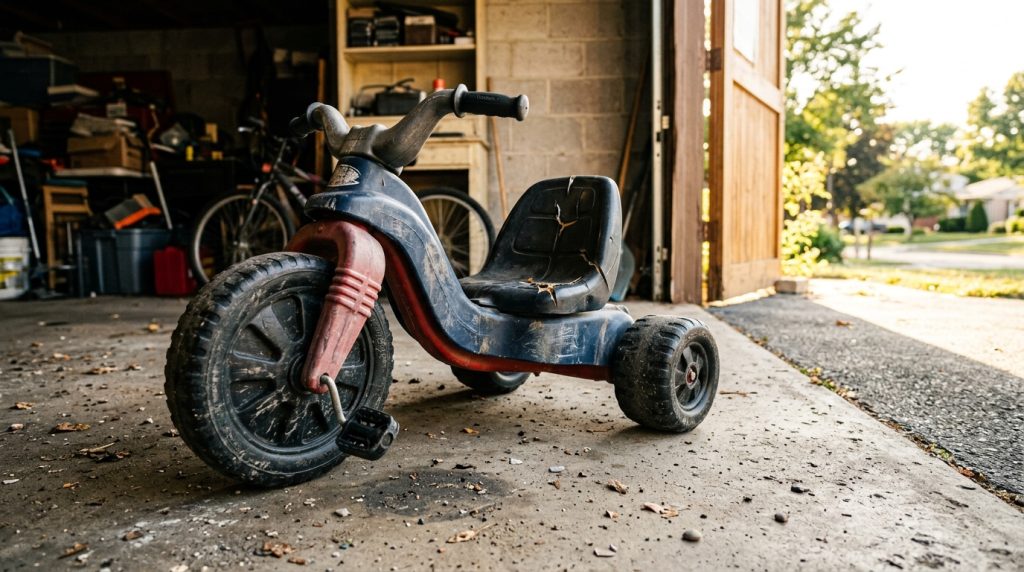
Here is the last one, parked right by the open door, ready to launch down the driveway. The low slung plastic trike with the giant front wheel, the one you could hear coming from a block away.
That sound is burned into a whole generation. The grinding roar of hard plastic on concrete, the squeal as you yanked the hand brake to throw it into a screaming sideways skid, the way the front wheel went bald and worn flat on one side from a thousand of those spinouts.
It rolled out of an Ohio factory starting in 1969, sold for around fifteen dollars, and it was the prized possession of nearly every kid in suburbia for two solid decades. There was only ever one in our garage, which is the whole problem, because my brother and I both wanted it at the same time and the fights over whose turn it was are probably still unsettled.
So call him tonight and ask him who really owned the Big Wheel. If one was parked by your door, that is twenty nine. Now go count up your score, because that number is really a count of Saturdays.
So how many did you get?
Be honest. If you scored twenty or more, you did not just have a garage, you had a whole childhood out there.
The One Trick Worth Stealing From the 1970s Garage
Of everything on this list, one habit is genuinely worth bringing back, and it costs nothing. That coffee can hanging system.
Take any wide mouth jar or empty can, screw its lid firmly to the underside of a shelf or a sturdy ceiling joist, sort your loose screws and nails and picture hooks by type, fill the jars, and twist each one up into its mounted lid.
The jars hang in a tidy row underneath the shelf, you can see exactly what is in each one through the glass, and you free up every inch of shelf surface above.
Our grandfathers figured this out with leftover coffee cans and a couple of wood screws decades before anybody sold a fancy storage system. It still beats most of them. Try it on one shelf this weekend and you will convert the rest of the garage within a month.
What was in YOUR family’s garage that did not make this list? Drop the one thing nobody else remembers in the comments.